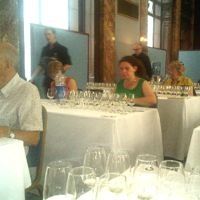
2 July 2009 On Tuesday I oultined in Wine faults - delicioius! the structure of the Advanced Wine Assessment Course organised by the Australians on Monday. Here is a guide to the faults and taints exhibited by the 22 glasses of wine we were served, 11 of them a basic Australian commercial Chardonnay doctored in some way, or not (for each colour there was one control glass as well as the first ‘clean’ sample) and the other 11 a basic commercial Cabernet Sauvignon.
I list them in the order they were served with first the name of the fault, taint or compound associated with it, then what our tutor Con Simos of the Australian Wine Research Institute reckoned are its olfactory characteristics (we merely smelt them all except for the last white sample, which had to be tasted to be sensed), my impressions, and finally some information on its causes and cure.
Guaiacol smoky, phenolic, medicinal – I thought definitely chemical, rather camphor-like
This is the compound that has been isolated as forming in wines affected by smoke taint. It is also associated with high-toast barrels.
Indole chemical, plastic, mothballs, jasmine/floral – I found it rather cardboard, and the wine seemed very developed
Associated with stuck Chardonnay fermentations and second fermentations in bottle in sparkling winemaking
Corky/musty (TBA) musty, mouldy – I thought this smelt distinctly fungal
Apparently this can be found in wines shipped in containers with wooden floors that have been treated with TBP flame retardant or fungicides. According to Simos, one French study found that 30% of all containers had some form of taint.
Chlorophenol plastic, paint-like, medicinal, phenolic – I found this just like plasticine or Playdo
These are the precursors of chloroanisoles and can come from disinfectants applied to wood apparently.
Corky (TCA) musty, mouldy – we all thought this very much less obvious than the TBA sample, even though the concentrations were apparently very similar
We all know about TCA or ‘cork taint’, the most common wine fault of all probably. Our sample was 5 ng/litre but apparently some people can spot it at concentrations as low as 0.8 ng/litre.
Acetaldehyde bruised apples, pears, stuck ferment character – this smelt oxidised and lightly sherrified and I couldn’t help thinking of all those wines (Friuli and Slovenia plus artisanal wines in France) that have this character in spades
Associated with oxidation. Yeasts can oxidise ethanol/alcohol to acetaldehyde.
Chlorocresol (6CC) chemical-like, plastic, chlorine, hot burning aftertaste – I found a very strong cardboard aroma
A contaminant in yeast hulls apparently. Con Simos told us of a biscuit factory whose produce was contaminated by smoke from a chemical factory some distance away.
Geosmin earthy, musty, muddy – this was so musty I thought it was TCA, and it reminded me strongly of a particular house in Provence I once lived in
This metabolite of botrytis can contaminate water supplies and has apparently been known to contaminate the carp in the river Danube.
Mousy caged mice (as opposed to wild ones presumably), cracker biscuit – I found this very astringent and the alcohol seemed especially obvious (this was the one wine we were instructed to taste as opposed to smell)
Three different compounds (2-acetyltetrahydropiridine, 2-ethyltetrahydropiridine and 2-acetylpyrroline) are responsible for this incurable characteristic, which is desirable in bread but in wine changes the pH and makes wines horribly tough and robs them of their fruit. It is most common in wines with low sulphur and low acid. Apparently as many as 30% of all winemakers are unable to detect this fault – but to those of us who can sense it, it gets worse and worse in the glass.
Mercaptan onion, rubbery, rotten cabbage – I didn’t pick up any of these descriptors in this instance. I found this first sample of red wine rather volatile and wondered whether that was the fault in question.
Associated with reduction, mercaptans form when hydrogen sulphide combines with some wine components. Australian winemakers are taught to continually monitor wines for the presence of mercaptans, which can be removed by adding copper (as we know from parlour games involving copper coins in glasses of wines with obvious mercaptans).
4-ethyl phenol (4EP) Bandaid, brett character – the unattractive aspects of this, not that marked in my view, did grow in the glass
This is one of the key marker compounds for the presence of brett and is associated with old barrels, although Con Simos pointed out that it can also occur in wines aged in new oak if sulphur levels are low enough. We were shown how each of the three brett markers, 4EP, 4EG and 4EC, are most obvious in neutral wines and least obvious in oaky wines. There was spirited discussion about whether wines should be marked down, or even up, if a little brett was evident. We were shown a graph demonstrating how brett in Australian wines peaked in 1997 but that levels had come down dramatically in Australia since about 2001 when winemakers began to be taught to recognise and eliminate it. AWRI consumer research suggests that consumers prefer low brett levels. I can quite see how it’s a cultural thing. I have rarely been bothered by a spot of brett but found it very distasteful on a Languedoc red I tasted last night.
Eucalyptus (cineole), er, eucalyptus, fresh, cool, medicinal, camphoraceous – for some of us this was not desperately obvious since the base wine, like so many Australian reds (and some Chileans and Californians) had quite a eucalyptus character
Con Simos explained how this character was definitely airborne, from eucalyptus trees on the edge of the vineyard. The ‘cure’ is to cut down the trees or use only those grapes grown sufficiently far from them. The character comes from skin contact so affects only reds.
Acetic acid/VA vinegar – ‘decay’ was my tasting note
Acetobacter turn ethanol/alcohol into acetic acid – happens only in the presence of oxygen.Threshold concentration is 0.6-0.9 g/l and the legal maximum in Australian reds is the rather high 1.5 g/l.
Geranium (sorbic acid) er, crushed geranium leaves aroma – this was the most disgusting sample of all in my view and had a sickeningly strong smell of some flower that I managed to identify as foxglove
This occurs when lactic acid bacteria metabolise sorbic acid, but this isn’t used much nowadays, except in some sweet eastern European reds.
[This was the point at which I filmed this video]
Dimethyl disulfide intensely oniony – I found this distinctly horsey (see below)
Mercaptan-related compound produced by the oxidation of methanethiol that can only be removed using sulphur dioxide/ascorbic acid to reduce disulfide bonds to mercaptans that can then be removed by copper fining.
4-ethyl catecol (4EC) horsey, smoky, bacon – I found this quite like the wine above but more obviously leathery.
Another possible marker compound for brett, presumed to derive very similarly to 4EP but with a different precursor (caffeic acid). Simos was keen to tell us that a survey of European Pinots and Cabernets found levels very similar to those of 4EG.
Ethyl acetate nail polish remover, spoilage – I smell this often on whites but failed to spot this concentration
Produced by yeast, especially native yeast, affected by temperature and sulphur dioxide levels.
Fungal must dirty, dusty, musty, mouldy, and at higher concentrations chocolate, coffee – I found this distinctly unclean and fungal
This may make a contribution to cork taint in bottled wine. Its chemical name is 2-methoxy-3.5-dimethyl pyrazine (FM).
Taking this list together with those faults described by Julia in her Musty alphabet soup – a guide to wine faults article is not the most appetising aspect of wine appreciation, although presumably it is important that winemakers are aware of all of these. I was quite surprised not to find a wine with excess sulphur dioxide, but perhaps I am showing my age. This was one of the more common faults I encountered when I started writing about wine in the late 1970s, but nowadays I suppose you find it only on wines such as sweeter German whites destined for a long life.
All I can say to you is that I sincerely hope you never come across any of these.
There was the amusing sub-theme of Adam Lechmere of decanter.com becoming increasingly irritated by Con Simos's habit of basing his statistics for faulty wines (6.6% of entries) and his second and third tasting sessions on the results of the International Wine Challenge instead of the Decanter World Wine Awards.
But probably the funniest moment of the day was when Anthony Rose asked Con Simos with a perfectly straight face whether he followed the biodynamic calendar when organising tastings. Simos looked completely blank, did a double take and then said rather nervously, ‘We need a bit of humour so, er, that’s good.’