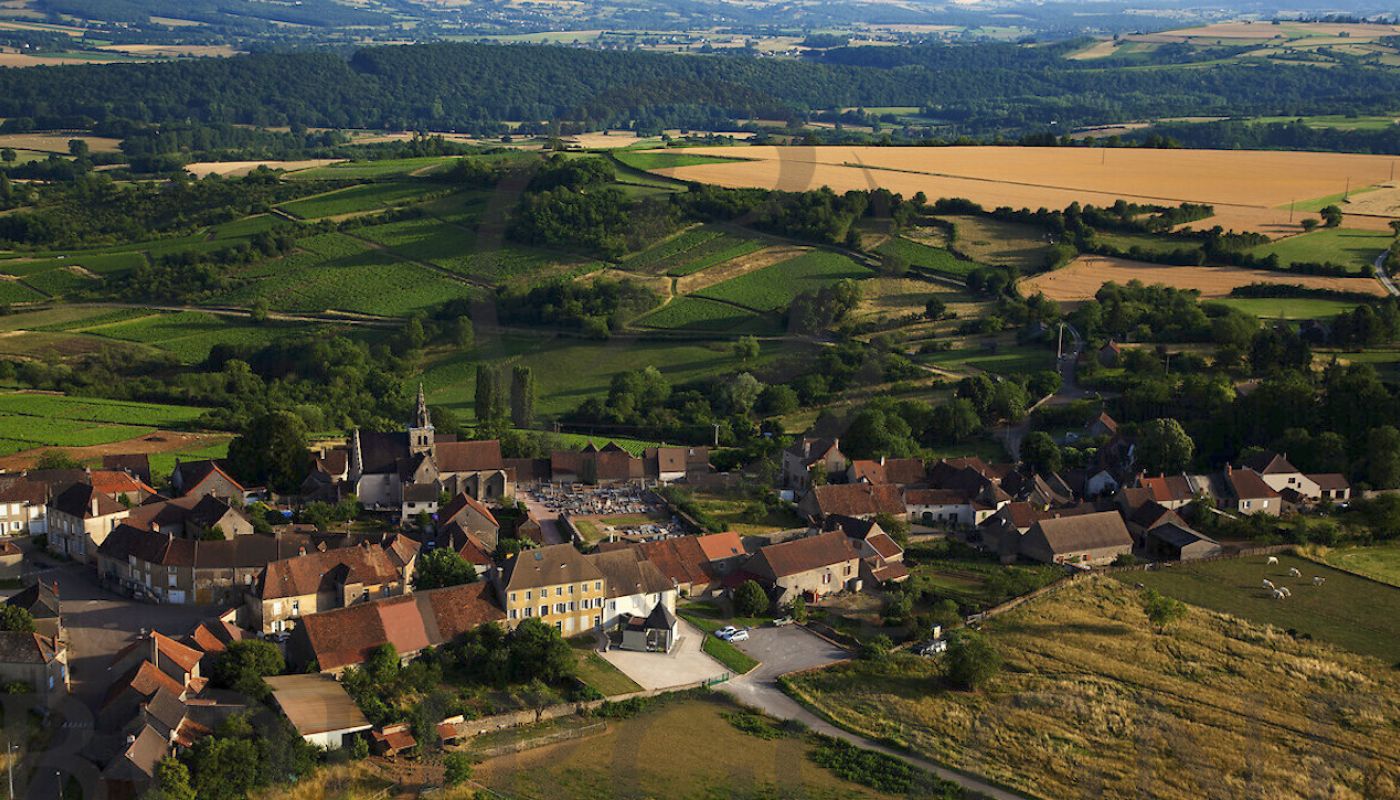
I grew up in a winemaker’s family in Burgundy in the late 1980s, and though the region wasn’t trendy at the time, those of us in the Hautes-Côtes de Beaune were already living in a different world from ‘les grands de la Côte’ (d’Or). Literally. Whenever my dad had to go to Beaune or Nuits-St-Georges – respectively a mere 25 km (15.5 miles) and 50 km away from where I grew up near Les Maranges – he had to plan the trip as thoroughly as I must to travel during COVID-19 time.
Bordeaux and its blends were the paradigm for quality at the time. Our wines were regarded as feeble and weak, with unripe, rusty tannins, and alcohol that partially came from chaptalisation each and every vintage.
Then, somehow, this paradigm changed. I now live in a world where the simple fact that I come from Burgundy makes me relevant in some wine circles. Funnily enough, my parents didn’t want to settle in Burgundy. They preferred Beaujolais but had to move to Burgundy because Beaujolais was too expensive at that time due to the incredible success of Beaujolais Nouveau. (Does anyone else remember these images of Japanese people bathing in huge pools of Nouveau every third Thursday of November?)
Thanks to ARENI I now get to speak with winemakers from all around the world, talking about quality, excellence and what it takes to be regarded as a ‘fine wine’. I have been struck by wine producers, particularly (but not exclusively) from the New World, who come to me with the following statement: ‘We need to define our identity and typicity as a region and, of course, it has to be authentic.’
Few traditional regions question their identity. Most of the time, the French themselves will just claim that their identity comes from their terroir, without thinking deeply about what that means at a regional, or collective, level. As long as you share a set of grape varieties and a style of wine that is clearly and globally identified, then why should you question anything further? Typicity helps you sell.
Regions outside France that aspire to make fine wine often use France as a model, deciding that authenticity and typicity are their goals. But by taking these notions out of their cultural context, I wonder if they are really chasing the right model.
How typicity was born in France
It all started in the early years of the 20th century. The phylloxera crisis had devastated French vineyards and viticulture was in ruins. The country lacked grapes, and what have been described as copycat vineyards were flourishing, taking advantage of France’s short supplies; French winemakers sourced grapes from Rioja and as far away as Algeria.
In 1919, the French government began to look at how quality could be defined and protected and origin became the focus. From 1919, producers whose wines came from the delimited zones of a designated place of origin would earn a premium.
Counterintuitively, this first set of rules created more problems. Because people were simply getting a premium by guaranteeing origin, they started planting huge quantities of productive vine varieties. This annoyed Joseph Capus, an agriculturalist who was to become Minister for Agriculture. For him, the goal was first and foremost to guarantee quality. The laws that followed in 1935 were not to protect wine from fraudulent wine, but to protect quality wine from ordinary wine. It was to exclude people that were not driven by quality.
And hence was born the AOC system that still rules the French wine world today.
The intrinsic problem
The French AOC system is unique, but based on a duality that is nearly irreconcilable, because it touches on both intellectual property and quality certification.
In terms of intellectual property, the law protects the author’s production, as if they were a regular artist, writer or musician. But the ‘author’ in this case is a collective body of winemakers settled within the delimited zone. Unlike copyright, the AOCs have an unlimited duration of protection, perpetuated by successive generations of winemakers.
What makes this different from other laws protecting intellectual property is that in other instances, while creative production is protected, nobody comes along to declare whether a production is worth it or not. ‘Quality’ is not a condition involved in protecting a musician’s latest opus or an artist’s painting.
But the AOC is also a certification of quality. And, so far, the only way to determine said quality is by tasting the wines. Since the AOC is a collective enterprise and a collective possession, quality has been assessed following a collective sense of style, historically determined by les usages locaux, loyaux et constants: local, loyal and constant customs.
Whenever there is doubt about what constitutes this sense of style, French winemakers are invited to refer to the local, loyal and constant customs. Local, of course, refers to what is customary in any given place, in opposition to what could be customary in the neighbouring village. Loyal can be understood as honest and fair, but also sincere and faithful. Constant refers to time. Only time can determine what is customary, and by tradition, what is quality.
There is not much room for disruptive innovation, and the only way to change is slowly, collectively, together, locally, through time.
The rise of typicity
Typicité (typicity) is a modern addition to the French language. The use of typicité emerged in the early 1980s and was proposed by agronomist Jean Salette as a way to counter the international competition that the French wine world was suddenly facing. It was articulated as a very positive notion, that would help the consumer recognise a wine from a region, and also make them more loyal and faithful to that region.
But to be clear, what locaux, loyaux et constants also means is that winemakers were basically all doing the same thing. Take my family, for example. The harvest date wasn’t really decided by ‘what the vineyard told us’, but by the ban des vendanges, the legal authorisation to start harvest given by each prefecture. My parents wouldn’t blindly follow the ban des vendanges and automatically start on that particular day, but they would observe what the others were doing, and knew, by experience, that they had to start approximately one week after their neighbour Daniel. And because everybody was doing almost the same thing, every wine tasted the same way, and it was easy to talk about typicity.
At the time, winemakers were responsible for their own official tasting, being judge and party in the process of delivering the AOC, so that everything that didn’t taste typical enough was rejected. This not only discouraged winemakers from working any other way, but also meant that typicity could be reverse-engineered: you started by defining what typical meant and then put in place the winemaking and viticulture needed to earn AOC status.
Typicity slowly began to mean conformity.
The pushback
In the early 2000s winemakers started to get sick of conformity. First, the AOC status didn’t bring anything like a premium price – AOC Minervois for €1.80 a bottle anyone? – but also because some obviously quality-driven winemakers who were having success internationally couldn’t get the appellation because they were different. There was also a backlash against wines made according to a recipe that were gaining critical approval. This spurred the movement towards Vin de France and a new idea of ‘authenticity’. This new meaning had consequences for French wine.
The first winemakers who challenged the equation ‘typicity = conformity’ wanted to work in symbiosis with their vineyards, rather than treat it as something that was just there to produce the wine. Practically, this meant giving up a certain degree of control. Each action conducted in both vineyards and winery had to be guided by what was required by the specific plot or tank, rather than being a recipe applied to everything. The French authenticity movement was driven by a very laudable, quality-driven mission.
Authenticity in its modern interpretation is closely linked to the individual, and the capacity to be your one true self, without caring too much – or at all – about what other people think. But when everybody is doing different things, it undermines typicity that’s based on the collective approach.
Recently, I had a conversation with a winemaker, not far from where I was born, who is a recent addition to Burgundy’s wine scene. His wines were very interesting, but they were not typical for the region at all. I asked him how he felt about putting the appellation on his label, despite the lack of regional identity. His answer was: ‘I don’t really care about Burgundy and the label. I want to do the best wine that I can do.’ Yet the only reason he could sell that bottle for €40 was because of the word Burgundy, or Bourgogne, on the label.
For the philosopher Hegel, whereas sincerity generally seems to accept a given social order, authenticity is an implicitly critical concept, calling into question the reigning social order and public opinion. In that sense, authenticity becomes the way winemakers fight against the reigning social order of the AOC system.
But what happens when everybody does it? Let’s say that all the wines coming from a given region are individually authentic. Each one is made by a winemaker driven by quality – but where ‘quality’ has a different meaning for each one. Every bottle tastes amazing, but they share fewer and fewer organoleptic characters. How can we identify origin?
The importance of the collective reputation in agricultural markets has been well studied and documented. In their paper ‘Individual and collective reputation: lessons from the wine market’, Italian researchers Castriota and Delmastro demonstrate that without collective coordination, investment in quality at the individual level is likely to be inefficient. A collective reputation lowers the cost of building individual brands.
We also know from ARENI recent studies that fine-wine consumers value the region of origin, and that being from a well-known, quality-driven region is one of the main attributes needed to be recognised as fine wine. The collective dimension of quality is primordial.
The reality is, there are only two ways to maintain a quality reputation through time. One is an infinite marketing budget. The other is to have a collective identity built on a collective vision and purpose. Finding a way to keep individual striving and collective responsibility in balance and harmony will be the key challenge for the evolution of fine wine.
Towards authenticity 2.0
How can all of this be reconciled? How can authenticity remain a driver of quality, without taking away the collective identity?
Patrick Baudoin is one of the leading vignerons of the SEVE association, an initiative pushing to restructure the AOC system. For him, there is a need to change the way we look at collective identity. Instead of it being defined by an agreed typical taste, it needs to be defined by an agreed ethos and set of values. For him, the ODG (Organismes de défense et de gestion, the local structure that in 2008 replaced the syndicat d’appellation) should become a place to share ideas, trials and results, with external insights from science and academia. The collective space hence becomes a place to define best practices, and a way to decide between possible options.
In this model, the shared profile of the wines becomes a consequence, but not the driver.
Conclusion
Those looking to France as a model of typicity and authenticity need to understand what these ideas truly mean. Typicity can mean conformity; authenticity can undermine collective efforts. Above all, these are ideas that come from specific historic and political circumstances, and so are not readily transferable elsewhere. Local people and local situations – that’s what makes something truly authentic.
For more on authenticity and typicity, listen to this ARENI podcast with Felicity Carter.