For the introduction to this report by Tanya Garnham, see Part 1 – introducing DJP.
I arrived in Spain a bit early – at the end of August – but only because you can never really predict the start of the harvest in this region due to the weather.
I emailed Ricardo to let him know when I would be arriving and received the following (unedited) message: 'Tanya!! The grappes are not ready, we have a delay of 2/3 weeks…'. There was more to the message, obviously, but not technically important to share. Unfortunately I had already booked my ticket to get a decent fare from London, so two or three weeks early I was.
Normally the pickers would be out during the first week of September. This year the harvest effectively started on 17 September, probably because the growing season was a bit unbalanced over in this part of Spain. In brief: there was unseasonably cold weather at Easter; lots of rain after that; it was incredibly hot in July with one or two heavy showers to cool things down a bit, after which it was back to hot until the harvest.
The result, according to one employee, was a considerably less chilled out than usual Ricardo, who was constantly after berry samples and lab test results to determine an approximate harvest date! According to others – and more technically – the cold weather and rain at Easter reduced the proportion of flowers fertilised and led to less uniformity in the size and ripeness of the berries, also known as coulure and millerandange. On the up side, one of the winery employees did say that, because the yield and berries are smaller this year, the colour of the 2012 wines is going to be really deep in comparison wth previous years.
Forest fires
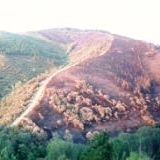
In the few weeks that I was waiting for the harvest to begin, there were two forest fires in Villafranca; the region is all mountains and pine trees so incredibly picturesque but also, apparently, quite fire friendly.
One fire was extremely close to the town and quite severe, and it burned for about 10 hours before it was contained (see the devastating results above). It seemed uncertain at first that it would be put out given that Villafranca has a single pint-sized fire truck, but eventually some firefighting helicopters from Léon were sent in. My Spanish colleagues surmised that the fire was started by a reforestation company – or even by the fire department itself! – as a means of staying in business, but perhaps that was just 'creesis' (how the Spaniards refer to the economic crisis) speak.
Collecting berry samples
On 6 September there were inklings from the vineyards that the harvest might just be getting underway as we started to collect berry samples. Generally, grapes grown at lower altitudes ripen earlier than those at higher altitudes, so I
 went with Luis 'Alcalde' (right) to some of the 'lower vineyards' belonging to the farmers who sell grapes to DJP.
 Nicknames are used a lot in this area, especially by the older generation, in order to differentiate between people with the same first name. Usually the nickname has to do with a job or a physical characteristic. Some names are not nice at all, and it seems that the more one dislikes one's nickname, the harder it sticks.
Luis' nickname is employment-related and was conferred because he also happens to be the part-time mayor (alcalde means 'mayor' in Spanish) of Corullón, the next town over. He supposedly ran for the post as a dare from his friends and actually landed the job. He has served the first year of his four-year term so what he'll be called if he isn't re-elected remains to be seen!
Prior to setting out to collect berries, Ricardo gave me a lesson on how to get a representative sample from the entire vineyard that would result in accurate lab measurements. Quite unlike the random 100-single-berries-from-anywhere-along-a-row approach that I thought was the norm, I was told to collect as many berries as needed 'but without going crazy', using the following guidelines:
- Avoid the outermost edges of the vineyard.
- Depending on the size of the vineyard and the length of each row, collect berries from every 2nd/3rd/4th etc … row and vine respectively.
- Collect 3-5 berries with some 'stem' attached from one bunch on the vine.
- While collecting, alternate between the sides of the row (to get berries from both the sunny and shaded areas), between the bunches at the top and the bottom of the vine (this is more evident on bushvines), and between the different parts of the bunch, ie the sides, the heart and the bottom, as the acidity levels of individual berries on a bunch can differ.
 Once back at the lab, the grapes had to be crushed by hand to extract the juice to test for density and temperature, pH and titratable acidity (TA). These test results are used to determine an approximate harvest date.
 Crushing the grapes by hand was actually quite painful at first, mostly because my hand muscles weren't used to the movement; it's a lot like squeezing a stress ball. There were also a lot of samples to crush and you need to extract as much as possible from every single berry in order to get accurate lab results.
I had both my hands in a jug of partly-crushed grapes (to better distribute the pain!) when Álvaro walked into the room. I don't know what I was expecting but it certainly wasn't him coming up to me to introduce himself – the man has been in practically every wine-related publication out there after all. But introduce himself he did, and I even got greeted Spanish style because my hands were unavailable to shake!
Together with lab tests, visual and taste tests help determine if the grapes are ripe, the last being especially good when you are also hungry. In the case of the red Mencia grape, you should look at and/or taste: the grape skin (which should be coloured when chewed about five times); the pips (which should be brown rather than green and crunchy rather than soft); the brush colour (which should be brown not green), and the pulp and its viscosity. The lignification (when the wood hardens) of the peduncle (the part of the stem attaching to the cane) is apparently also a dead giveaway for ripe Mencia.
Part 3 – harvest begins follows tomorrow.



Guest contributor













