29 April 2020 Where angels, and the Consorzio, have feared to tread, Walter bravely stomps in, with a ranking of the best Chianti Classico producers. See also The case for Chianti Classico 2018 and 2017 and Great 2017 and 2016 Chianti Classico Riservas.
There are two parallel universes in Chianti Classico: one of large producers, who, for the last 25 years or so, have pursued a style for which they found a ready market and who not only believe that the market is not saturated, but think it actually wants more of the same.
Frustrated by a perceived price ceiling for wines carrying the Chianti Classico denomination, and keen to continue the production of Supertuscans with a much higher price tag, they became fervent proponents of the Gran Selezione category which was developed solely to satisfy their needs. These large-scale producers have the upper hand in pushing a general style rather than an expression of origin, while often adding international varieties to local Sangiovese in the blend.
In doing so they continue the path of concentration, power and oak, prioritising style over terroir. In the last couple of years a few token producers of wines which are much purer expressions of Sangiovese have been persuaded to release them as Gran Selezione, encouraged perhaps by the fact that the Consorzio, the generic organisation, has put so much of its weight as well as budget behind the marketing of this category. Ironically, it is particularly these pure Sangioveses that highlight the shortcomings of most Gran Selezione wines.
The other universe is that of small, artisanal producers who have moved away from a stylistic model, while taking Sangiovese as a vehicle to express their unique terroir, resulting in highly original wines, some of which struggle to pass the official controls because they are considered ‘atypical'. [See, for instance, the first tale in Wine’s Salon des Refusés – JR]
As a consequence, these latter wines, several of them representing the very pinnacle of Chianti Classico, are not allowed to carry the Chianti Classico name on the label. This comes at an economic cost for their producers, who must still pay a levy, while others have chosen to stop labelling their wines as Chianti Classico entirely, instead opting for the less restrictive IGT Toscana. This situation irks me and many of my colleagues because excellence is neither recognised nor honoured. This situation also throws up the question of how serious these control systems are, and, more importantly, how independent.
With many of my Italian and international colleagues I have pointed out to the Consorzio time and again that the Gran Selezione wines are the least representative of the entire denomination. Since the category’s inception in 2014 this criticism has fallen on deaf ears, apparently because the Consorzio does not believe in its terroir, or, rather, argues that it is too diverse with regards to soil composition, elevation and exposition, to take the lead.
Every now and then the Consorzio reluctantly considers adopting a system of subzones based on its famous villages, mostly because journalists, importers, sommeliers and educators are already doing this. There is sound historic proof to argue in favour of this, as demonstrated in this important work.
Producers feel strongly about this too, and in the last couple of years a host of private producers’ associations have sprung up in order to promote the wines of a particular commune in an effort to try to get traction for the concept of single-village wines with the Consorzio. So far with little success.
Of the eight Chianti Classico villages only Poggibonsi doesn’t have its own producer association, while Greve boasts two, the more important and historically justified of the two being that of Panzano. Here they are, roughly north to south.
- Associazione San Casciano Classico (2018)
- Viticoltori Montefioralle di Greve in Chianti (2015)
- Unione Viticoltori Panzano (1995)
- Vignaioli di Radda (2018)
- Associazione Viticoltori Gaiole (2017)
- Viticoltori di Castellina in Chianti (1995)
- Classico Berardenga (2015)
- Associazione Viticoltori di San Donato in Poggio (Barberino Tavarnelle) (2018)
A recent development has further put Gran Selezione in crisis: as I pointed out in The case for Chianti Classico 2018 and 2017, the denomination of Chianti, far bigger than that of the historic nucleus that is Chianti Classico and with much less stringent production rules, has requested and obtained the right to use Gran Selezione too. Many other denominations throughout Italy may follow its example. The unpalatable truth for the Consorzio of Chianti Classico is that it has spent an enormous amount of energy, time and money to promote a category for others to jump into their ready-made bed. All of this could have been prevented if marketing had focused on what makes Chianti Classico unique – its inimitable terroir.
In my recent article on the 2018 and 2017 vintages of Chianti Classico I also mentioned that in spite of many unworkable ideas and concepts emanating from the Consorzio, an unofficial classification of producers based purely on their proven track record of excellence has started to emerge. Founded on a shared belief in Sangiovese, sometimes in combination with other indigenous red varieties but eschewing international ones, these producers’ transparently expressive wines are some of the best in the whole of Italy and the world.
I had been playing with setting up a classification of these estates and producers but it was Jancis who gave me a nudge to publish it.
Because of the fact that the following classification (see the table below) is explicitly not based on terroir, but on merit, the Consorzio can surely have few arguments against it. Among many colleagues, importers and sommeliers, the classification below is pretty much undisputed, but I am aware that I am opening a can of worms.
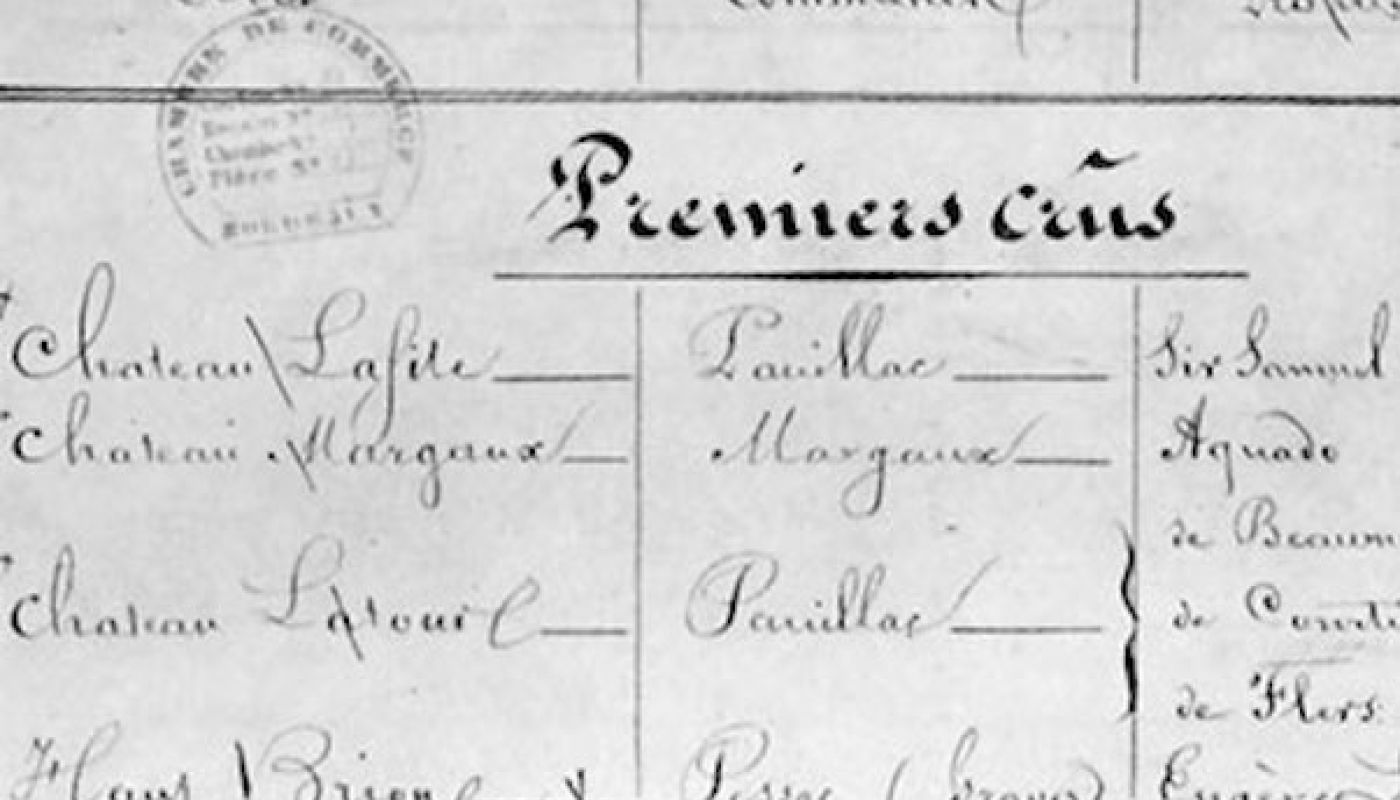
I have taken as an inspiration the classification of St-Émilion rather than the 1855 classification of left bank châteaux shown above because it is revised every so often. This of course leads to huge controversy and disputes, which in my opinion is inherent in this type of exercise. However, with all its flaws and failures, it keeps producers on their toes and it is dynamic rather than inert, giving everyone, in theory, a fair chance to excel and be recognised. I hope readers are willing to see my classification in that light.
I have added an additional, very personal, category, fuori concorso, or hors concours, for a specific wine rather than a producer, Villa del Cigliano Riserva 2016 Chianti Classico, in honour of Niccolò Montecchi, who in January 2019 at the age of 43 died far too early, having turned round his family’s estate in a spectacular fashion.
The selection of the producers in categories A and B is, of course, my own and hence subjective. However, all have a track record of excellence, which can be verified by checking the roughly 2,500 tasting notes on Chianti Classico our tasting notes database.
In this classification only producers working with Sangiovese and other local varieties up to the allowed 20% of the final blend are included. The inclusion of international varieties, however minute, disqualifies producers from being eligible. I can understand that some might disagree, but I for one cannot imagine a classification of St-Émilion in which Italian varieties would be allowed. I especially struggle to understand why minute quantities of international grape varieties are considered so propitious by the producers who add them. It just makes me want to see their skills in a 100% Sangiovese wine.
Several wines in this classification are labelled IGT rather than Chianti Classico. Some producers, such as Il Borghetto, have in the past labelled their wines as Chianti Classico but have recently seen them thrown out time and again by the official control system and so have switched to IGT.
I hope, but don’t expect, the Consorzio will fully appreciate the non-terroir approach of this classification system. It is not an attempt to scandalise but to offer an alternative to the current politics of promoting a set style to the benefit of the few, an alternative based on uniqueness and originality. We need an independent tool to counteract the biased power that determines who is considered to produce quality and replace it with a much more transparent system, which must also include an adaptation of or change to the current control system. This classification is aiming at that.
Unless otherwise stated, the wines in the table below are 100% Sangiovese.
Chianti Classico Grand Cru 2020
Classifica A
| Village (N to S) | Producer | Wines |
| Castelnuovo Berardenga | Castell'in Villa | Poggio delle Rose Riserva Chianti Classico |
| Chianti Classico | ||
| Riserva Chianti Classico | ||
| Radda in Chianti | Montevertine | Le Pergole Torte IGT Toscana |
| Barberino Tavarnelle | Isole & Olena | Cepparello |
Fuori concorso
| Village | Producer | Wines |
| San Casciano in Val di Pesa | Villa del Cigliano | Riserva 2016 Chianti Classico |
Classifica B
| Village (N to S) | Producer | Wines |
| San Casciano in Val di Pesa | Il Borghetto | Clante IGP Toscana |
| Bilaccio IGP Toscana | ||
| Montigiano IGP Toscana | ||
| Monte de Sassi IGP Toscana | ||
| Paz IGP Toscana | ||
| Montesecondo | Montesecondo IGT Toscana | |
| Chianti Classico | ||
| Tïn IGT Toscana | ||
| Barberino Tavarnelle | Ormanni | Chianti Classico |
| Chianti Classico Gran Selezione | ||
| Riserva Borro del Diavolo Chianti Classico | ||
| Castello di Monsanto | Il Poggio Chianti Classico Gran Selezione (95% Sangiovese, 5% Colorino and Canaiolo) | |
| Greve in Chianti | Querciabella | Chianti Classico |
| Riserva Querciabella | ||
| Panzano | Fontodi | Vigna del Sorbo Chianti Classico Gran Selezione |
| Chianti Classico | ||
| Flaccianello della Pieve IGT Colli Toscana Centrale | ||
| Monte Bernardi | Riserva Chianti Classico (95% Sangiovese, 5% Canaiolo) | |
| Riserva Sa'etta Chianti Classico | ||
| Retromarcia Chianti Classico | ||
| Vallone di Cecione | Chianti Classico (90% Sangiovese, 10% Canaiolo) | |
| Vecchie Terre di Montefili | Anfiteatro IGT Toscana | |
| Chianti Classico Gran Selezione | ||
| Vigna Vecchia Chianti Classico Gran Selezione | ||
| Lamole | Fontodi | Filetta di Lamole Chianti Classico |
| Radda in Chianti | L'Erta di Radda | Chianti Classico (95% Sangiovese, 5% Canaiolo) |
| Monteraponi | Chianti Classico (95% Sangiovese, 5% Canaiolo) | |
| Riserva Il Campitello Chianti Classico (90% Sangiovese, 7% Canaiolo, 3% Colorino) | ||
| Poggerino | Chianti Classico | |
| Riserva Bugialla | ||
| (N)Uovo Chianti Classico | ||
| Tenuta Carleone | Chianti Classico | |
| Val delle Corti | Chianti Classico (95% Sangiovese, 5% Canaiolo) | |
| Riserva Chianti Classico | ||
| Gaiole in Chianti | Badia a Coltibuono | Chianti Classico (90% Sangiovese, 10% Canaiolo, Colorino, Ciliegiolo) |
| Riserva Chianti Classico (90% Sangiovese, 10% Canaiolo, Colorino, Ciliegiolo) | ||
| Fattoria San Giusto a Rentennano | Chianti Classico (95% Sangiovese, 5% Canaiolo) | |
| Riserva Le Baròncole Chianti Classico (97% Sangiovese, 3% Canaiolo) | ||
| Le Miccine | Chianti Classico (95% Sangiovese, 5% Colorino) | |
| Riserva Chianti Classico | ||
| Maurizio Alongi | Riserva Vigna Barbischio Chianti Classico (94% Sangiovese, 4% Malvasia Nera, 2% Canaiolo) | |
| Podere il Palazzino | Argenina Chianti Classico | |
| Grosso Sanese Chianti Classico Gran Selezione | ||
| Rocca di Montegrossi | Chianti Classico (90% Sangiovese, 5% Canaiolo, 5% Colorino) | |
| Vigneto San Marcellino Chianti Classico Gran Selezione (95% Sangiovese, 5% Pugnitello) | ||
| Castellina in Chianti | Castagnoli | Chianti Classico |
| Terrazze Riserva Chianti Classico | ||
| Castelnuovo Berardenga | Castello di Bossi | Riserva Berardo Chianti Classico |
| Felsina | Riserva Rancia Chianti Classico | |
| Colonia Chianti Classico Gran Selezione |