See our recent tasting notes on Germany's alluring 2009s as well as Michael Schmidt's substantial first tranche.
Could 2009, offered during the centenary of the VDP, the top growers association, be the vintage that finally gets German wine back in the mainstream where it so obviously belongs? Winemaking in Germany has never been more brilliant, the weather never in recent times more propitious for ripening grapes fully while retaining the freshness that is German wines' special trait. And the 2009s are easier to like at this early stage than any German vintage I can remember.
Marcus Titley, fine wine buyer for Seckford wine merchants in Suffolk devotes most of his working days to the arcane business of acquiring the most famous red bordeaux at eye-watering prices but, like so many wine professionals, has always had a tendresse for German Riesling. Does he buy it for Seckford, I asked? Oh yes, every year, he assured me. And every year it languishes on the list until he buys it for his own cellar. And even there it languishes because he is practically the only person in his circle of family and friends who drinks it.
He told me this sad story a few hours after I had been to a lunch at which most of Britain's top independent hoteliers were celebrating the 30th anniversary of country house hotel Hambleton Hall on Rutland Water. The choice of aperitif was Pol Roger 1999 champagne or von Schubert, Maximin Grünhäuser Abstberg Riesling Spätlese 2001, a Mosel wine with as much flavour as complication in its name but only 7% alcohol – the perfect wine for drinking on an empty stomach out of doors. Yet the champagne, a good one admittedly, was far more popular, even though it tasted rather dull after the vibrancy of the Riesling.
Many otherwise open-minded wine drinkers freeze at the sight of a tall, tapered bottle. I suspect they associate the traditional German bottle shape with an excess of sugar, acidity, sulphur, dilution or possibly three of these, faults which were indeed all too evident in the 1970s. But I wonder whether they have tasted the sort of German wine being made today? Much of it is dry, some is relatively full bodied, and wines made by the producers listed in the box make white wines that deserve comparison with the world's finest.
It is true that in some vintages, 2008 for example, the wines can taste a little austere and tart on release. Fine German Riesling can and sometimes should be cellared every bit as long as a fine red bordeaux so there is no hurry to open the bottle. But what distinguishes the 2009 German vintage is how open and friendly the wines taste already – unusually fruit-driven, one might say in the New World. The 2009s might just convert some of the unconverted, even if it is too late for the seriously prejudiced.
Everyone in the German wine trade seems thrilled with the quality, ripeness and general healthiness of the grapes in 2009, from the most lauded estate owners down to those responsible for the most commercial blends. The only problem is that quantities are less bountiful – an average of 12% less wine was produced than in 2008, largely because of poor weather during flowering.
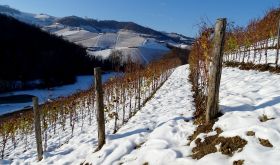
The 2008/09 winter was particularly severe, especially in eastern Germany where temperatures fell so low that many producers lost half their crop. There was more snow and ice in March but April was unseasonably warm and the vines sprang into life and ran ahead of themselves. But the unusually early flowering encountered yet more frost, which resulted in looser-than-usual bunches of unevenly sized grapes. This reduced the risk and effects of the fungal diseases that threatened in early summer and helped concentrate flavour.
What really defined the quality of the 2009s however was the fine, sunny weather from late August onwards. The grapes ripened steadily and the lack of rain kept them in exceptionally good health, even if it meant a relative lack of noble rot so that in the end it is possible that these friendly wines, even those that ripened enough to produce wines qualifying as Beerenauslesen and Trockenbeerenauslesen, may not be the most complex. They lack the backbone and nerve of the better 2008s, for example, and it is possible that they may not age quite as long. (But since top German wines can age 30 years and more, this may not be a serious drawback.)
The grapes ripened so reliably in fact that in 2009 many of the wines that technically would qualify for one of the riper categories such as Spätlese may well be sold as a less ripe wine such as a Kabinett, or the increasingly interesting QbA category, simply to offer consumers a variety of styles. The chief executive of the German Wine Institute Monika Reule promises 'a lot of wine for your money' in 2009.
It is possible that the most interesting 2009s will, as is so often the case, turn out to be those relative few made from the grapes picked at the very end of the season. From mid October temperatures fell considerably so that sugar levels stopped rising, acidity was preserved but the easy, charming fruit gave way to more terroir-driven characters derived from vines that by then were struggling.
In the 2009s I have tasted so far (the top dry wines sold as Grosses and Erstes Gewächs are not shown until September) I found lovely wines at all prices and quality levels, from almost bone dry to lusciously sweet. According to German wine exporters, it is mainly the British, once their most ardent supporters, who are being slowest to catch up with the German wine revolution which has seen so many great dry whites being made and has even seen a change, thanks to a warmer climate, whereby one vine in every three in German produces red wine, especially Spätburgunder, or Pinot Noir. Americans are importing more German wine now than they were even during the previous peak of demand in the mid 1970s, and Riesling is the fastest-growing varietal in general in the US. The Germans even claim to be exporting their new, top quality dry Rieslings to smart restaurants in France and Italy.
UK merchants bucking the trend and either already making special offers of 2009 Germans or expected to do so include Bibendum, Bordeaux Index, Farr Vintners, Fine & Rare, Hicks & Don, J&B, OW Loeb, Montrachet, Howard Ripley, Tanners and The Wine Society. German retail specialists in the UK are The WineBarn (online) and The Winery shop in Maida Vale, London.
Growers who made especially great 2009s
Dönnhoff
Emrich-Schönleber
Fritz Haag
Reinhold Haardt
Kloster Eberbach
Johannishof
Karthäuserhof
Keller
August Kesseler
Josef Leitz
Dr Loosen
Egon Müller
Horst Sauer
Willi Schaefer
St Urbanshof
Schäfer-Frolich
Schloss Lieser
Van Volxem
Vollenweider
von Othegraven
von Schubert
Wagner-Stempel
Robert Weil
Weisler-Künstler
J L Wolf
Zilliken
NB J J Prüm regularly makes some of Germany's greatest and longest-living wines but the Prüm family have not yet shown their 2009s.
See our recent tasting notes on Germany's alluring 2009s as well as Michael Schmidt's substantial first tranche.