'A very famous Bordeaux Château is about to announce a major investment in China.' This was Li De Mei's tantalising sign-off at the end of perhaps the most relevant of many presentations given at a recent get-together of international wine luminaries in Hong Kong, WineFuture. Could this be connected to the rumour that Pierre Lurton, director of LVMH's Châteaux Cheval Blanc and d'Yquem, has been overseeing vine plantings near the Tibetan border? I certainly spotted Cheval's public relations person at the conference.
But of course the much-hyped Chinese wine market is about very much more than a handful of investments by the likes of Château Lafite, the first growth whose wildly inflated prices in China are now on the wane and which is engaged in a joint venture to produce wine in Shandong in the east of this vast nation. Per capita wine consumption in China is still minuscule but the total wine market has grown exponentially, which is why there were quite so many wine producers gathered in Hong Kong, both for this conference and the official Hong Kong trade fair immediately before it.
The relationship between the wine markets of Hong Kong and mainland China is an awkward one. Hong Kong abandoned duties on wine in February 2008 and has achieved its aim of becoming Asia's wine hub. Auction totals from fine-wine sales now comfortably outstrip those in London and New York. According to one of Hong Kong's three resident Masters of Wine, Debra Meiburg, who has been surveying the Hong Kong wine market, there are now no fewer than 350 wine importers in this tiny commercial honeypot, but 79% of them have fewer than 10 employees and many of them have only two. Although virtually all of the major British fine-wine traders have set up a stand in the old colony, they must be finding it increasingly difficult to make much impact there.
Wine duties in China are still quite high so of course the level of smuggling between Hong Kong and the mainland has soared. As Don St Pierre Jr of ASC, one of the three best-known foreign-owned wine importers in mainland China, points out, even Hong Kong's famously thirsty residents are not actually drinking the billion dollars' worth of wine it imports each year. (Although I must say that a world map on which each case of fine wine were represented by a tiny light would be dominated by the brilliance generated by Hong Kong – with other notable clusters in Bordeaux and Corsham, Wiltshire, site of Octavian's fine-wine warehouse.)
Don St Pierre, needless to say, is calling for much more stringent checks on trucks travelling north into the mainland. For the moment, it must be frustrating to have to rely on the Chinese government's impressively detailed official statistics, knowing they represent only a fraction of the wine that actually makes its way into China. Official imports, for the record, increased fivefold to 15 million cases between 2007 and 2010. The Chinese government has deregulated the wine business, much to St Pierre's dismay, so that the number of licensed wine importers in China has risen from 1,000 to 20,000 licensed importers or distributors. Although, as his old arch-rival Ian Ford of Summergate makes clear, he would be hard pressed to name 200 companies with a completely engaged, legitimate wine business rather an opportunistic outfit trying to make a buck out of China's current love affair with the grape.
The French, or rather the Bordelais, dominated imports for some time but, as China's most respected sommelier, Yang Lu of Shanghai's Peninsula Hotel, points out, tastes are changing. Two weekends ago auctioneers Acker Merrill had huge success selling the contents of a great American burgundy lover's cellar in Hong Kong – with some of Burgundy's most famous (-ly reclusive) names in attendance. There are dangerous signs that China's (still small) nucleus of seriously well-heeled wine buyers may now be turning their attention to Burgundy. Dangerous because the quantities of top burgundy produced are so tiny that Chinese interest could easily upset the market. 'DRC' (Domaine de la Romanée-Conti, Burgundy's most famous domaine) could become the new Lafite – which is remarkable when one considers that as recently as two years ago, Aubert de Villaine of DRC went to Beijing and Shanghai to present, at free tastings, his wonderful 2005 vintage. According to Purple pagers Marcus Ford of Pudao, a subsidiary of Summergate, these events were, incredibly, very poorly attended with only about half the 40 seats taken. [I should point out that Aubert de Villaine himself remembers the tasting, of various vintages of DRC wines, as being well attended.] The Chinese wine market is indeed a volatile one – and one in which fakes (particularly of Lafite and DRC and often of pathetic quality) are rife.
For the moment, according to Lu, Tuscan wines are easier to sell than those of Piemonte because 'customers like a bit of sweetness'. For the moment, Yang Lu reports, champagne is difficult to sell by the bottle, yet that situation could change overnight. The Chinese are even beginning to drink white wine – although it probably needs to be called 'pale' or 'golden' to distance it from the association of the colour white in Chinese culture with death.
According to Li De Mei, only about a tenth of China's 400,000 hectares of vines are devoted to wine production, but there are now more than 900 wineries all over the country, just over half of them in Shandong, where maritime influence keeps winters mild but also brings the risk of humid summers and rot. The most exciting new region is Ningxia – crudely, about a third of the way from Beijing to Nepal. But here, as in so much of China, winters are so severe that vines have painstakingly to be individually buried by mounds of earth in winter and uncovered each spring. Now that so many young Chinese have moved from country to city, labour costs are suddenly a major factor in wine production.
Li De Mei reported matter-of-factly that the official figure for wine production in 2010 of 10.9 million hectolitres (about a fifth as much as France) includes 1.37 million hl of wine imported in bulk from the likes of Chile and sold as though it were Chinese. There has recently been enormous investment by Chinese wine companies in creating supposedly luxury brands of Chinese wine, although most of the money has gone into extraordinarily lavish packaging and the 'marketing' costs inevitably associated with a market as unregulated as China. The actual wine itself can often be remarkably similar to the one sold by the same company at one tenth the price.
Li De Mei made the Chinese red that won a Decanter World Wine Award earlier this year, Jia Bei Lan 2009 from Qing Xue winery in Helan Mountain in the Ningxia region. Some cynics thought this award was too conveniently coincident with the launch of a Chinese edition of Decanter, but a) the latter does not exist and b) I agree that I have already been impressed by wines produced in the Helan district. See Promising newcomers in China.
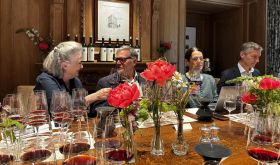
Incidentally, Marcus Ford (third from the right in the front row of the photograph below – to the right of the man with the bottle) reports that the wine course he teaches at Jiaotong University in Shanghai, one of China's top five, has a class size of 50 and a waiting list of 700 – and is far from the only popular wine course in China. Purple pagers Fongyee Walker and Edward Wragg teach another in Beijng for a start, and the major western importers such as ASC make education key to their attack on the mushrooming Chinese wine market.