I don't know about other wine lovers but I felt a small glow of pride when the Chinese government made wine its diplomatic weapon of choice in the trade war over its cheap solar panels exported to the EU (see China threatens action against EU wine). Yes, volumes of European wine imported into China really are now significant enough to be worth slapping an additional tax on!
 The wine-in-China story is one with many different and often unrelated facets, however. There is the surge of imported wine into China, the great volume of it pretty ordinary stuff, half of it imported in bulk to be given labels in China which bear only the most creative relationship to any known brand in their country of origin. One of my favourites is Royal Lateet, prominent when the réclame of Bordeaux first growth Château Lafite was at its height in China, but 'Bordeaux Port' on a label decorated with a fair copy of the engraving on a Lafite label was good, too.
  Solicitor Nick Bartman, who had been based in Hong Kong and was aghast at how slack controls were on wine labels in China, aproached me more than three years ago seeking help to publicise the problem to wine exporters to China. It was then an uphill struggle to enlist the support of the wine trade and he has now moved on to other areas of dubious commercial practice in China but told me recently, 'we've done one major job in Shandong and I reckon we've done €30+ million damage to the fake wine business. I've worked with the police and others. Wine companies have been closed and others are now under strict supervision. There's more to do, but it's time for me to move on.'
 France, Spain, Chile and Australia in particular vie for this high-volume, low-profit sector of the wine business in China. Australian and other southern hemisphere wine exporters will presumably be hoping to benefit from the new, higher duties on wine imported from the EU. But the taxes are unlikely to have that much impact on sales of fine wines in China – not least because most of them are shipped to Hong Kong with its zero wine taxes and then somehow spirited across the border into China with its punitive but apparently avoidable duties of almost 50% by value.
Much more of a threat to this market on which so many hopes have been pinned, particularly by the Bordelais, who have recently seen demand in more traditional markets evaporate, is another Chinese government phenomenon: the strict crackdown on official gifts. This has been a hugely important factor in China's fine-wine market and helps to explain the inordinate trouble wine producers in China take with their packaging. Any ambitious Chinese wine comes packed in excessively lavish packaging, sometimes worth more than the wine itself. (I recently weighed the box and bottle of an offering from the Franco-Chinese Château Reifeng-Auzias of Shandong and found they came to almost 3 kg.) And there is a certain market, albeit increasingly fragile, that actively seeks out the most expensive wine possible regardless of quality. It is significant that the top Chinese wine with which peripatetic Bordeaux-based oenologist Michel Rolland is associated costs considerably more than his own Pomerol, Château Bon Pasteur – a property recently added to the growing list of Bordeaux châteaux acquired by Chinese investors, incidentally.
Partly thanks to dogged work on the part of visiting French proprietors from Bordeaux, red bordeaux dominated the fine-wine scene in China initially but there is now an active desire to widen horizons on the part of that small proportion of the Chinese population that drinks wine (although even they will probably drink or give it only on special occasions). Burgundy is the obvious next stop on the Chinese wine route – a truly terrifying prospect for those who already have difficulty enough securing allocations from this extremely small fine-wine region.
As a result of the army of new wine importers in China, all hoping to capitalise on this new market but insistent on exclusivity, China is awash with brand names that are completely unknown in their country of origin. According to Shanghai wine lover Young Shi, 'there is lots of awful burgundy in China'. She is a Diploma graduate of the courses run by the London-based Wine & Spirit Education Trust, the world's leading wine-education provider which expects to see the number of its students in Hong Kong and the rest of China overtake its British student numbers this year.
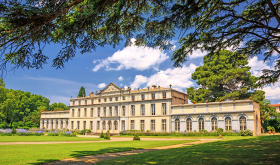
Appearance is all when it comes to the production of wine in China, too. The countryside is now studded with vast palaces built in the image of what one might call Château Walt Disney that purport to be wineries but often harbour more air, marble and in some cases spirits than wine. (The photograph above left of Château ChangYu was taken by Jànis Miglavs, who specialises in Chinese wine photography, most recently having completed a book on Chinese wine due out later this year.) There sometimes seems no end to the number of Chinese plutocrats whose dream is to make the best and/or most expensive wine in China. Much of the expertise is imported, sometimes into countryside that has never previously seen a grapevine.
Lilian Carter is an Australian winemaker who worked three harvests at the winery Pernod Ricard use for their Helan Mountain brand in the wine province of Ningxia. Along with Professor Li Demei, one of China's most respected winemakers, she has now been recruited to establish a privately owned 130-hectare wine estate 150 miles south west of the Muslim city of Urumqi, five hours' flying time west of Shanghai in the province of Xinjiang. Most of the grapes at WangZhong, as in most Chinese vineyards, are the red bordeaux staples of Cabernet and Merlot but Demei's involvement is likely to guarantee interest in the debut 2012 vintage.
French consultant oenologist, and rival to Michel Rolland, Stéphane Derenoncourt has been drafted in by the ex chairman of the vast CITIC group to develop vineyards in Manasi county west of Urumqi, dramatically overlooked by the foothills of the Himalayas and on the old Silk Route. The advantage of this terrain compared with other Chinese wine regions such as Shandong in the east, where a Château Lafite team is busy establishing a vineyard, is its lack of humidity and vine diseases. The disadvantage is icy winters that mean that each vine has painstakingly to be buried each autumn.
And then there is the project in which the owner of St-Émilion first growth Château Cheval Blanc and LVMH are involved with a local investor in Yunnan province close to the Tibetan border, apparently in the most beautiful but isolated sky-high, Tibetan-influenced setting far enough south to need no winter protection.
The Wild East indeed.