James Mayor draws parallels between Ukraine and Portuguese history. See Julia's giant collection of Portuguese tasting notes also published today.
The story of humanity is a constant pathway of territorial acquisition, with wars shifting the hopes and dreams of entire populations.
In December 2018 I spent Christmas in Kyiv with my daughter, my son, his Ukrainian wife and her family. We visited the magnificent snow-covered city, so lively and cosmopolitan, so European. Around a table laden with borscht, Varaniki dumplings, pickled herrings and dried fruits, we discussed their plans and toasted the future with sparkling wine and vodka.
And yet, less than four years later, we heard Olena Zelenska, Ukraine’s first lady, refer to ‘the mass murder of Ukrainian civilians’ and, most shockingly, of children.
Civilians are at the heart of this war. With Ukrainian cities encircled and under siege and ports blockaded, supply chains are in tatters with shortages biting viciously. Normal manufacture and trade, and Ukraine’s primary income, agricultural activity, are either unpredictable or totally impossible.
Russia and Ukraine account for about 30% of world wheat exports. Worsening supply-chain disruptions are creating a commodities shock that is driving up prices worldwide. Food availability for vulnerable populations is already an urgent global concern.
Conflict affects more than basic necessities. Throughout history wars have also impacted on luxury products, sometimes bringing their trade to a complete halt. Take wine, for instance.
Good Wine is the largest Ukrainian importer of fine wine. This week their warehouse in Kyiv, and the €15 million of stock it contained, was totally destroyed by Russian shelling.
Olga Lapina, author of the current series of Letters from Kyiv, and her husband Stanislav Lapin, respectively senior import manager and manager responsible for liaison with local wineries, found a moment to tell me, ‘we know that after the war we will be thrown back in volumes significantly. We assume that wine consumption in general will decrease and many people will switch to entry-level wines. Sale of alcohol is forbidden in the time of war, so Ukrainian producers have no operational business right now. Even with orders from abroad, it’s impossible to export Ukrainian wines.’
Paul Symington, former chairman of port shippers Symington Family Estates, offered a historical comparison with another wine-producing country, Portugal. ‘War has played havoc with port many times over the ages; its impact has been immense.’
Portugal is today one of Europe’s most peaceful countries. The history of port, however, is as much about war as about viticulture. This historically remote corner of Europe has experienced multiple conflicts, with generations of grape growers and port shippers demonstrating repeated resilience.
Heavily dependent on exports, the port trade has always been vulnerable to international conflict. At the same time, this trade has to a very significant extent been conducted by foreigners. The British have traditionally formed the largest group, although today the ‘British’ port companies account for only about 30% of all port sales, the largest group by volume being French-owned. There have also been Dutch, Flemish and German merchants and shippers.
Some of the best Ukrainian wines have been produced in Crimea, the peninsula on the northern coast of the Black Sea occupied by Russia since February 2014. The Massandra Winery, near Yalta, produces famed rich dessert wines (some incidentally called ‘port’!). Sparkling wine, long enjoyed by the Russians, is produced around the cities of Kyiv, Kharkiv, Lviv and Odessa, which are all too familiar from news reports today.
In 1756, Portuguese Prime Minister Sebastião José de Carvalho e Melo, more frequently known as the Marquês de Pombal, created Real Companhia das Vinhas do Alto Douro and established the Douro as the world’s first legally demarcated wine region, providing a regulatory environment for the production of port. Relations with the British were not always easy. Pombal protested that a British circular to Douro grape growers treated Portugal as though ‘it was not a kingdom that had an indisputable right to make its own domestic laws’.
For centuries Portugal was the target of external aggression from foreign powers. Since the early days of port production, Portugal’s position on the westernmost edge of Europe was not sufficient to protect it from the rapacious gaze of larger European nations, just as Russia spent the last few years eyeing Ukraine, before pouncing.
Spain constantly resented its smaller neighbour, at times behaving as if Portugal were a province of Spain. For nearly 60 years, from 1581, Philip II of Spain ruled Portugal as its King. In the mid 17th century, border fighting between Portugal and its more powerful neighbour contributed to the isolation and impoverishment of the remote Douro.
The British, in a Treaty of Peace and Friendship, signed in 1661, vowed to defend Portugal ‘as if it were England itself’, deftly providing the perfect environment to equally defend their commercial interests such as wine, which replaced claret during an Anglo-French trade war in the late 17th century.
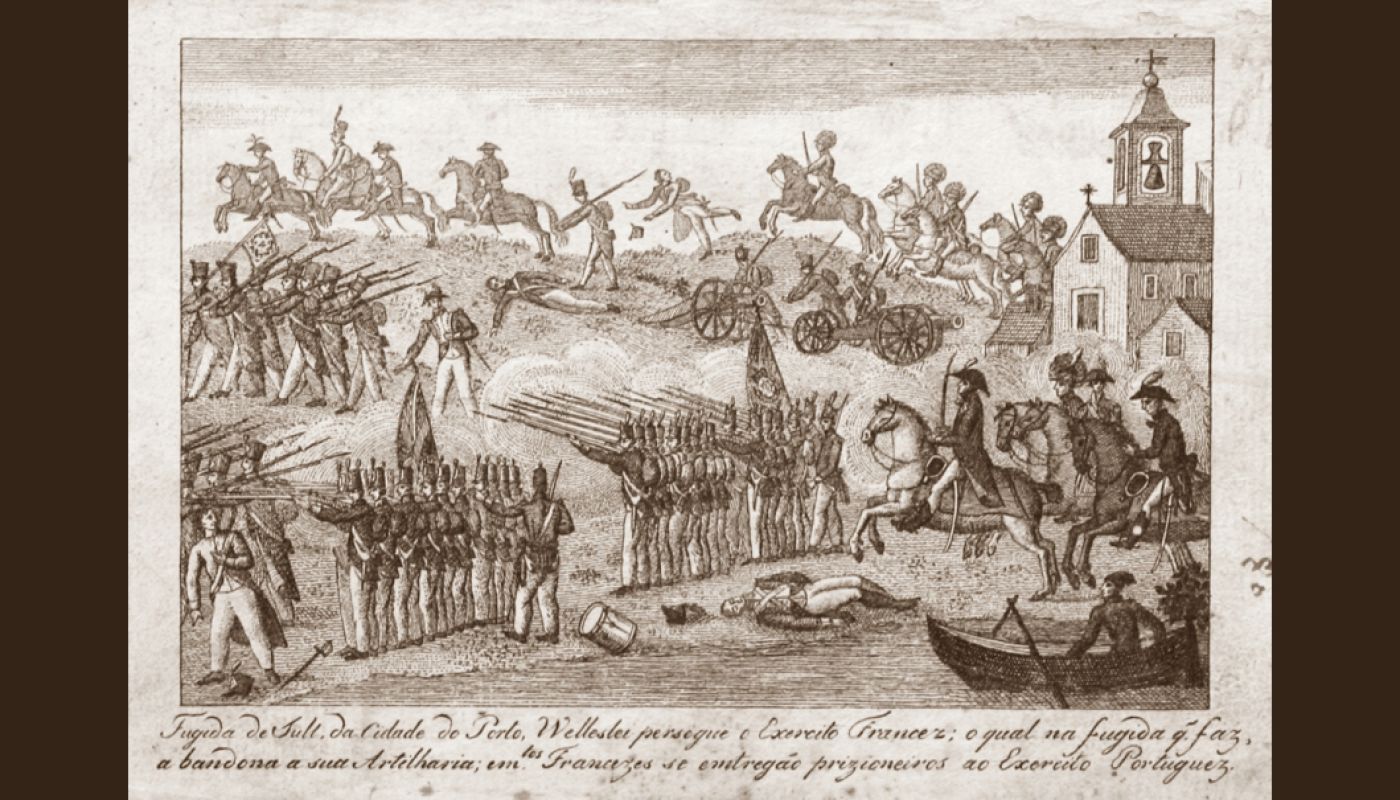
With the Peninsular War at the outset of the 19th century, French and Spanish armies invaded Portugal. The British were treaty-bound to protect their oldest ally. Oporto, the centre of the port trade, was occupied for three months in 1809 by French forces under the command of Marshal Soult – forcing many of the British merchants and shippers to return to England, leaving their companies under the protection of Portuguese agents – before being relieved by British forces under Sir Arthur Wellesley, the future Duke of Wellington. (The anonymous engraving at the top of this article shows the withdrawal of French troops from Oporto before the arrival of Wellesley’s army.)
Symington comments, ‘The fact that the British army were here in Portugal from 1807 to 1814 meant that many British soldiers got a taste for Douro wine and port. There was little fighting in the winter; they had time to play cards and drink! Veterans tend to keep memories of where they spent some of their most challenging years. I’m convinced that the Peninsular veterans helped in the 19th-century growth of port consumption in England, introducing its traditions right across the country.’
In 1820, Portugal erupted into civil war, and Oporto experienced a terrible 18-month siege, which practically reduced the population to starvation. The absolutist Miguelites bombarded the main city held by Miguel’s brother, the liberal constitutionalist Pedro, from Vila Nova da Gaia, where the port warehouses are located. Today’s sieges of the cities of Mariupol, Karkiv and Kyiv by Russian forces are a barbaric step backwards.
Svitlana Tsybak of Beykush Winery, head of the association of winemakers of Ukraine, wrote last Friday, ‘Vineyards are being bombed and shelled and Russian Federation forces have occupied some wineries. For now, wineries in western Ukraine are not affected and are able to continue their work, but they have changed their course and are working with the military and refugees. They make Molotov cocktails, sow pillows, cook food, provide financial support… The winemakers of the south are also preparing food and supporting the civilian population with humanitarian aid from European countries.’
On the outbreak of World War I, in 1914, men of combat age in the port trade left to fight in the trenches, although Portugal entered the war, on the side of the Allies, only in 1916. Many of them never returned, and their loss had a severe impact on several port-shipping families. German submarines threatened shipping, insurance costs rose steeply and exports of port plummeted. The Russian market for port collapsed with the revolutions of 1917.
The ‘roaring twenties’ which followed World War I saw a boom in port exports as people partied and tried to forget the terrible war they had experienced.
When World War II broke out in September 1939, the port trade was once again severed from its vital export markets, the commercial equivalent of an almost mortal heart attack. Symington comments, ‘to my knowledge, no port company made any profit whatsoever between 1939 and at best the early 1960s’.
Portugal’s right-wing Salazar regime managed to maintain uneasy neutrality throughout the conflict. Lisbon was an international hub of espionage and a port of departure to the Americas for Jewish refugees, intellectuals and anyone fortunate enough to have got as far as Portugal in their flight from Nazi brutality. Wolfram, the steel-strengthening mineral vital to the German war machine, was mined in the Douro and exported directly to Germany.
Annual port shipments to England dropped to 825,000 litres a year (compared with between 16 and 22 million litres in the 1930s). In London, port held in bond was destroyed by German bombing, great vintages flowing down the streets. Remember the shelling of the Good Wine warehouse in Kyiv?
Symington recalls: ‘with port sales at a virtual standstill, the British port shippers and their families dedicated themselves to preparing food parcels for Allied prisoners of war in Germany and raising money for the war effort. For many months after the outbreak of war, no parcels could be sent from England to Germany. In Lisbon, my Portuguese grandmother was a leading figure in the effort to help the countless refugees arriving in the city. My mother, Elizabeth, now aged 91, was 10 in 1940 and vividly remembers packing POW boxes and helping refugees. She lost two brothers in the war.’ Again, the parallels with Ukraine today are striking.
After World War II, the inward-looking policies of the autocratic Salazar isolated Portugal from mainstream post-war Europe, maintaining social deprivation and economic backwardness, exacerbated by costly colonial wars. Surprisingly, Portugal was one of the 12 founding members of NATO, in 1949. For port shippers, times were once again tough, with heavily reduced sales. This time there was no post-war boom, such as had occurred after World War I, and port exports remained depressed. Many historic port companies closed or were sold. Some even believed the port trade would not survive. In the end, sales remained weak until the 1960s, not overtaking pre-war levels until the early 1970s. How many years will it take for Ukraine’s wine industry, never a major exporter, to recover?
Portugal’s politics, economy and society were soon to go through one more momentous upheaval: the April 1974 revolution. In the understandable euphoria of the moment, after decades of repressive right-wing dictatorship, Portugal swung wildly to the far left. Real Companhia Velha, the largest port company by volume, was nationalised, although the British-owned port companies were able to escape nationalisation. One wonders whether foreign companies will be so fortunate in Putin’s Russia. A more moderate government, Portugal’s first post-revolutionary, democratically elected administration, under the Socialist Mario Soares, steered Portugal on the path to membership of the European Union in 1986.
Four days after being invaded by Russia, on 28 February 2022, Ukraine submitted a request to join the European Union, through a fast-track procedure. This was rejected.
Pinevich-Todoriuk added, ‘in the regions of Kyiv, Zaporozhye, Vinnitsa, Nikolaev and Kherson, viticulture and winemaking have been left for later. All the attention is on protecting Ukraine and supporting the army. Several wineries have been bombed, and a woman working in a vineyard near Radsad was killed by a rocket. As for future prospects for Ukrainian winemaking, if we manage to save the wine that has already been made, then the focus for the coming years will be export, since the Ukrainian market will sag very, very much.’
On 10 March, the first Ukrainian refugees arrived in the Algarve in southern Portugal, while in the Douro preparations have been made to receive 400 people.
The national anthem of the indomitable Ukrainian people offers hope with these words: ‘fate will smile once more’. To help the brave Ukrainian people, please make a donation to Disasters Emergency Committee, an experienced aggregator of proven UK charities which already raised £150 million in the first week of its Ukraine Humanitarian Appeal.
Fundació humanitària Dr.Trueta G62292545 C. Canigó, 33-08500 Vic, BCN, Spain
BANC SABADELL: ES4800810056900001821389
SWIFT/BIC: BSABESBBXXX
Purpose of payment : AYUDA UCRANIA SV
In my research for this article, I am indebted to Richard Mayson’s authoritative book Port and the Douro.
















