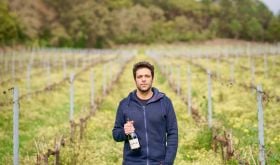
The 26th published contributor to our wine writing competition has an impressive scientific background, as explained below.
Thibaut earned a masters degree in Viticulture and Enology in 1997 and a masters degree in Winemaking in 1998 from SUPAGRO, one of the top agronomy schools in France. Thibaut holds a PhD in viticulture from the French National Institute of Agronomy at Montpellier, France. His research focused on vine water status variations under dry climates and their consequences on berry ripening. Prior to his PhD, Thibaut worked as a winemaker for various companies throughout the world (Chile, California, France and Australia). In 2001, he was hired by the Robert Mondavi winery as a research viticulturist: his projects focused predominantly on mapping vineyard variability, analysing the impact of climatic conditions and vineyard practices on fruit composition. He is the co-founder of Fruition Sciences created in 2007 and lives in Oakland, California.
How to link wine sensory properties with picking date?
Knowing when to harvest is a key step in the making of a good wine. Why is the timing of harvest so critical? How can picking date affect the sensory perception of astringency in the final wine?
Many winemakers will claim that the most reliable tool they have to decide when to harvest is their palate. The method consists of tasting the fruit on the vine to anticipate sensory perception in the eventual wine. While successful, this method is not practical or always reliable since it varies with each individual palate. On top of that, what the mouth tastes may not always reflect what will be extracted into the wine. To help support such decisions, more winemakers are now backing up pre-harvest berry-tasting comments with fruit analysis.
Historically, analysis of sugars and acids (which are found only in the pulp) have been the main chemical indices to track fruit ripeness. However, as aridity and heatwave frequency increase, fruit-sugar accumulation and acid degradation happen earlier because the pulp is essentially made of water. Consequently the levels of sugar or acid concentrations are often disconnected from compositional changes observed in seeds and skin compartments (where flavanols responsible for bitterness/astringency are found). This phenomenon, referred to as an ‘asynchrony’ in ripening, has been reported widely by teams of researchers – for instance, in France by Garcia de Cortazar and in Australia by Sadras. It is speculated that warmer temperatures during the growing season cause such asynchrony. Consequently, winemaker picking decisions, regardless of pulp composition, are increasingly supported by fruit analysis of flavanols since they affect astringency.
These new insights offer a great opportunity to strengthen the bridge between viticulturists and winemakers. They require an understanding of fruit skin and seeds flavanols’ response to seasonal variations such as light exposure, drought or higher temperatures.
Flavanols and astringency
Condensed tannins found in berry skins and seeds result from the polymerisation of small molecular units called flavan-3-ols. The concentration of flavan-3-ols peaks at veraison and there is no synthesis of flavan-3-ols after veraison. Because of this, the tannin potential of a wine is determined by environmental conditions affecting the vineyard before veraison. Flavanols form co-pigments with anthocyanins and protect the wine colour against sulphur dioxide bleaching or pH changes. Thus, flavanols contribute to stabilising wine colour, but they also play a direct role in wine sensory perception. In fact, flavan-3-ols polymers are the main contributors to bitterness and astringency.
The effects of tannin structure on the perception of astringency have been studied by Chira and her colleagues. After analysing the tannin properties of 23 vintages of the Cabernet Sauvignon-based wines of Ch Mouton-Rothschild, the authors found that older wines had lower polymer size along with weaker astringency perception than the young wines. These results suggest that the size of tannins may directly drive wine’s sensory properties.
In practice, the ratio of astringency to bitterness is low with low-molecular weight flavan-3-ols (found in seeds) and is high with high-molecular weight flavan-3-ols (found in skins). Recent measurements have shown that as fruit ripens, polymers of flavan-3-ols increase in size while at the same time astringency increases faster than bitterness. Thus, the timing of picking directly affects the astringency to bitterness ratio.
In that context, analysis of tannins’ structural properties is becoming more and more interesting to support the picking decision. We discuss two new methods of characterising tannins’ astringency before and during winemaking.
Essentially, chemical analysis for astringency is based on the interaction between tannins and salivary proteins. Subsequent precipitation reduces the lubricating properties of saliva leading to sensations of dryness, hardness, and constriction in mouth. A team of Italian researchers led by Rinaldi has shown that tannins' reactivity toward human saliva is a useful tool to measure the tactile sensation of astringency. The saliva precipitation index analyses saliva before and after the binding reaction with tannins. This index measures red wine astringency and could be used to track fruit tannins’ sensory properties before picking.
A team of Californian researchers led by Kennedy has developed the concept of tannin activity to characterise tannins’ sensory properties on fruit and on wine. The approach consists of measuring the energy needed to ‘unstick’ tannins from their bond to salivary proteins. Recent results on fruit tannin composition during ripening suggest that a reduction in the size of tannins correlates with a reduction in tannins’ activity, which directly affects the perception of astringency.
Conclusions
Sensory perception of astringency is influenced by tannins' size and the relative contribution of seed versus skin tannins in the final wine. Picking date directly affects tannins’ polymerisation and thus the distribution of tannins’ size, which in turn affect wine’s sensory properties. Measuring the saliva protein index or the tannins’ activity offers new ways to relate fruit tannins’ structural properties to wine’s sensory properties. As variations in pulp composition become less relevant to support picking decisions, the tracking of tannins’ structural properties will become more and more useful in predicting their sensory impact on wine composition.