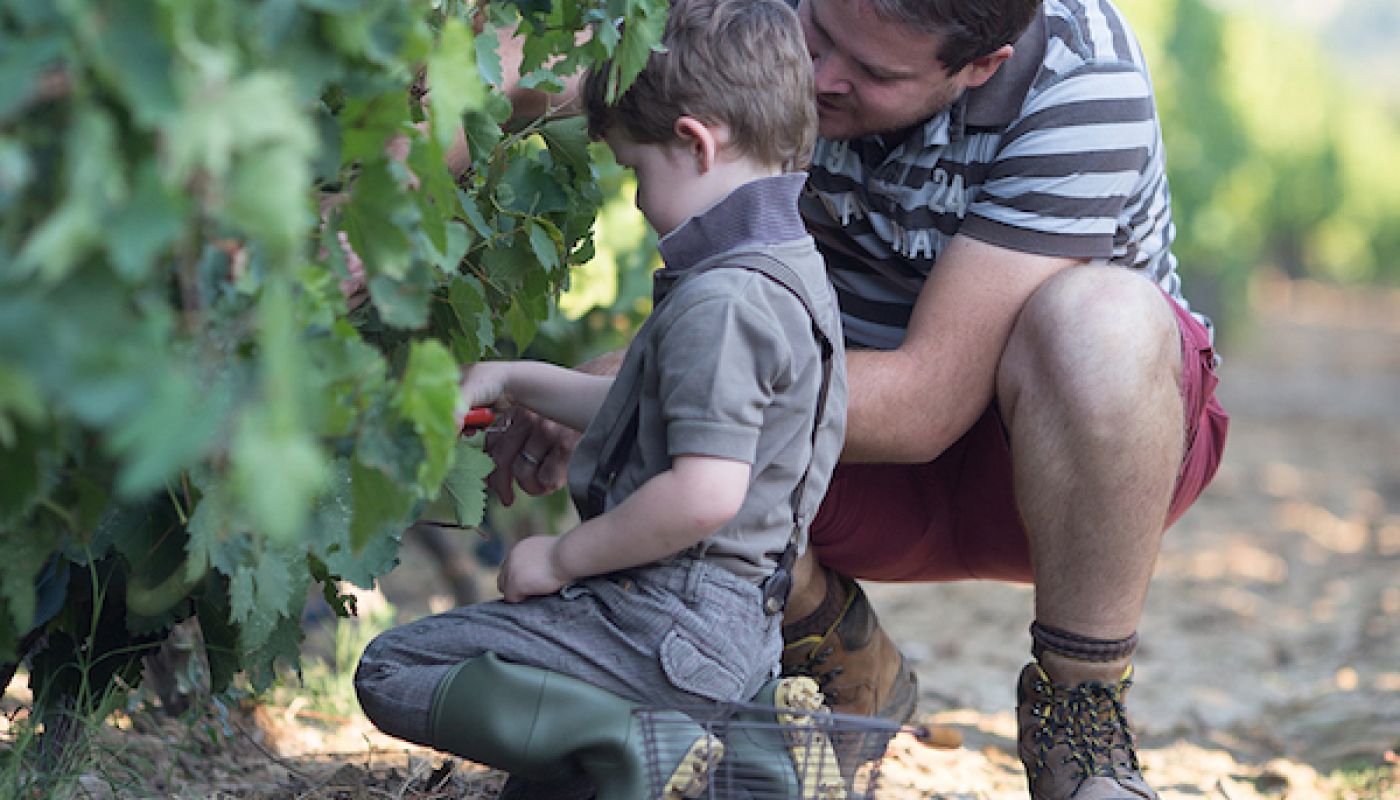
We're publishing both articles submitted to our popular wine writing competition by Ian Renwick, who describes himself thus:
I am the owner of Jaded Palates, a new wine merchant in Chagford, Devon. I am 37 with a wife and two children, one of whom was born in Avignon while I was working on a vineyard in the Luberon (more details below). I am relatively new to the wine industry itself, despite being an avid consumer and student for most of my adult life.
Jaded Palates is attempting to be a modern and forward-looking wine shop in a fairly traditional part of the country. I firmly believe that people appreciate wines more when they know more about them, so we do regular free tastings, and provide a lot of information to customers about the wines they are choosing. For me, the stories behind the wines are fascinating; they allow me to meld my previous life (HR – all about people) with my current one.
I like to think I choose wines to stock based on them being different, unusual and very drinkable. I’m not a huge fan of wine competitions and points systems (sorry!) but I understand their relevance.
I hope you enjoy the little stories I’ve written below. They are obviously both quite personal, and taken from my experience in one way or another, even if they are both written in slightly different voices.
Plants are from Mars
I distinctly remember the day I truly began to 'get’ plants. Having been brought up almost exclusively in the city, I definitely had a mixed view on anything green as a child, to put it generously. To the extent that when asked to comment on a beautiful view from on top of a mountain we had just clambered up (‘building character’ no doubt), I grumpily came up with the snarky, if rather pithy response, ‘It would look better from behind an air-conditioned window’.
So my family took my announcement that I was going to go and study viticulture and oenology with a rather knowing raise of the eyebrows. They could see me in the winery, perhaps, getting to grips with ferments and science, although anything mechanical was still a stretch. But trudging up and down long, muddy rows of vines and bugs with a pair of secateurs in my hand and anything other than a grimace on my face was difficult for them to envisage.
I was, if I’m being brutally honest, probably in agreement.
I spent many years appreciating the contents of a wine glass without really understanding them, but it wasn’t until embarking on WSET study that I began to scratch at the itch of knowledge that was lurking. Vague concepts of soils, varieties, clones, pruning and the like, though, remained purely secondary to what flavours I was encouraged to elicit and describe. It was almost life-affirming going through that ritual of searching and clawing through your memory, before nods of comprehension from your classmates as you came up with some flavours that they could also find. I was always a fan of studying and learning, so the Diploma and MW became a long-term goal almost inevitably.
Then, something evolved. It wasn’t quite enough for me to simply appreciate and describe. I wanted to understand. What, exactly, made this wine so good? Or this wine mediocre? What were the series of decisions that led to this wine tasting like this? Other events in my working life came to a head, and my young family and I made the huge decision to leave Asia, where I’d grown up and worked for the last 10 years, and move to France. I wanted to learn about how wine was made.
I was fortunate to have a good connection with a beautiful château in Fronsac – Château Gaby – and we decamped there for six months while they kindly began to satiate this thirst for knowledge. And, of course, it wasn’t just the biology and chemistry I was remiss on; I was fast coming to the realisation that I had absolutely no idea about anything agricultural. How do you connect a hose to a pump? Why do you drive at a certain speed on a tractor? What on earth does THAT tool do? Très bien. It was time to swallow my city pride and be ignorant again.
I was ready to be tired and cold (Hong Kong’s weather is really not the same as Libourne’s). I was even ready to be bored by the repetitive nature of a lot of the work. I was not prepared to be quite so fascinated, if perplexed.
I learned to prune, and I followed the guidelines for how to prune in Guyot to the letter, but without really understanding the theory behind it. I was also amazed at the sense of peace walking up and down rows of vines. Yes, it was back- and hand-breaking work at times and there was freezing fog, thick clay mud and snow to contend with. But on a bright, crisp January day, it was fantastically therapeutic to focus your mind on the task of cleaning these wooden structures up. From leaf-free, spindly spider-webs of mixed-up branches, to trim, crisp and minimalist beauty in just a few snips. Of course, we were preparing the vines for the new season, but for me, it was incredibly aesthetically pleasing too.
I can’t, however, say I was unhappy when pruning came to an end. Especially as we were using hand-secateurs and not pneumatic ones. But it did clearly plant a seed (ahem) in my mind about what vines themselves could offer, other than their obvious autumnal bounty.
Fast-forward about six months… I’d taken the decision that the production of wine was worth studying at least as much as the WSET, and I’d embarked on studying for the Brevet Technique Supérieur in Viticulture and Oenology: a highly-rated technical diploma in France designed to produce qualified and knowledgeable vignerons, capable of running their own vineyards and wineries. Allied to this was an excellent apprenticeship scheme allowing students to work more or less full-time at a domaine, while spending three days every three or four weeks in class learning the theory. Absolutely ideal: at the end of the programme I would have my diploma and also two years’ invaluable winery experience.
Of course, it meant going way, way back to basics in sciences I hadn’t touched since my GCSEs 20 years ago. Phrases dredged out of memory (and translated into French): atoms, ionic bonds, xylem, phloem, stomata, photosynthesis, nodes… hang on. Nodes?
I’ll paraphrase my biology teacher: ‘A node is a portion of a plant from which everything stems. It can create roots, branches, leaves and flowers, and represents one of the truly major differences between plants and animals.’ This was the moment. Somehow, this spoke to me: the notion that all of a plant’s existence can be contained within one beautifully formed element was remarkable. From that sprung the notions of balance and equilibrium, and, crucially, harnessing the extremely fine balance between the vine ensuring its own survival and growth (root development and branch growth) and the survival of its species (flowering and, of course, grapes). Pruning really made sense now – just one of the ways humans worked with the vines to harness and focus their energies.
Somehow, in our own vastly developed human minds, we have removed ourselves from being concerned about this intricate interplay – mostly, we worry about far more lofty issues than our own survival (and thank goodness). Plants are a gorgeous representation of equilibrium, vitality and maximising your available resources. That was it: the city boy had fallen in love with vines.
And now, when I approach tasting a wine, I think about the vines that produced it. In an ideal world, that’s also how I approach my job: explaining the effort, not just of man, but of the plants that went into producing this drink. Learning about vines has given me a huge appreciation for how a wine is intrinsically linked to the plant and soils it came from.
In the end, the wines you get can only be as good as the grapes you put in it, which are in turn only as good as the vines which produced them. Cutting through all the scores, points, critical acclaim or otherwise, if the grapes are well-made, the job of the winemaker is, frankly, a doddle.

The off-licence is dead… Long-live the off-licence!
Once upon a time there lived a man… and it was usually a man. It would actually be quite nice if this wasn’t always the case, but there are other articles out there about women (or the lack thereof) in the wine trade. I won’t encroach on them here.
Back to the story: Once upon a time there lived a man who ran an off-licence. This was your typical local village bottle shop, complete with wood panelling, display of pork scratchings and choice of tobacco products behind the counter. This man – let’s call him George – was a well-liked and respected member of the community. He understood his locals well, knew what they liked and always provided bottles to the local charities to auction off for their fund-raising raffles.
George made a decent living buying his wines from wholesalers and putting a reasonable margin on them. There were plenty of bin-end deals to be had, and his suppliers would often support him by offering samples and tastings to entice his customers to try new things. Occasionally, he would make the trip over to France to see if he could buy in some super-cheap co-op Languedoc that he could buy a pallet of and sell for less than a fiver. But by and large he stuck to his methodology. People knew what they wanted, after all.
And what they wanted was decent wine at good prices.
So supermarkets started to up their game on the buying front. Wine clubs started springing up out of the woodwork offering direct deals. And that bane of George’s existence, Majestic (he can’t even say the word), opened up a superstore just 10 minutes down the road. And what was that Richard Branson doing selling wines on the internet? What does he know? As for Naked Wines, well…
So life got rather harder for George. People starting picking up more and more bottles of varying quality from supermarkets, Majestic, online and from wine clubs, and there was less and less reason to go into what seemed a comparatively expensive shop like George’s. George found he had to really expand his range even more, and stock international beers and snacks as well as really clamping down on his margins. Things were looking tough.
George could have gone out of business, slowly carried on eking out less and less of a living, or retired. But George, to the surprise of many (including himself), innovated. He saw the death of the traditional off-licence as being inexorable, and he actually wasn’t that upset by it. He saw the future, and it excited him.
He saw himself
- Taking advantage of the change in very old-fashioned licensing laws to allow him to sell both on and off the premises. He could become a wine bar and allow for tasting samples to be served, meaning customers could try before they bought. You can’t do that at a supermarket!
- Refurbishing the tired old look to make it more contemporary and inviting. Gone would be the dark wood panelling and cramped shelving. In would come bright lighting, simplified displays and clear signage.
- Reducing the vast numbers of stock he sold. He wasn’t a tobacconist, and he didn’t want to be. You could buy snacks and Heineken anywhere, so he’d stop selling those. But most of all, and most riskily, he’d slowly reduce his dependency on those cash-cow wines that he was trying to compete with the supermarkets on. He would specialise in wines with a story; good-value wines, even if they were slightly more expensive than what he sold before.
- Making the most of his now-quite-numerous contacts in the Languedoc to become a specialist importer and wholesaler of these wines. They were quite willing to offer him exclusivity on these wines, as they were desperate for a foothold into the UK, and his keen pricing allowed him to start getting onto a few local hotel and pub wine lists. This afforded him just a little breathing room to concentrate on slightly riskier wines of more unusual provenance, thus keeping his clientele interested and devoted.
- Above all, becoming a real centre of wine knowledge and information for his area. He found new customers started coming to him because they had no idea what to buy at the supermarket, and often didn’t really know what they actually liked. He was able to help these people discover wines and regions they had never considered before, and they appreciated that advice and were willing to pay for it. His regular wine tastings and the wine bar were hits: yes, he’d needed to hire an additional staff member to cover the extra hours, but he found that often when people came in to try something, they liked it, and bought more.
And thus, George foresaw the future shape of the off-licence: not a typical offie as such any more, but a real specialist resource for the community. People were becoming more interested and engaged with wine as a subject. Supermarkets, online retailers and mail-order wine clubs just weren’t able to provide that face-to-face customer service and knowledge that George could. Yes, customers still bought cheaper everyday wine from these other places by the caseload. But they came to George when they wanted something a bit different. George could tell them all about the wines he had, who had made them, and a little anecdote about the time he visited the vineyard.
That’s value added.
















