Number 44 in our wine writing competition series comes from Texas, courtesy of Maureen Bailey.
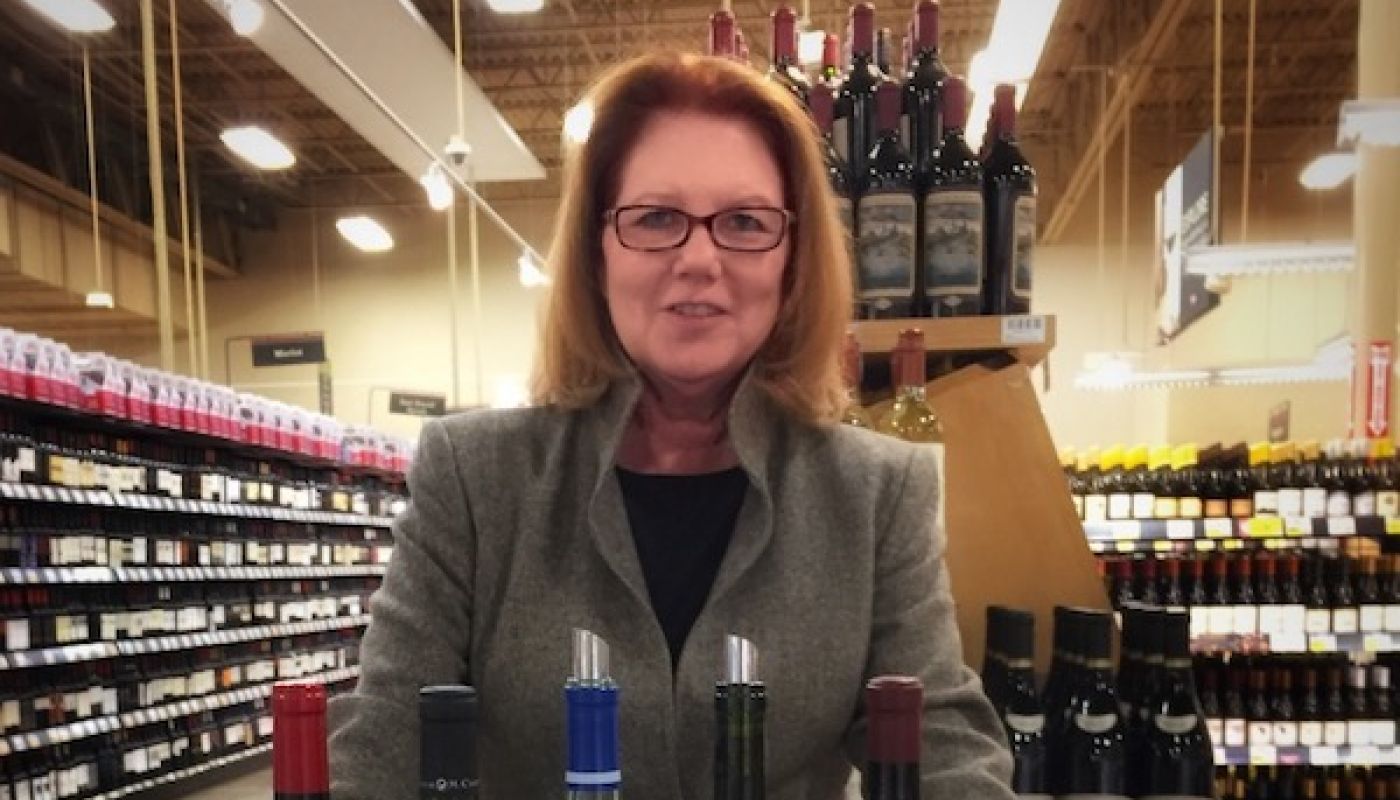
Maureen Bailey works as a wine-pourer in Austin, Texas. Early in her professional life, Ms Bailey was an associate editor of Barron’s and a stringer for The Economist. She also spent two decades working as a speech-writer and a communications executive. Now 65, she used to live in France (two years), California (five years), Boston (likewise), and New York City (25 years) while travelling extensively and drinking wine.
LOCATIONS AND TERROIR

There’s a charming scene in the romantic comedy French Kiss in which Kevin Kline teaches Meg Ryan about terroir, the trinity of soil, climate and vine.
A profligate son who is trying to buy back his vineyard with the proceeds of his success stealing jewellery, Kline brings Meg Ryan to his childhood home in the south of France to see what the fuss is about. They’re at a vineyard, so not much time passes before he hands her a glass of wine and asks her to tell him what she tastes. 'Wine.' Then he opens a wooden box, explaining that it contains a prized school project. He lifts a vial from an unmatched set, uncorks it, asks her to close her eyes and inhale. 'What do you smell?' 'Rosemary?' she asks. Next vial. 'Mushroom.' Another: 'lavender.' He hands her the glass again and says, 'Now, tell me what you taste'.
I was thinking about this the other day while sipping TX, the June 2015 release from David Phinney’s Locations collection. Apart from the label on this elegant blend of Rhône varieties, there’s nothing remotely evocative of Texas about it. And that’s ironic because the whole point of Locations is terroir.
Phinney’s vision for Locations was, by his own definition, simple: 'to make the best possible wine from a given country or location'. This he accomplishes by partnering with select vineyards and winemakers around the world. For TX, he chose Kim McPherson of McPherson Cellars in the Texas High Plains AVA just south of the Texas panhandle.
The idea for Locations came to Phinney while he was standing outside the Sheraton Hotel at Paris Charles de Gaulle airport waiting for a taxi. He was talking to his general manager of France about various challenges of the day, including the wine glut in the south of France and the complications of dealing with various appellations, when the taxi pulled up bearing a white oval sticker with the letter F, the country code for France. In that instant, the concept for Locations crystallised: no vintage, no appellation, no variety listed on the bottle. Just a country code and the winemakers’ signatures authenticating their pledge that each bottle represents the best of the location indicated on the label: E (Spain), F (France), I (Italy), CA (California), P (Portugal), AR (Argentina), OR (Oregon), WA (Washington), TX (Texas), and Corsica, whose label bears a rendering of a shepherd’s knife.

To his followers, Phinney’s signature is an imprimatur. He created The Prisoner, Papillion, Palermo, Abstract, Mercury Head and many other successful wines for his Napa-based Orin Swift Cellars, which he sold, in part, to E & J Gallo in June, terms undisclosed. He’d already sold The Prisoner and Saldo in 2008 to Quintessa’s Huneeus family, which sold The Prisoner Wine Company to Constellation Brands last April.
No surprise that Phinney’s wines have broad appeal. They promise instant gratification. They are ready to drink now. Their fruit is ripe. Their tannins are supple. Their alcohol tends towards the higher end of the spectrum. And their labels are collectible, which may be a by-product of the year he spent in Florence.
Which brings us back to TX Locations wine. Most people wouldn’t have the chutzpah to even attempt to capture Texas in a 750 ml bottle. Everything about the state is big, even the toast. Texans are unabashedly chauvinistic about their place in the world, and they rate themselves a lot higher on their totem pole than Lord and Lady Grantham.
Some even like to think there’s a little Texas in every glass of French wine because it was a Texas horticulturalist, T V Munson, who developed the phylloxera-resistant stock that was used to rescue French vineyards in the late 19th century. For this, he was awarded the Medal of the French Legion of Honour and a statue in Montpellier.
So what might one reasonably expect to be the fruit of the Texas terroir? Something earthy, certainly. Something macho. A little smoky, perhaps, with leather or a trace of hay. prickly pear cactus or tomato. Pecan, maybe, or cedar. Blackberries, strawberries, lavender, rosemary. Something that conveys heat because there’s something unique about the heat in Texas. It could have inspired its own ring in The Inferno.
One might reasonably expect the overall effect of a wine called TX to be big and bold. That’s because, to quote Jancis, 'Wine is an expression of place.'
Locations’ blend of Grenache, Mourvèdre, Syrah, Carignan and assorted Bordeaux varieties, the latter from Phinney’s own California stock, conjures the lush countryside of the Rhône Valley. The wine is delicate and delicious, redolent with plum and cherry, and a finish that lingers seductively. At $25, one might even call it a value wine with snob appeal.
It just doesn’t have anything to do with Texas.
CONFESSIONS OF A WINE POURER
Observations on comments made at a wine barrel where wines are offered for tasting and purchase in Austin, Texas.
'I can taste the Meritage', he said, as though it were nutmeg.
This is amusing because Meritage is neither variety nor note, but rather the registered mark of a trade association, The Meritage Alliance, devoted to honouring the merit and heritage, thus Meritage, of the wines of Bordeaux.
In Californian parlance, the alliance’s rules are fairly laid back. For red wines, members pledge to use at least two of the noble grapes of Bordeaux in each Meritage blend, with no single variety accounting for more than 90% of the whole. Qualifying red grapes include Cabernet Sauvignon, Merlot, Cabernet Franc, Malbec and Petit Verdot, as well as the rarer Saint-Macaire, Gros Verdot and Carmenère. Similarly for white wines, the winemakers limit their choice of varieties to Sémillon, Sauvignon Blanc and Muscadelle du Bordelais.
When it was founded in 1988, The Meritage Alliance aimed 'to help consumers identify wines that represent the highest form of the winemaker’s art – blending – and distinguish these wines from so-called table wines'. Members consider a Meritage wine to be the best of a vintage.
A visitor may look at the breathtaking châteaux and manicured vineyards of Bordeaux and see a halo of aristocracy. Many would be stunned to learn that the soul of Bordeaux is not wine but commerce, that its raison d’être is the English market, that not a single grape is indigenous to the region, or that Bordeaux’s place on the World Heritage List has nothing to do with wine, but rather architecture and the city’s place in the Age of Enlightenment.
That doesn’t diminish the quality of a single premier cru. If anything, it makes Bordeaux more of a marvel. But how stark the contrast with Burgundy, whose terroir was accorded World Heritage protection. Pinot Noir and Chardonnay, two of the world’s most noble grapes, are indigenous to Burgundy.
In Burgundy, particularly in villages such as Vosne-Romanée and Gevrey-Chambertin, one understands why it is that the word terroir defies translation. It is the life-force that pulses through the province. Pinot Noir, it is said, provides the perfect expression of place: one can taste the differences in terroir from one small plot of land to the next.
Is that why there is nothing resembling a Meritage Alliance for Burgundy? Is it just too tall an order?
Pinot Noir is the prima donna of the vineyard. Thin-skinned and finicky, it has earned a reputation as the most difficult grape to cultivate in all the world.
All the more mystery, then, that so many California winemakers go to such lengths to disguise the grape, plumping the Pinot with noisemakers such as Syrah and Zinfandel, bringing pepper and spice to what could have been a pas de deux of elegance and allure. Guarachi and Williams Selyem, prize Pinots of the Sonoma Coast and the Russian River Valley, respectively, realise this balance beautifully.
One unfortunate California fashion is to shroud the Pinot in black. The trend is doubtless market-driven, coming on the heels of the recent success of black fruits in general: Black Hole Cabernet, Chain Gang’s Pitch Black, Cosentino’s The Dark and Rare Red’s Black Blend to name a few. But the new Mark West Black, which purports to be 81% Pinot, the rest Syrah, is not remotely evocative of Pinot. The noble grape is wasted on this full-bodied mélange of black cherry, plum and so much black pepper it made this wine pourer sneeze.
Perhaps all this is an effort to expand Pinot’s reach by capturing a share of the fast-growing market for full-bodied Cabernets and blends for which California is known. After all, some people are put off by Pinot’s viscosity, which can be dismissed as thin. Then, too, there doubtless are purveyors who hope to cash in on Pinot’s reputation as the wine that pairs with anything. Many a sale is rung for someone buying Pinot because Pinot Noir is the thing to bring when one doesn’t know what to bring to a dinner party.
Rare is the Pinot Noir that can hold a candle to the best of Burgundy: Dom de la Romanée-Conti, Dom Leroy, Chambertin. Indeed, the average price for one bottle of the 2013 DRC on wine-searcher.com exceeds $12,000.
Americans have made extraordinary contributions to oenology and the culinary arts. But Americans can also take credit for some dubious McContributions. It is this wine pourer’s sincere hope that California will stop tinkering with Pinot Noir and devote its blending prowess to more malleable grapes.
Leave the poetry to Pinot. Blend the Merlot.