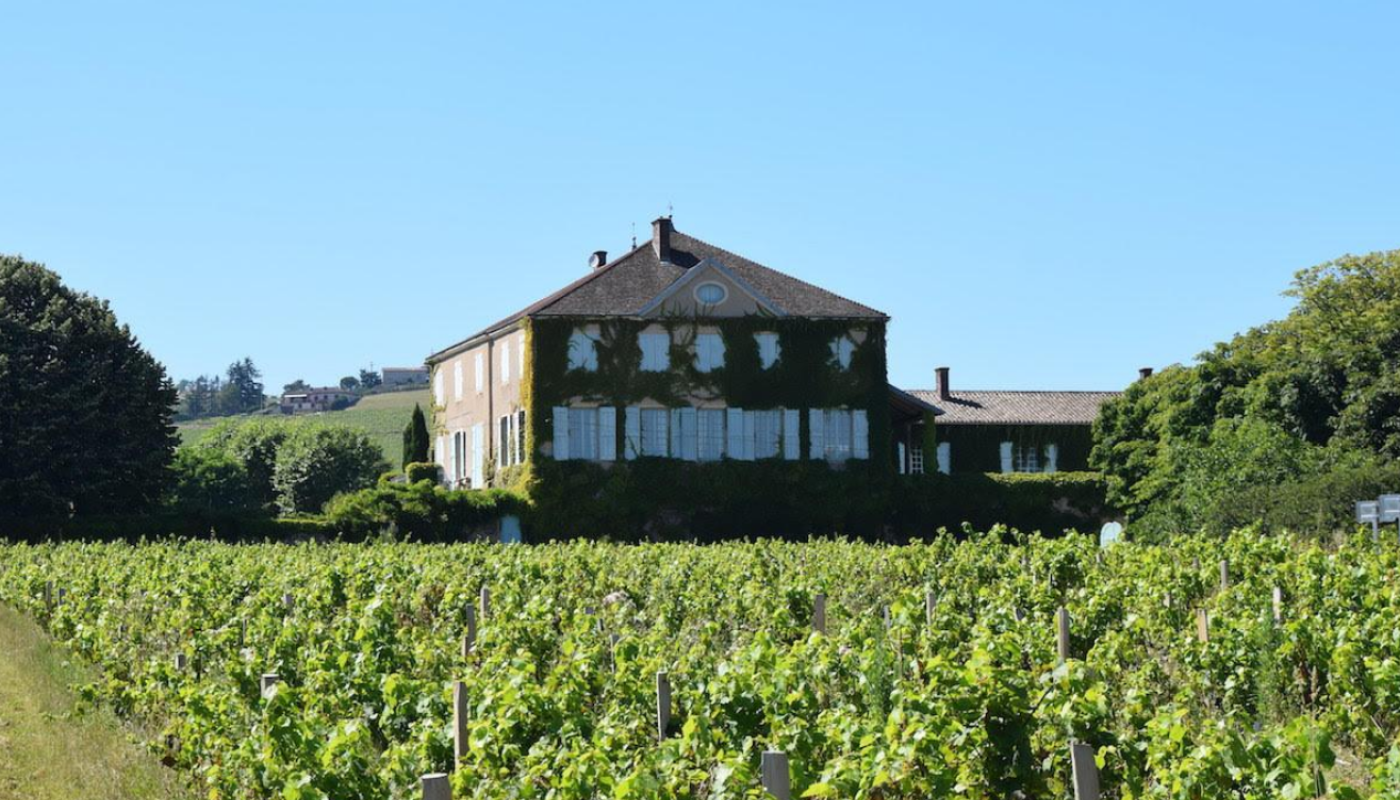
Knowledge Left Behind: Sustainability and Biodynamic Living at Château des Bachelards
‘It’s not complicated’
This was the frank response of Alexandra de Vazeilles, owner of Château des Bachelards in Fleurie, when I raised the subject of sustainability with her over our recent Zoom call, demonstrating her stripped-back and pragmatic approach to viticulture. I don’t think I’m in a minority of wine folk both equally compelled and perplexed by the methods of Biodynamics. What I considered a niche and complex subject, seems to be more of an intuitive, forgotten skill available to anyone who chooses to slow down, observe nature and work with it. De Vazeilles’ comments on sustainability for this article are sure to inspire.
De Vazeilles acquired Château des Bachelards in Fleurie in 2007 and began the impressive task of converting all her vineyards to Biodynamic by 2015. Hers are the only Demeter-certified biodynamic vineyards in the three appellations of Fleurie, Moulin-a-Vent and Saint Amour. For the visionary femme du vin, the history of Château des Bachelards or House of Gods in the English translation, and its surrounding land has been a source of inspiration for her, informing how she both lives and farms. The Cluny monks who demarcated the territory for the Gamay in the 12th Century, understood just how well the grape performs here on the highly acidic granite soil. Few grape varieties can withstand this acidity and it is most likely that the autochthonous Gamay adapted to suit the needs of its environment. The wines of Bachelards are a far cry from the mass-produced light and vapid wines that have given Beaujolais a tarnished name in recent years. These wines are more akin in style to Bordeaux, inky in the glass, smoky on the nose and richly extracted. None of the wines undergo carbonic maceration and de Vazeilles uses the Bordeaux bottle for emphasis.
Sustainability as an approach bears little novelty for de Vazeilles. In fact, her whole attitude forced me to rethink the subject for myself, about what it really means to be sustainable. With a deep reverence for the past, she frequently brings the conversation back in time to explain how we should work with nature by observing it, switching our focus from crisis-reaction to prevention. Modern commentators frequently direct the conversation to how we must ‘fix’ a climate on the brink of collapse through accelerated change and innovation, pitching elaborate and novel solutions. De Vazeilles’ approach is different. For her, the solution lies in the past. By its very definition, to ‘sustain’ infers an essential link to the past, to effectively preserve what is already here. Maybe it’s due to a lack of glamour or because it asks too much of us as a collective to revert to a former, slower pace of life, but it seems to me that we already have a model for greater sustainability if we can access knowledge left behind.
De Vazeilles’ first brush with Biodynamics (or what she simplifies to ‘just living’) occurred when she was a little girl of five. A local farmer warned her family to cover their olive trees in Provence with an insulating layer of pine nuts as they were to expect a harsh winter ahead. According to this wise old man, the oak trees were unusually thick with nuts which signalled cold conditions for the coming winter. When the freeze finally arrived her family were glad they followed the farmer’s advice and the olive vines were salvaged. Be it coincidence or a matter of diligent science, the experience nevertheless affected the little girl and ever since, she has looked to nature for clues about how best to live and farm.
France is a kaleidoscope of micro-climates and certain plants thrive best in certain regions. When a plant is suited to its habitat, less intervention and water is required for survival. Plants, at the same time, play a symbiotic role in maintaining the ecosystem in which they grow. This is the foundation of permaculture and before the middle of the 20th century, this was how most of us farmed. Vehemently anti-irrigation, in her three vineyards at Fleurie, Moulin-a-Vent and Saint Amour, de Vazeilles has nourished the land with diverse plantings that are suited to the climates here. The flowers and herbs she grows are typical of Southern France and require very little water like lavender, sage and thyme, the eponymous ‘Garrigue’ bouquet. Essentially, if you grow everything mixed up together, the vines require less water and there is less humidity related disease. Humidity regulation is maintained very successfully by the agroforestry project with diverse plantings of bushes, little oak and nut trees which act as moderators for unpredictable weather conditions. When it is too humid the plants absorb excess moisture and when it is too dry they release moisture back into the air. When working as she should, nature is always on ‘automatic’ mode. When rebuilding the Château at Fleurie, de Vazeilles installed a double circuit of water, making use of the generous supply of fresh rainwater from her outside pond while the second circuit comes from the city providing drinking water.
For a mass conversion to this way of farming, it will take a significant shift in attitude away from a preoccupation with quantity, speed and efficiency towards an approach that prioritises quality and minimal intervention. For every 1,000 plants per hectare, de Vazeilles plants 500 randomly from massal selection to increase diversity. When I asked her if she worries some years that certain clones mightn’t perform consistently or that yields might suffer, she breezily shrugged off my concern and replied, ‘I don’t care’. Overall, quality year upon year is better because everything has to perform at its peak to thrive in a diverse and competitive environment. This kind of approach requires not only a shift in attitude but a trust in the natural forces outside the scope of our interference and meddling. Diversity is quality, as de Vazeilles likes to put it; ‘It takes many violins to make a symphony’.
Meeting her vision for a self-sustaining vineyard has not been without challenges. Forgoing the convenience of modern technology and intervention is expensive and labour intensive. Every 12 hectares requires four labourers full-time. Permitting the use of chemicals requires just one worker for every 40 hectares. Implementing permaculture means a messier vineyard area which requires more hands and eyes at harvest, another cost she can’t avoid. The additional price is absorbed by the consumer but de Vazeilles fights her case arguing that the alternative (bulk-produced, cheap wine) has hidden costs that we pay in other ways, both physiologically and through the larger economy. Poor air quality, soil erosion, endocrine disruption and pesticide residue in the bottle are just a few of nasty trade-offs for cheap wine. Both our health and our environment suffers. I remember visiting Corbières a couple of years ago and a farmer expressed his concerns to me over the increased flooding in recent years. It was no surprise then to hear from de Vazeilles that when a soil that is well and alive, it can absorb up to 7cm of water per hour whereas dead soils lose the ability to absorb and therefore flood.
Another challenge at Bachelards arose during the early years of converting to biodynamics. De Vazeilles likes to employ local workers in the area but these young men, just out of school, were more comfortable with the conventional way of doing things (‘macho’ tractors, ruthless pruning, heavy chemical spraying). The first blow was her ban on soda cans and plastic bottles, weaning her workers onto herbal teas, a new brew each day from flowers and herbs like wild sage, oregano and thyme interspersed through her vines. The next blow came when she presented her workers with their new tractor, a small multitask fuel-preserving machine that trades considerable speed and efficiency for careful and precise handling and less environmental impact (lighter on the ground, requires only one round of pruning). There was much pushback. The tractor has a number of tools attached to essentially complete multiple jobs at once but slowly, rather than a number of tractors with limited tools making numerous journeys through the vines, guzzling fuel and impacting the earth from the heavy machine weight. In agriculture, as de Vazeilles comments, everything you do is judged and watched, ‘Your tractor and workers are in the centre of a field, the centre of the village. There is much to prove’. The reality is that the Bachelards vineyards are a viable source of local employment because de Vazeilles chooses people over cheap industrial substitutes.
Sustainability shouldn’t be an arduous uphill battle. De Vazeilles believes that if you work with the seasons they provide what you need so it should be easy. This was how it was for everyone until the 1950s when a booming chemical industry that had been bolstered by wartime necessity turned its attention to ‘solving’ other issues like the perceived nuisance of low-yielding vines. In 1948 the inventor of pesticides, Paul Hermann Müller, won the Nobel Peace Prize, but back then they didn’t know the price we would pay for this today. As the years passed many vineyards lost their ability to function without chemical help. One could argue that this period of rapid innovation severed the link from the past, hindering the chance for vineyards to sustain themselves. The bulk of modern agricultural problems are man-made and with some collective effort could be prevented. Indeed, the general approach needs to move from reaction to prevention. De Vazeilles’ is a silent but urgent plea to wake up, take notice of the natural world and learn from the rich reservoir of knowledge that the past has to offer: plant liberally and practically, choose manual labour over machines, use natural fertilizers and encourage what is wild to flourish. As consumers we can buy more of these wines and pay for quality. If we refuse to do this then how can we expect farmers to radically change their approach and put their livelihoods on the line to rescue our future?
















