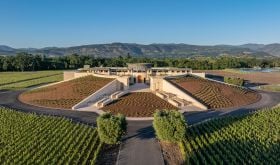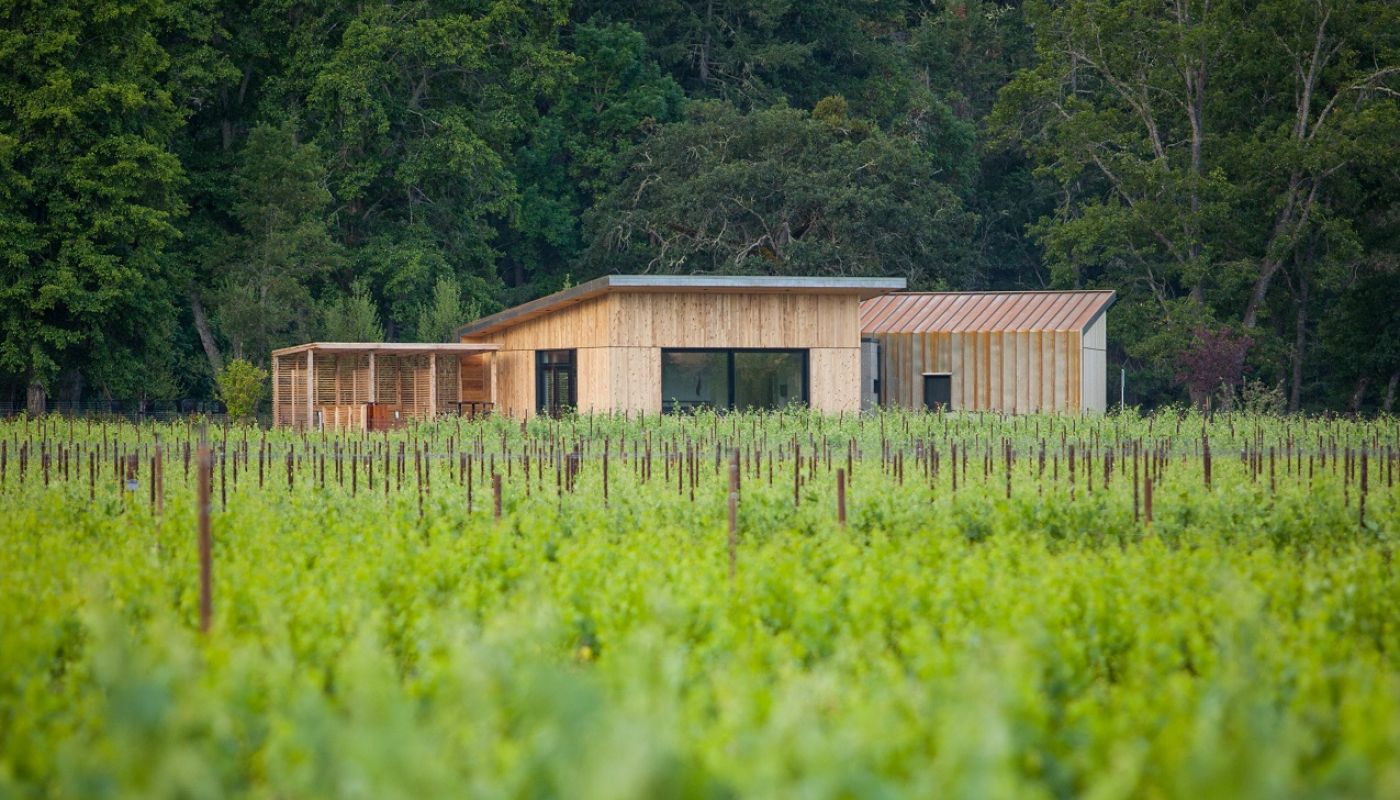
Cowhorn Vineyard & Garden is the very first Living Building tasting room certified by the International Living Futures Institute. Yes, I said it, the first Certified Living Building Tasting Room in the whole wide world, and I hope you can feel my pride. Not only is it the first tasting room to achieve the most progressive and rigorous standard for green buildings and sustainability, but also the first small business in the world, the first commercial building in Oregon, and the twentieth building in the United States. Here at Cowhorn, we believe that Certified Living Buildings instigate change for a sustainable future. Other wineries are following suit, Silver Oak Winery achieved their LBC certification in April 2020.
In the tasting room (pictured above, photo by Robb McDonough), I open the knife of my wine key and rip the foil off four wine bottles. I insert the screw and withdraw the corks with muscle memory ease. Gazing through the biggest and most beautiful window I’ve ever seen, I’m watching a pair of eagles that have taken residency at Cowhorn’s farm. This window was made in Poland and because of its size and weight, it took a crane to mount it into the framework of Cowhorn’s Tasting Room. To be certified under the Living Building Challenge, a project must meet a series of requirements. One major requirement to pass the LBC is to build using materials and resources not on – The Red List. The Red List, created by LBC, is essentially a list of 'worst in class' materials and chemicals that are not to be used while building sustainably. The list is long and detailed, which is what makes achieving LBC status so challenging. Needless to say, it is also very hard to find local, sustainable materials, hence the window from Poland. There wasn’t one company in all of the United States that would declare what gas was used in the making of their windowpanes, and without that, we couldn’t source locally. So instead, we went to Poland. And that is just one example of the meticulous decisions Bill and Barbara Steele made while creating Cowhorn’s stunning, holistic, progressive, net-positive, free of all toxins, sustainable tasting room.
‘The Challenge aims to transform how we think about every single act of design and construction as an opportunity to positively impact the greater community of life and the cultural fabric of our human communities’, says Barbara Steele, the Owner of Cowhorn.
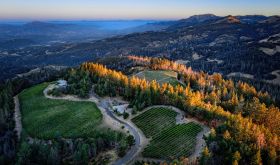
Cowhorn is tucked into the bottom corner of the Applegate Valley in the Rogue Valley AVA of Southern Oregon. Its very name, Cowhorn, hints to other certifications, as it is also the first certified organic and Biodynamic winery in Southern Oregon. The land, the animals, the people, and the products are all connected and thriving in harmony here on the farm. Biodynamics encourages us to think of our farm as a whole organism – breathing, giving, and taking; a beautiful life form.
Along with 26 acres of Rhone-inspired vines, Cowhorn is a perennial polyculture farm. We grow purple and green asparagus (an off-season crop so that we can employ people 12 months a year), lavender, and hazelnut trees that have been inoculated with black truffle spores. We farm ‘with the wild’ inside of our fence. In fact, right now there are 31 bird boxes adhered to the tops of 31 fence posts, inviting the bluebirds, swallows, and finches into the vineyard. Invite them in, house their babies, and give them plenty of bugs to eat; and just before veraison, we remove the boxes and the birds find new homes. Our corridors, habitats, perches, limited electricity, and water all encourage animals to live on the farm, or the surrounding BLM (public land). When a bunny burrow multiplies, so do the fox, and the circle of life naturally brings vine-pests back down to neutral. The bees, the bats, the river weasels, ducks, geese, turkeys, raccoons, bobcats, mountain lions, bears, and coyotes all regularly inhabit the farm.
If you find yourself in the tasting room to sample our cool-climate red and white wines, you’ll walk past a series of pictures showcasing unearthed cow horns, compost tea, quartz crystal grinds, lavender, rocks, lots of dirt, and a baby bear cub sitting in a tree. To foreign eyes, these pictures might look out of place for a wine tasting room, but the more you listen, the more you will understand about Biodynamic farming. Most people know of organic farming by how easily organic grapes can be found at any grocery store. But Biodynamic farming takes organic farming and raises it to a new level. We strictly avoid all herbicides, fungicides, and pesticides. Instead, we use nine compost preparations to enhance our soil and plants. These specially prepared minerals and compost manures, as showcased in the tasting room, help increase the vitality of the vineyard and farm. Inside those unearthed cow horns are the health, strength, and dynamism of our farm.
Happy soil creates happy plants, and happy plants make good wine. According to Wine & Spirits Magazine, Cowhorn’s Sentience (100% Syrah) was awarded ‘the best U.S. Syrah’ in 2019. Remember the meticulous decisions Bill and Barbara made to construct their tasting room? They put forth all of this energy with the belief that the whole will be healthier because of it. In the end, the winemaking part is the easy part. When the ‘whole’ is happy, it reduces the need for much input. Bill Steele, the winemaker, says ‘winemaking does not improve grapes; at its best, it can only maintain their quality’. If we were to include an ‘ingredients label’ on the back of a bottle it would simple say: biodynamic grapes, water, and SO2. Bill believes so strongly in not adding anything to his wines that he even makes his own SO2. He uses native yeasts found in the vineyard. He co-ferments most of his blends. He uses exclusively French oak barrels for aging, as well as limited filtration, and lots of time. Most wines are cellared for one year before they are released.
If there was ever a winery to be crowned sustainable, it is Cowhorn. It lives in a peaceful place, a wild place; a place where all ends tie, and the air smells more refreshing. The birds chirp, the vines are green with life, the animals live in harmony, and the people embody the same sense of beauty. I would like to honor these people by submitting this short story of their ultimate sustainability.
I will leave you with this quote by Barbara Steele:
‘The scale of change we seek is immense. But without recording these utmost visions and clarity to purpose, we as a society will never experience the type of future that is possible and necessary for our long-term survival. It is our belief that only a few decades remain to completely reshape humanity’s relationship with nature and realign our ecological footprint to be within the planet’s carrying capacity. Incremental change is no longer a viable option.’