Gramona, where craftsmanship meets nature
Located in Penedès, 30 km from the bursting Barcelona, Gramona is a historical producer of Catalan sparkling wines. Among sommeliers and wine lovers, it is famous for its long aging on the lees, using a natural cork stopper during the second fermentation and the dosage liquor made in solera. Though for me, at that time an Erasmus student of the Universitat Rovira i Virgili, the most interesting part of the visit was Gramona’s sustainability programme.
OIV defines sustainable viticulture as ‘Global strategy on the scale of the grape production and processing systems, incorporating at the same time the economic sustainability of structures and territories, producing quality products, considering requirements of precision in sustainable viticulture, risks to the environment, products safety and consumer health and valuing of heritage, historical, cultural, ecological and landscape aspects.’ Sustainable viticulture is the number one axis of the OIV Strategic Plan. Though, the weak point of the concept is that everyone tends to understand it in his own way. Sometimes I see producers who just stopped using herbicides and already claim to be sustainable. Nevertheless, the true meaning is far beyond it.
17 Goals for People, for Planet
The UN 17 goals were adopted already in 2015 as a part of the 2030 Agenda for Sustainable Development. In the current situation of the global crisis, this mission acquires a new perspective. ‘We need to turn the recovery into a real opportunity to do things right for the future,’ – says UN Secretary-General António Guterres. The example of Gramona shows how wineries can put the global goals into their everyday routine.
Goal 6 stands for ‘Clean water and sanitation’ and urges to ‘ensure access to water and sanitation for all’. In 2010 Gramona started to use rainwater for the irrigation of gardens and installed a purifier that returns clean water to the river after using it in the winery. The pond created to collect rainwater also attracts birds which improves biodiversity. Thanks to the responsible consumption, the winery’s water footprint equals to the impressively low-lying 3L of water for the production of 1L of wine.
Goal 7 is called ‘Affordable and clean energy’. Celler Battle, the new winery constructed in 2001, sits mostly underground which allows better thermal insulation and thus energy savings. The producer is using 100% renewable energy resources, geothermal and photovoltaic (solar) in particular. A masterpiece LED system was also installed in the winery which provided additional energy savings of 6% per year.
Goal 8 is the one that lies closest to my heart. It is about 'Decent Work and Economic Growth' and urges to 'promote inclusive and sustainable economic growth, employment, and decent work for all'. In 2015 Gramona established an association of winegrowers called ‘Aliances per la Terra’. Today it counts 12 members and 303 hectares of vineyards farmed biodynamically. The mission of the union is to share knowledge and best practices. Also, as a founder and member of the Corpinnat brand, Gramona is dedicated to paying a fair price for the purchased grapes. In 2019 this minimum price is set for 0,65 euro per kilo, while the ‘Big Three’ Cava producers were paying no more than 0,3–0,35 euro which led to a serious grape-pricing scandal.
Goal 9 ‘Industries, innovation and infrastructure’ is aimed to ‘develop quality, reliable, sustainable, and resilient infrastructure, including regional and transborder infrastructure, to support economic development and human well-being, with a focus on affordable and equitable access for all.’ Gramona’s winery is integrated perfectly in the surrounding landscape. The architects have used the principles of bioclimatic architecture. The wave-shaped roof reminds that the sea is just 30 km away but also brings to mind the masterpieces of the famous Catalan modernist architects – Josep Puig i Cadafalch, Lluís Domènech i Montaner and Antoni Gaudí.
Goal 12 stands for ‘Responsible consumption and production’ and is targeted to ‘ensure sustainable consumption and production patterns’. Gramona is dedicated to lighten, simplify packaging, and make all of it biodegradable or recyclable. As a first step, they reduced the weight of the bottle from 900g to 835g which gave an annual reduction of 45 tons. One controversial moment for me when I visited the winery was wrapping the bottles with a cellophane film which at first looked to me unecological and needless. Though I found out later that the cellophane used is 100% compostable and this kind of packaging is not only a tribute to tradition but a means to protect the bottle and the wine from temperature, light, and label damaging.
Goal 13 is the broadest one and is called ‘Climate Action’. It appeals to ‘take urgent action to combat climate change and its impacts'. Gramona boasts to be the first Spanish winery to achieve European EMAS (Eco-Management and Audit Scheme) certification. It is an instrument for companies to ‘evaluate, report, and improve their environmental performance.’ This badge acknowledges the company's constant strive for minimizing the environmental impact of its activity.
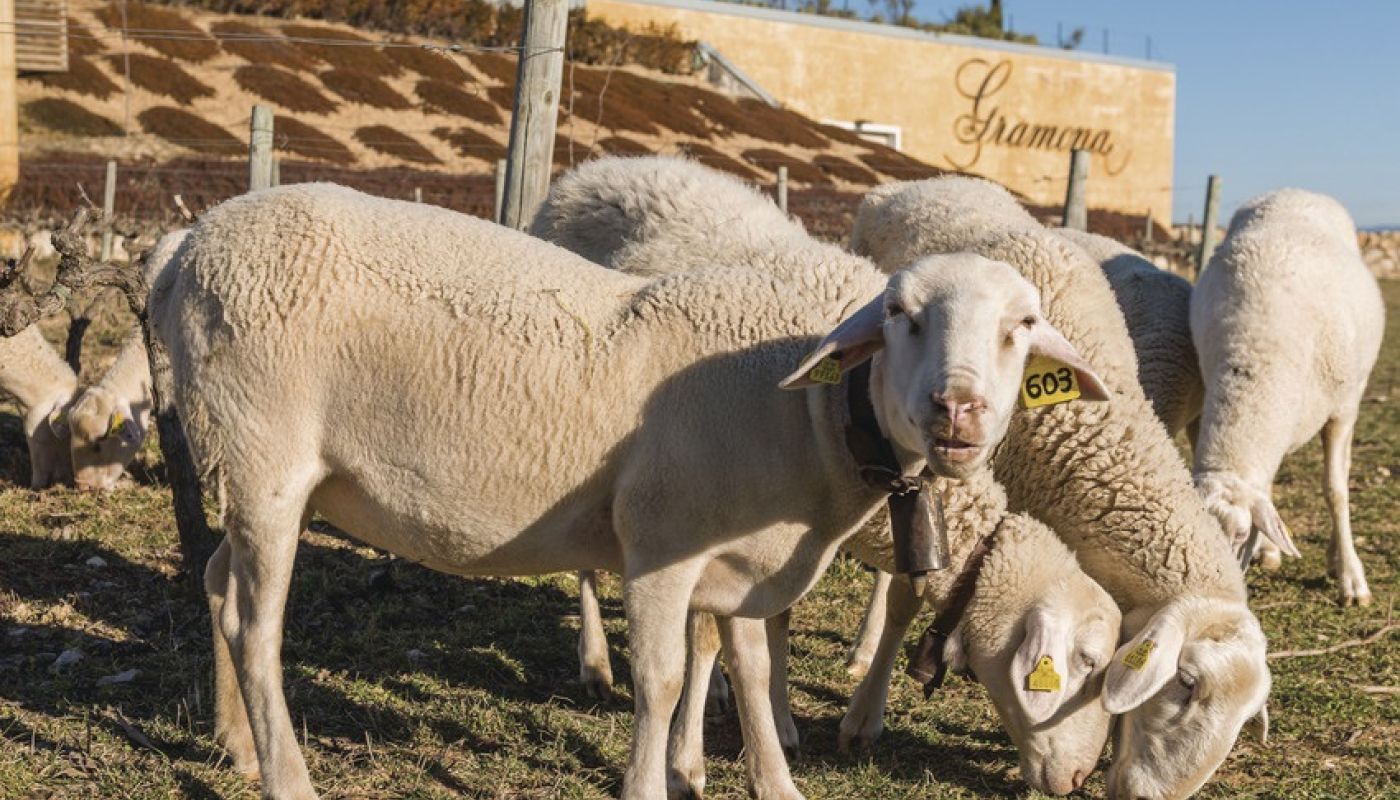
Goal 15 supports ‘Life on Land’ and calls to ‘sustainably manage forests, combat desertification, halt and reverse land degradation, halt biodiversity loss.’ In Gramona they cherish biodiversity at their ‘Granja’, a farm where horses, donkeys, sheep (see picture at the top), hens, peacocks, and geese live happily together. It allows the winery to have its own ingredients for biodynamic preparations and support the biodynamic cycle. 22 hectares of land is worked by horse. The main purpose of horse work is to bring man back to nature, make him understand the processes, and be a part of them.

Goal 17 encourages ‘Partnerships’ and strives to ‘revitalize the global partnership for sustainable development’. Since 2014 Gramona is certified by Demeter and since 2018 by Biodyvin, making it a part of the international community of growers that follow biodynamic principles. The winery also takes an active part in local, European, and global initiatives, like, for example, 'Vineyards for heat' which aims to 'apply and implement a Vineyards Virtuous Circle as a local strategy to mitigate climate change contributing to meet the goals to reduce greenhouses gases'. Jaume Gramona is a regular speaker at different events dedicated to climate crisis solutions and along with Miguel Torres represents the avantgarde of the Catalan sustainability movement.
















