Immense Responsibility: Sustainable winegrowing with Kindeli
The heavier the burden, the closer our lives come to the earth, the more real and truthful they become. Conversely, the absolute absence of burden causes man to be lighter than air, to soar into heights, take leave of the earth and his earthly being, and become only half real, his movements as free as they are insignificant. What then shall we choose? Weight or lightness? – Milan Kundera, The Unbearable Lightness of Being
Alex Craighead, who grows and makes natural wine under his two labels, Kindeli and Don, in Moutere at the top of New Zealand’s South Island is guided by the question: How can my wine be made, and all of my actions, be done more sustainably? After a brief overview of his winemaking career, let’s trace the careful steps he takes on the path towards hand-on-heart sustainable winegrowing.

Alex followed a fairly conventional if enviable winemaker’s path until several years ago. After getting hooked on wine while living in Perth, he worked in vineyards and wine bars while studying oenology at Lincoln University in Christchurch. Vintages ensued in the Hunter Valley, Marlborough, Okanagan Valley, Yarra Valley, Waipara, Barbaresco, Barolo, McLaren Vale, Central Otago, Riverland and Burgundy. Following this wayfaring spell, Alex took a full-time job in Hawkes Bay as an assistant winemaker, going on to work as a flying winemaker in Corsica, Languedoc and Bordeaux, and making his own wine for a vintage in Mornington Peninsula. After consulting to five wineries in Spain, he moved back to New Zealand, taking a production winemaking job in the Wairarapa, followed by a head winemaker position in Martinborough.
At this point, you might think Alex then settled happily into retirement. But this was all before he was forty! Five years ago, with $3,000 in savings, he started growing grapes and making his own wines in the Nelson sub-region of Upper Moutere.

Organic viticulture
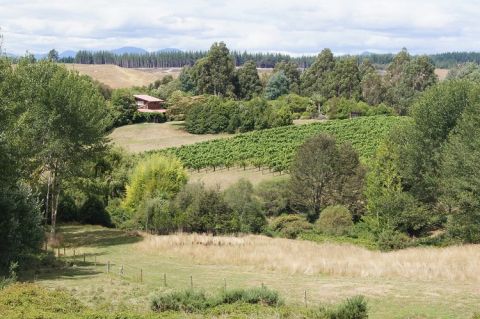
Alex’s approach to viticulture centers on protecting, preserving and enhancing the local ecology and biodiversity within which he dwells and makes wine. Both the vineyard and winery are Biogro-certified organic and will soon be Demeter-certified biodynamic. Needless to say, all synthetic fertilisers, pesticides, herbicides and fungicides are strictly avoided.
He makes his own organic composts with marc, straw and foraged seaweed. While some wineries are sowing cover crops between rows to promote the soil health, Alex prefers to grass down, as there is evidence that constant soil disturbance results in a net carbon loss.
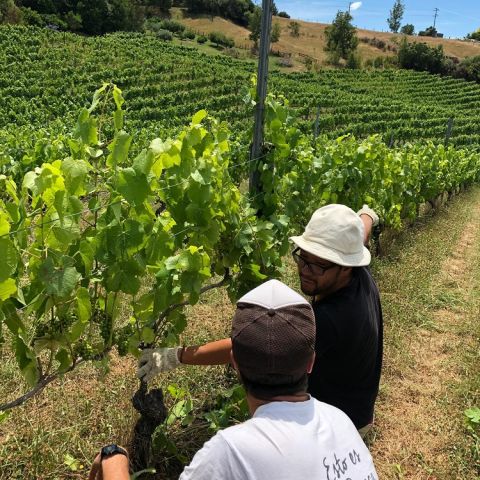
Employing practices from regenerative farming, Alex does minimal under-vine mowing and tilling, as these techniques cause soil compaction, erosion, and nutrient loss. Eschewing machines, a few cows and sheep roam the vineyard, keeping weeds down naturally while providing organic, site-specific fertiliser. All grapes are hand-harvested from the four organic vineyards that are located in close proximity to the winery and residence.
On the aquatic front, captured rainwater provides most of the winery’s water needs. Despite the ample rainfall that blows in from the Tasman Sea, Alex is judicious with water use. The vineyards are dry farmed and he is currently making a wetland for the winery’s greywater. Since no chemicals are used in the vineyard or winery, this will provide a healthy environment for local flora and fauna.
Beyond the vineyards, tree planting is a regular practice within the property’s eight-hectare forest. The forest offsets carbon while providing an expanded habitat for wildlife, as well as construction materials. Much of the winery and house onsite are built from wood grown on the property, along with locally sourced mudbrick. Being an old school New Zealander, Alex is handy and resourceful, but when projects aren’t DIY, he hires local tradespeople.
Organic winemaking
Unlike many wineries that lay claim to organic viticulture, Alex’s ‘more than organic’ approach continues in the winery. As a natural wine producer, absolutely no chemical inputs or additives are used. This not only keeps the wine true to place and healthier but avoids the environmental contamination involved in producing, consuming and transporting chemicals. For Alex, organics are just the starting point. In his dialogic way, he asks:
Help me understand the point of treating vineyards organically, only to turn around and pump the wine full of lab-made chemicals. All that care and attention in the vineyard, only to make wines full of enzymes, acids, fining agents, etc. – all sadly legal in ‘organic wine’.
The small winery uses solar hot water and will soon be completely solar-powered. As anyone who has worked in a winery knows, winemaking is 75% cleaning. Typically, this involves harsh chemicals like caustic acid. Taking cues from green chemistry, Alex uses mildly alkaline and peroxide-based cleaners that are much gentler on the water cycle.
Waste is minimised and what remains is either dealt with by recycling, upcycling or composting. Plastic is avoided as much as possible, as is flying. Utilising a range of vessels, from second-hand stainless-steel tanks to old oak barrels, Kindeli really shines with their move to clay amphorae tinajas. As Wellington’s Stephen Wong MW (a big fan of Kindeli), pointed out:
Year after year, wine-growing regions around the world import billions of dollars worth of new oak barrels from Europe and the United States. Although the forests are managed, surely this massive global trade in oak products is not part of a sustainable wine industry? Clay vessels or even larger, longer shelf-life formats of oak would reduce the need for this revolving door of new oak barrels. For instance, I was floored when I visited a medium-sized winery in Margaret River and was told by the cellarmaster that they buy in more than AU$1,000,000 worth of new oak barrels every year! That is a lot of wood for one winery.
The long-lasting amphorae Alex uses are produced by Tinajas Moreno León, a seventh-generation family business located in Cáceres, Spain. Hand-made with local clay and a wood-fired kiln, the timeless vessels are crafted in much the same way as when the company began in 1783. Given archaeologists have unearthed and reconstructed clay qvevri in modern Georgia dating back 8,000 years, amphorae clearly have some sustainability advantages over oak.
Kindeli wines are bottled on-site using a second-hand contraption Alex rejigged and shares with a few other local winemakers. The lightweight bottles that are made in New Zealand from 69% recycled glass. Kindeli’s distinct labels, designed by a pair of local artists, are printed on paper from FSC certified forests with plant-based ink. Rather than cork from Portugal or aluminium screw caps, the bottles are stopped with carbon-neutral Nomacorc, made from sugarcane byproducts. To top it off, they are sealed in locally produced organic beeswax, as opposed to the typical metallic foil used to ‘dress the bottle’.

The cartons used for shipping are made from 46% recycled material and the inner dividers are 100%. While most ‘biodegradable’ pallet wrapping options are simply greenwashing, Kindeli is in the final stages of importing a wrap from Australia that is truly home compostable and marine biodegradable. This is all part of a master plan to strip the use of plastic from the product life cycle and promote a truly circular economy.
On the human front, health and safety, fair wages and equal opportunities are of paramount importance for Alex and Kindeli’s assistant winemaker Yuki Nakano. Seasonal employees come from near and far and local charities are donated to from sales of Kindeli's ‘brutal’ label.
Weight or lightness?
If the modus operandi of industrialisation is efficiency, rational calculation and control, why does Alex Craighead make life difficult for himself? Surely, a highflying global winemaker could be living free and easy. It comes down to what he describes as an ‘immense responsibility’: ‘As producers, I think we should all feel the burden of responsibility to act in the least impactful way possible.’ Within this responsibility is a firm commitment to honesty and transparency regarding organic wine:
If you asked most consumers, they would expect that organic wines weren’t full of all that nonsense, yet they are! This seems fundamentally dishonest to me on the part of the producers. The idea of natural wine is quite simply ‘nothing added and nothing taken away’. Having said that, vineyard and wine additives are still only pieces of the puzzle; that is why we are constantly dissecting what we do, often in micro ways. I am in no way suggesting we are anything close to perfect, but we are striving to be better every year – it seems like the least we can do for the environment and our customers.
We all know the current industrial system is unsustainable and the direct cause of climate change and the dawning of the Anthropocene. As Alex demonstrates in his meticulous approach to sustainable winegrowing, the necessary shifts will be incremental insofar as the industrial form of life we are dependent on cannot be reassembled overnight.
In 2020, we are confronted with the fact that our ‘modern’ relationship with nature threatens not only the biosphere, but humanity itself. Rather than ‘mother nature’ being infinitely exploitable by and for humans, our role now is one of protection, conservation and care. This is an immense shift, for since when does a child carry its mother? We can continue making the classic excuse that we’re simply individuals, or we can take on the ‘immense responsibility’ that people like Alex Craighead don’t just speak about but enact.
As a natural wine producer, Alex is guided by the question, ‘how can my wine be made, and all of my actions, be done more sustainably?’ As consumers and wine lovers, we too can ask and be guided by similar questions, such as ‘how was this wine actually made, how organic is it really, what additional steps were taken to minimise the environmental impacts?’ Given questions entail answers, such dialogues can help us move closer to a hand-on-heart sustainable wine industry.
















