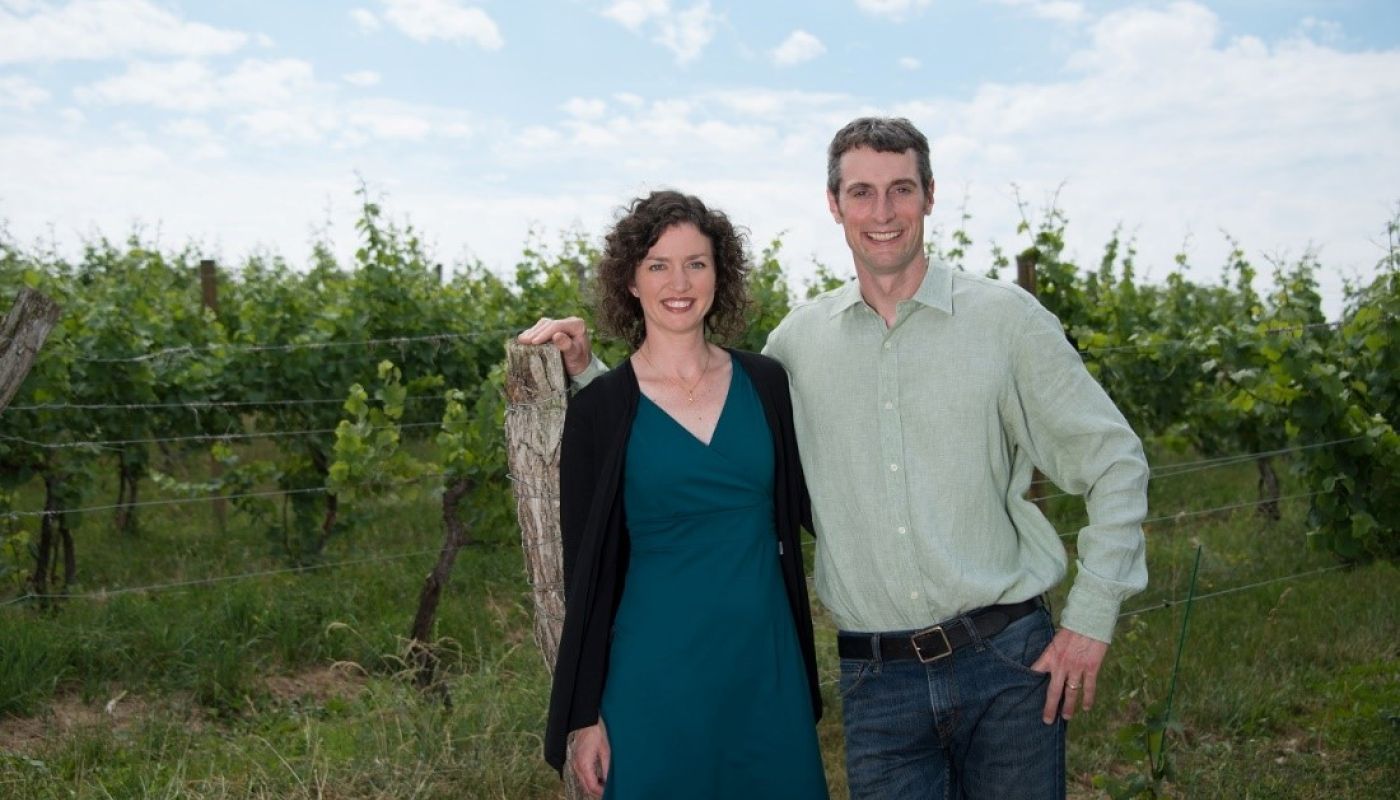
Silver Thread Vineyard sits on the eastern shore of Seneca Lake, in the Finger Lakes region of New York State. The 8 acres of vines start only 200 feet back from the lake, at 100 to 200 feet of elevation above the water. The westward facing slope soaks up the afternoon sun and the shallow soils of silt loam over shale and limestone encourage the roots to dig deep. The lake provides a cooling effect in the summer and frost protection in the winter and spring. It is here in this favorable site that Shannon and Paul Brock decided to make sustainable Finger Lakes wine.
One of the first things you notice when you meet Shannon and Paul is that they like to talk about their work. This is understandable since they are both wine educators. Paul has an MS in Enology and Viticulture from Cornell University, and is an Associate Professor of Viticulture and Wine Technology at Finger Lakes Community College (FLCC). Shannon holds the WSET diploma and is a certified wine educator, who has taught WSET classes through level 3. They both believe in the scientific method, yet they also hold a deep respect for the natural world. The Silver Thread labels feature a Native American drawing of a turtle, an earth symbol that the website declares ‘reminds us to care for the land and water that give us the gift of wine’.
The Brocks purchased Silver Thread in 2011 and from the beginning Paul and Shannon were determined to run the vineyard and winery sustainably. Shannon had been interested in environmental causes from an early age and Paul believed that modern farming had lost its way. They were both aware of the consensus in the Finger Lakes that it was not possible to grow vinifera grapes organically in the region, but they set their sights on coming as close as possible. They wanted sustainability to be important in all aspects of their business. As Shannon says, ‘sustainability is a mindset’.
Silver Thread has a current production of about 3,000 cases annually. Paul is the winemaker and vineyard manager, Shannon is the business manager, as well as the tasting room and wine club manager. They have five employees, four part time and one full time. Shannon and Paul believe in paying their employees a living wage, which is substantially above the industry average. Their full-time employee has health insurance through the winery. Shannon would work with any part-time employee that needed coverage. The local community is important to Shannon and Paul, and they work hard to make themselves a part of it. They hold a fundraiser each year, Good Earth Day, to support the local food pantry. They also donate to the local library, the United Way, FLCC, a museum and science center, a scholarship fund, and numerous environmental programs. They care deeply about their employees and the community and believe, as Shannon says, that ‘if you really can’t afford to pay your employees a living wage you are doing something wrong’. They are concerned for their own family as well and, though they have considered adding space to the tasting room/winery, they’ve agreed that a limit of 5,000 cases annually would allow for growth and still give them adequate time for a rewarding family life.
Paul believes that healthy soil is paramount to growing quality grapes sustainably. He explains that for the soil to be healthy it must have a diverse population of beneficial microorganisms. His vineyard practices are geared towards maintaining a more natural ecosystem, and use elements from organic, biodynamic and ancient farming, a system the Brocks refer to as ‘biointensive’. A low growing cover crop enables Paul to be completely spray-free for weeds. He also tries to be 100% organic with insect control, using highly targeted chemical sprays only if the entire crop is endangered. He is willing to put up with a certain population of pests, confident in the healthy vines’ ability to survive. Natural teas, made from local flora, are sprayed on the vineyard. Paul and Shannon recently introduced a small flock of chickens for insect control. The chickens have the added benefit of providing fertilizer, and they have even been known to make appearances on webcasts. The clients love them.
When winemakers in the region ridicule the notion of organic grape growing, fungal diseases are what they have in mind. Paul uses a systemic approach to the problem. First and foremost, he maintains the soil, and thus the vines, in the best possible health, believing that healthy vines carry an increased resistance to disease. Next is canopy management. The vines are VSP trained and leaf pulling in the fruiting zone is done to keep the fruit exposed and dry. Netting is used to keep birds and other pests from damaging the fruit. If disease pressure is too high for these procedures to work, Paul will use a biological spray first, then an organic spray such as copper or sulfur. As with insect pests, he uses chemical sprays only as a last attempt to save the crop. The pledge on Silver Thread’s website vows to always use the most targeted and biodegradable sprays possible.
This desire to be as sustainable as possible carries into the winery as well. The winemaking at Silver Thread is modeled on an ideal of ‘no intervention’. Paul believes that if the grapes are healthy and ripe there should be no reason to manipulate the wine. He does not adjust acid, sugar or tannin levels. No animal products are used; therefore, the wines are vegan. No new oak is used, and sulfites are added to only minimum necessary levels. The winery is built into a hillside, allowing natural temperature control and gravity flow. The wines are bottled in lightweight glass (30% lighter than industry average) and sealed with natural, technical cork. All packing is recyclable and, when wine is shipped, the winery buys carbon offsets. The goal is to be a Zero Waste Company, meaning any waste produced is composted, reused, or recycled. Solar panels were installed in 2015 and the winery is a net energy producer. They have been recognized by the New York State Agricultural Environmental Management program as a ‘Lake-Friendly Farmer’ for best practices in soil management and pesticide use and storage.
As is true of most of the world’s businesses, the stability and health of Silver Thread have been tested in the last six months by the COVID-19 pandemic. Most of their wine had been sold through the tasting room. These DTC sales are much more profitable than selling through a distributor, and they disappeared overnight when the winery was forced to stop on-site tastings. Shannon and Paul did what any good business owners would do; they considered how to turn weaknesses and threats into strengths and opportunities. They already had a social media presence and they used Facebook and email to reach out to clients and wine club members. They started hosting virtual tastings on Facebook and found that their audience grew quickly. They developed a much larger following than they had ever been able to reach in person. They began offering coordinated tasting packs that could be purchased and shipped, or picked up curbside. They even held a ‘Riesling Expert’ series of four tastings with a certificate awarded to anyone that participated in all sessions. Most of the tastings offered a prize drawing of Silver Thread merchandise. All wines tasted were offered for sale in discounted packs with reduced shipping costs. Shannon says that their community grew to include people from all over the U.S. that needed social interaction during the quarantine. Amazingly, these online sessions were so successful that the winery’s sales for the first three months of quarantine were greater than for the same period in 2019. The Brocks felt the need to offset the taxes lost in shipping to other states, and so increased their local charitable donations.
Shannon says many of the new requirements ‘play to their strengths’. Reservations are required for tastings now in order to maintain social distancing, which limits the number of people that can be seen daily. She claims that this has not been an issue. The winery is small, after all, and has never allowed limos or tour buses. They have always felt that a more intimate setting allows them to showcase their wines and better educate their clients. Shannon and Paul plan to continue the virtual tastings at some level and keep many of the new winery procedures in place even after the mandated guidelines are lifted.
During my interview with the Brocks, I offered them the opportunity to comment on the current social unrest and lack of diversity in the wine business. Like most of us, they find the issues both disturbing and difficult to solve. Shannon and Paul feel that the ultimate answer lies in education. The high school in the nearby city of Geneva, which has a large Black and Latino population, has started an agricultural program for students, which Paul participates in. Shannon likens the lack of diversity to the historic low numbers of women in the business. She is on the board of the Finger Lakes Wine Alliance and, as head of the membership committee, has increased the number of women on the board from 8% to 25%, with a goal of 50%. Paul and Shannon’s consensus is that we need mentors and educators to encourage minority students to consider wine as a career. Both believe that a more diverse wine drinking public can only do the industry good. It is impossible to listen to them talk about diversity being necessary for a healthy society and not draw a parallel to their ideas about a healthy, diverse soil. I will give Shannon the last word on this difficult subject as she exclaims ‘I hate the idea that we’re excluding people’!
So, what is a sustainable winery and how are Paul and Shannon Brock achieving one at Silver Thread Vineyard? My wife and I have been visiting Silver Thread for many years now and, if we go to the tasting room tomorrow, we will likely be greeted by Janice, the same employee we met on our first visit. Happy, long-term employees are a sure sign that a business is doing something right. When I walk the vineyard, I see flourishing vines and a rich diversity of insects and wildlife, including birds and pollinators. The pond that collects vineyard runoff is full of indicator species like frogs and newts. The biointensive practices used at Silver Thread are working well. The place is alive and diverse, an ideal microcosm of what our society could and should be.
Of course, none of this would matter if the wines weren’t great. I can assure you that they are excellent, truly among the absolute best wines produced in the Finger Lakes, and that is very good indeed. Silver Thread’s wines have been lauded and highly scored by many top tiered publications such as Wine Spectator, Wine Advocate, and Vinous. Shannon and Paul dwell on all the little things that come together to make interesting, natural wines, and they are doing it in a sustainable manner. The Brocks are using their vision to set the standard for sustainable wine growing in the Finger Lakes. Recognizing their efforts will encourage other producers to follow their example and improve Finger Lakes wine and the region overall.