Have you ever heard of Slovenia? That is the question I often ask over a glass of wine when I am somewhere abroad. There are still quite a few people who have not heard about Slovenia, and even if they did some of them do not know that Slovenia is a wine country. We are often overshadowed by more popular Italy on one side, and Hungary on the other. Slovenia is smaller in size than some major cities, with a population of only 2 million. This small size is an advantage and that is why we are often found in the headlines when mentioning the preservation of natural beauty, biodiversity and sustainable development. We are ecologically aware and advocate sustainable development. Slovenia was recognized as the most sustainable country in the world in 2017 by National Geographic and Ljubljana, the capital, held the title of Green Capital of Europe in 2016.
What exactly is sustainability? Sustainability is a broad term for which there is no single definition. If sustainability is defined as the ability to maintain the balance of certain systems or processes, then a definition of sustainable development would be the ability to meet our needs in the present without compromising the ability of future generations to meet their own needs.
Radovan Šuman, from Šuman Wines, is a fine example of the Slovenian approach and mentality when it comes to sustainability. He is a biodynamic winemaker with Demeter certificate located in the northeastern part of Slovenia in the Podravje wine region. He is one of the ‘Four Musketeers’, as likeminded winemakers called themselves in that area with the others being Urbajs, Zorjan and Šumenjak and certainly one of those unusual winemakers in Slovenia who has taken wines to an extraordinary level by using biodynamic principles. When I called him to arrange a visit, he asked me if I was familiar with his wines. He turns down anyone who does not appreciate biodynamic wines not out of arrogance, but instead he notes he is not trying to convince people otherwise because they simply would not understand such wines.
The main advantage of visiting small wineries here in Slovenia is that the winemaker is the one who shows you around and conducts a tasting. Regardless of the fact that I have visited quite a few of them, the different winemaker’s knowledge and devotion to their craft continually engrave a dramatic impression of their passion and appreciation of their products.
When I visited Šuman Wines, a wine expert who was creating a new wine list for the restaurant of a boutique hotel which built its reputation on sustainable development, also joined us. Therefore, only Slovenian wine producers who follow sustainable principles in winemaking will be added on the new wine list. There will be around 150 different wines on that list, which is an impressive number considering the country’ size, proving the importance and prevalence of sustainability in our culture.
For Radovan Šuman the product produced is more important than the presentation. The concept of substance rather than profit is a direct reflection of Radovan’s modest and unpretentious character. He sees himself as a wine farmer, not a winemaker. The slogan of Šuman Wines is Earth – Vine – Wine. He says that he is not trying to influence nature but instead co-habitat in partnership with his environment. Everything begins with the soil, continues in the vine and ends up as a wine in a bottle. Therefore, it is not surprising that the tour of the winery begins in the vineyard by Radovan lifting and turning over some soil with a digging fork. The layer of soil underneath the grass is almost black, very rich, humusy, and full of living organisms. An integral task of the wine farmer is to revitalize and nurture the soil. The goal in the vineyard is to establish such an ecosystem that will be able to regulate its biorhythm independently. Radovan further explains ‘If everything is in balance in our body, we are healthy. If that balance is broken, we get sick. The same is also true for vineyards. In the event there are many pests in the vineyard, there must also be plenty of their natural enemies to consume those pests.’
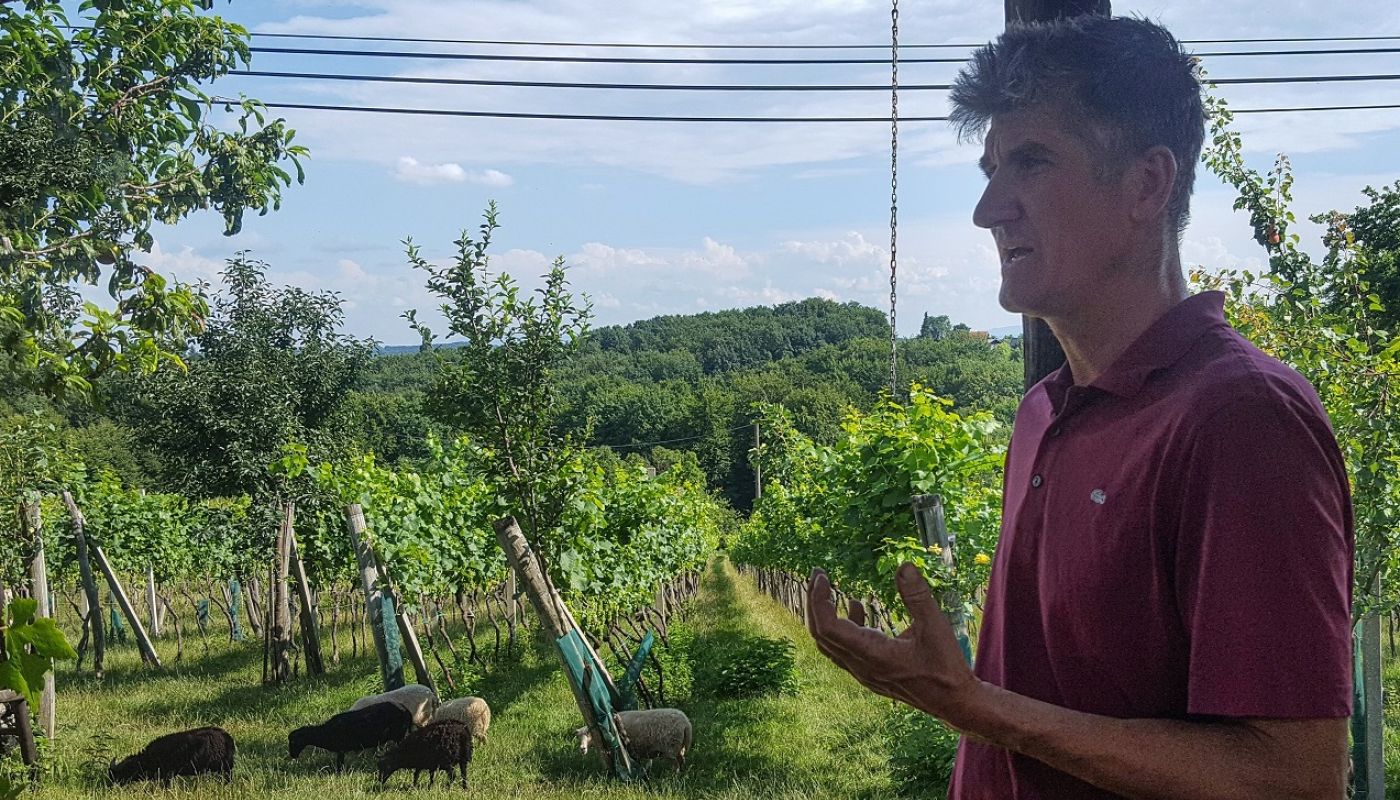
That is why a true biodynamic vineyard cannot exist without animals. Sheep roam freely in the vineyard greeting us curiously upon our arrival and then continuing with their work. Radovan tells us that they are his co-workers, efficiently pruning the vines. He knows exactly how many sheep he needs per hectare of the vineyard to keep this little ecosystem of his in balance. He says that if sheep need to choose between the grass and the vine, they will always choose the vine and is comfortable knowing they only eat the excess leaves and not the grapes. As a result, Radovan has less work in the vineyards although he and his wife still undertake most of the work on their 7 hectares of vineyards. Of course, he too needs workers for harvests when required. But instead of needing to mulch seven times, he mulches only twice. Radovan has reduced the use of the tractor in the vineyard to a minimum. By doing so he is not only reducing carbon emissions, but he also manages to keep the soil lighter with the lack of added mechanical stress. In addition to sheep, poultry and birds are also present in the vineyard. The chickens feed on insects and he sets up hatcheries in the vineyards to attract birds which can also eat their share of insects. He keeps bees because of their pollination and manufacturing of beeswax. In the vineyards he only uses his home-made preparations from his biodynamic ‘pharmacy’ which are, among other things, composed of herbs planted in the vineyards.
It is only after his explanation of what healthy soil is, and why biodiversity, that we are invited to the winery. In his wine cellar, he says, that all requirements needed for a biodynamic certificate are just minimum standards for him. ‘For me, biodynamic means not only the absence of toxins but also the presence of life. Grapes must be healthy, as this is the only way to preserve the life created by nature. We maintained and encouraged this in the vineyard.’ He tries to produce wine in the cellar with as little manipulation as possible. All grapes (white and red) are macerated, with the exception of the ones with botrytis. Wines are made with wild yeasts and after pressing the wines are left maturing for a minimum of 2 years in used wooden barrels. The wines are handled gently without using pumps when bottling, just gravity. No filtration and fining or addition of sulphur is allowed during the process. In keeping with Radovan’s ideas, he strives to reuse all waste material. One is permitted to enter the room where he stores his biodynamic preparations without mobile phones, as the radiation could affect his preparations. In a small room, jars for his preparations are made from used wine barrels. He does not forget to use the other 'waste' of wine production – grape seeds. He makes grapeseed oil, which is treated to coat barrels. He uses beeswax instead of foil on bottles and says it is as healthy as wine and can be eaten. When we were tasting wines he notes ‘I can produce live wines only from grapes, which are healthy because nature has already given them everything they need on their way.’
And oh wow what wines! The aromas are much more extensive, the flavors more intense and vibrant. ‘For me, this is the only true reflection of terroir,’ he says and yes, we all agree on that. Less is often more.
Radovan Šuman is certainly maintaining the balance in his little ecosystem, preserving natural habitat and encouraging wildlife, taking from it only what he needs to produce extraordinary Šuman wines. His wines are like a symbol of Slovenian mentality, a respect for our environment and traditions. This is what we have been doing for generations and it will go on with future generations. This is our mindset.
















