It is hard to believe that Colomé exists, even when you arrive there. Equally hard to believe it was not a wild swerve of your imagination, once you have gone away. Argentina is vast, the eighth largest country on earth. Salta, the northwestern province abutting Bolivia and Chile, is bounded by the Atacama desert to the north and east and the High Andes to the west. By latitude it is in the tropical zone, but its high altitude allows some of its green valleys to grow fine grapes. To suggest it is a long way from anywhere is the acme of understatement. Argentinians say Salta is “where the Devil left his poncho”. If so, Colomé may be where his hat blew away.
Current owner Donald Hess spent two years trying to get there after he first tasted an old bottle of Colomé malbec in a restaurant and recognised the uncut diamond he had been searching for. He tried to go right away, but floods had washed away the road near Molinos and in Salta repairs are not hurried. Even after his first expedition to the vineyard it was another three years before he succeeded in buying the place.
It had no electricity supply, no running water, no telephone signal, no modern winery, was untouched by chemicals. What it had was a literally breath-taking location (thanks to the 7,500 foot elevation), Andean snow-melt for irrigation, ancient complex soil, a diurnal temperature range of twenty degrees, a remarkable absence of pests and a year-round blue sky. Oh, and some of the oldest ungrafted malbec and cabernet sauvignon vines in Argentina.
A small adobe building in the estancia’s front yard is thought to be the oldest winery in South America. It was built in 1831 by Nicolás Severo de Isasmendi y Echalar, an Argentine by birth but a Spanish nobleman by blood and upbringing. In 1809 he became the last governor of Salta province appointed by the King in Spain. It was not to be a long reign. He was defenestrated following the Cinco de Mayo revolution in 1810. After independence, Severo de Isasmendi retrenched to his vast family estate in the mountains. Politics behind him, he married a woman forty years his junior and started a family.
On my first visit to Colomé in 2009, the viticulturist showed us a row of monumental black vines, more petrified forest than living plants, which he said were thought to be the original ones planted by Severo de Isasmendi in the 1830s: probably Pais, also known as Mission, the first grapevines brought to the Americas with the conquistadors, cultivated for sacramental wine by monks and missionaries in Mexico and all points south.
But the oldest verifiable vines in the Colomé vineyards were planted by Nicolás’s daughter, Ascensión. Ascensión was born at Colomé and her father bequeathed her the hacienda as a dowry. In 1850 she married José Benjamin Dávalos, a lawyer from Salta. While he was embroiled in cases surrounding the new Argentinian constitution, she set about bearing children (five, at a steady annual rate) and improving her father’s vineyard. Estate records show that in 1853 she ordered French malbec and cabernet sauvignon vines.
1853 was a foundational year for malbec in Argentina. Domingo Faustino Sarmiento, a future president but then in exile in Chile, urged his friends in Mendoza to campaign for a Quinta Normal, an institute dedicated to improving Argentinian agriculture. On 17th April 1853, the state government approved the proposal and invited Michel Aimé Pouget, the French viticulturist who had already imported French vine seedlings to Chile, to bring cuttings over the Andes by mule to Mendoza and run the new school. 17th April is now celebrated as World Malbec Day. Maybe Doña Ascensión’s new vines came direct from Bordeaux, as I was told, or maybe she was one of the Quinta Normal’s early adopters. Either way the young plants had quite a journey. Colomé lies over eleven hundred kilometres even from Mendoza.
The journey is epic by twenty-first century means, let alone by mule. The first time I made it, I had no idea where I was going. Colomé was simply one name on a hectic itinerary. After a morning visiting wineries in Cafayate, five of us piled with our bags into an old yellow mini-bus, a random crew of young sommeliers, restaurateurs and a journalist assembled by Wines of Argentina.
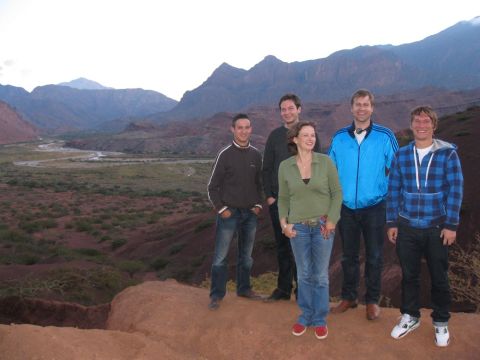
Like most wine trips, it was a whistle-stop affair. Nine wineries a day, with many samples to taste and discuss, and lunches and dinners to follow. Colomé, though we didn’t know it yet, was our reward. As we pulled out of Cafayate, our driver, a droll Amerindian named Yaco, warned us we had a three hour drive ahead, and we slumped in our seats, ready for post-tasting, post-prandial naps. But as we left the last signs of human habitation behind, we passed instead into the most dramatic, extraordinary landscape. No one was sleeping. The road wound through canyons between towering cliffs of ancient folded rock: staggering red sandstones and deep green shales. With the Calchaquí river winding beside us, it was like driving through a museum cross-section illustrating how the earth was formed. After about an hour we pulled over at a spot with an unforgettable view of the curving silver river, range after range of mountains serried beyond. We opened our water bottles and Yaco tipped a splash onto the ground. “Pachamama” he murmured. We stared at him. “Giving it back,” he said. “To mother earth.” Feeling unutterably out of place, we took our photographs and climbed back on the bus.
The dirt road ground on along the rocky valley between the implausible cliffs. It was perfect ambush country, straight out of the old Westerns I used to watch on Saturday afternoons. Surely just a matter of time before a band of piebald ponies appeared along the top of the arroyo and a war party of Comanches swept down on our mini-bus.
After another half-hour, we passed into an even stranger country. “Quebrada de los Flechas” shouted our affable guide, over the noise of the labouring engine and the tyres slapping the rutted road. “Flechas. Arrows.” I looked up nervously, along the heights, before I realised he meant the bizarre grey rock formations, fields of jagged, almost triangular rocks that did resemble a tray of prepared arrowheads. My imagination shifted from Westerns to alien worlds. George Lucas’s location scout missed a trick.
We jolted on through empty country, passing no settlements, no one on the road. It was increasingly hard to believe that anything lay ahead, certainly nothing so lush and complex as a vineyard. Three hours were becoming four and dusk fell fast. Ahead, far off to the right, someone spotted a light. As the road wound, it moved to the left, then disappeared, then reappeared again, on the right. Finally, we entered a small silent town, the whitewashed walls looming out of the darkness, cramped, oppressive after the expanses we had crossed. But it seemed we weren’t stopping there and were soon back in empty country, the will o’ the wisp light dancing ahead, the road rougher than ever.
Another twenty minutes passed, and I had given up hope of being heard of again by those who love me, when the bus pulled into a courtyard in front of a subtly up-lit wooden doorway. We had arrived.
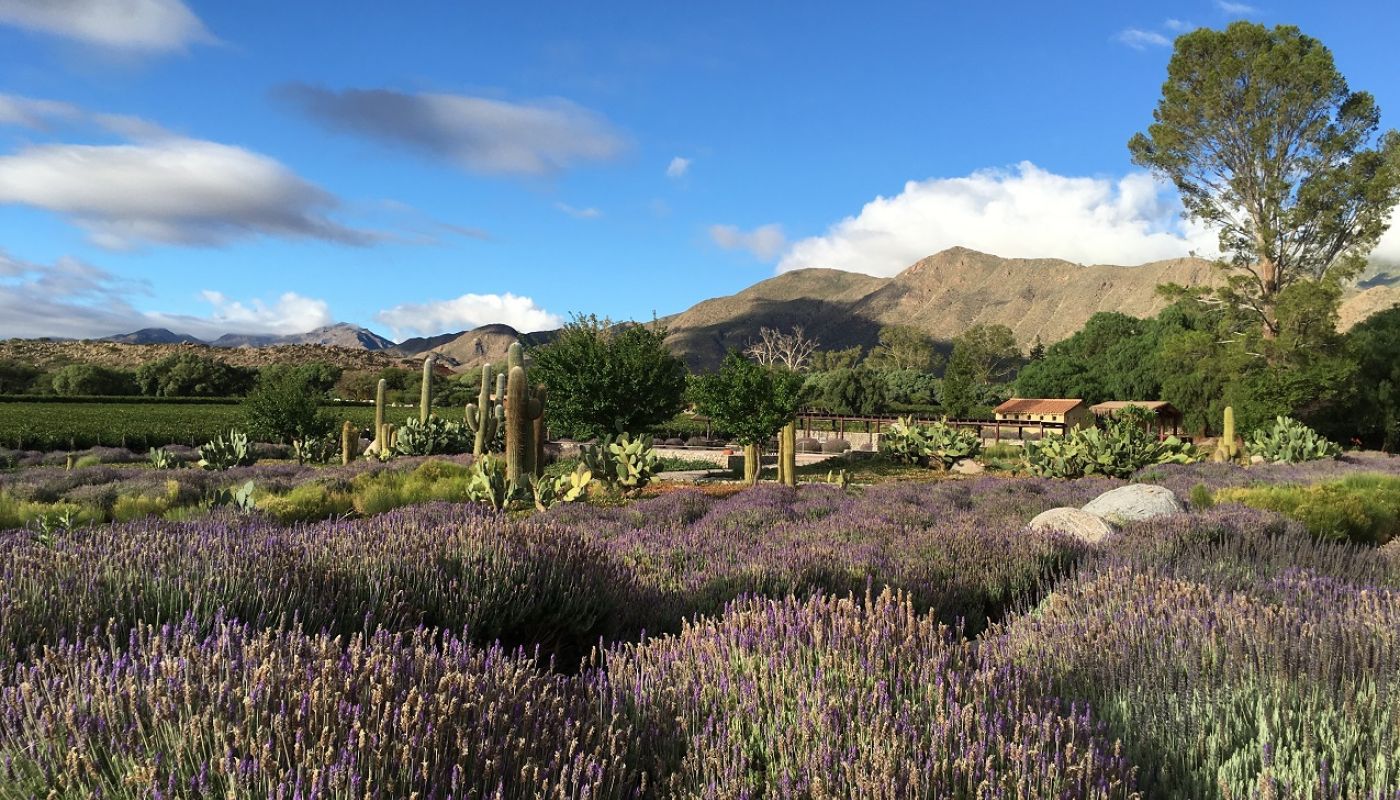
Behind the doorway was a quiet quadrangle with an open courtyard and the sound of flowing water. We showered, drank a cold beer, introduced ourselves to our hosts, ate dinner, listened to the winemaker’s story of having been invited for lunch by Donald Hess while on a back-packing trip and almost destroying his tiny hire car on the road. We slept in cool, pressed sheets and opened the shutters next morning onto an unimaginably beautiful foreground of towering cacti underplanted with lavender and a backdrop of mountains.
Donald Hess is a collector, of vineyards and art, but there is a strong sense that the Swiss is not an absentee owner, but one who leaves reluctantly a place with which he has fallen in love. From 2001, he and his wife Ursula spent over six years at Colomé, building a house, a winery, a hydro-electric plant, a church and school for the four hundred people they found living on the property, planting new vineyards, introducing biodynamic techniques, driving to Molinos to make phone calls to their family and the outside world. Thibaut Delmotte, the young French wine-maker who came for lunch in 2005, is still there in 2021. Colomé may be difficult to reach. It is at least as hard to leave.
Seven years after my first visit, I was astounded to have the chance to visit a second time. The opportunity to see how things had changed in Argentina since my intense week of Malbec immersion was compelling enough. (The short answer was that the wines had leapt forward. Winemakers still experimenting with style and technique in 2009 had really found their feet by 2016.) So Colomé wasn’t the reason I said yes, but it was the reason I didn’t pull out when I was laid low with pleurisy a month before the trip. I convinced myself I was better. After four flights in three days, it was clear I’d been optimistic. Back home, I would be diagnosed with pneumonia. My GP laughed at me when I confessed I’d just driven through the Andes.
This time we approached Colomé not via the canyonlands from the south but driving west across the Atacama desert from Salta City. I was disappointed to miss the ochre cliffs, but the tall solitary cacti of the Parque Nacional Los Cardones are almost as spectacular, as are the switchbacks through the mountains. By the time we reached Piedra del Molino at over eleven thousand feet all views had disappeared. The clouds hissed under the wheels of the export manager’s pick-up. I lay in the back, fighting to breathe, wondering if it was possible to cough up a lung. I’d always said I wanted to see Colomé again before I died. I hadn’t intended the two events to be so close-knit. Arrival was a blur. I went straight to bed. But next morning I opened the shutters on that heart-stopping view, and felt I could stay forever.
Doña Ascensión Isasmendi de Dávalos almost managed it. She lived to ninety-three and died, in 1910, in the valley where she was born. Forty-four years earlier her husband, like her father, had become Governor of Salta, though democratically elected rather than appointed by a distant empire. Unfortunately, his administration lasted no longer than his father-in-law’s. He died in office on his fiftieth birthday in 1867. Despite this blow, Doña Ascensión endured on her remote estate, winning a gold medal for her wines at Argentina’s Exposición Nacional in 1871, and ensuring they were among the first exported to Europe.
Her gold medal hangs in a Salta museum, but Doña Ascensión’s living legacy is the juice that still flows each vintage from the vines she planted in 1854. Colomé 1831 Estate Malbec is made from it. Her vines yield small bunches, skins thickened against the fierce high-altitude UV radiation, ensuring structured tannins and intense colour. But the cool nights let them ripen slowly, retaining freshness and acidity. Gentle vinification using indigenous yeasts allows the fruit to express its unique origin. Colomé is recognised as one of Argentina’s “first growths” in Tim Atkin’s annual classification.
Martin Luther wrote: “Even if I knew that tomorrow the world would go to pieces, I would still plant my apple tree.” We owe a debt to those, like Doña Ascensión, like Donald Hess, who plant despite a world eternally threatening to go to pieces. Thanks to them both, with a swirl, a sniff, a sip, we can enjoy a twenty-first century wine in which a visionary woman born over two hundred years ago still has a hand.
The photos were provided by Jo Eames.
















