If you want to understand your inclination towards making old vines, think about living with a healthy elderly person under the same roof. It’s as simple as that.
In a certain sense old vines are just like old people: they need more patience, they do not respond well to changes, they get slow, but, still, they produce the best fruit (or make the best cakes).
Therefore, yes: growing old vines is a bold decision, requiring bold personalities.
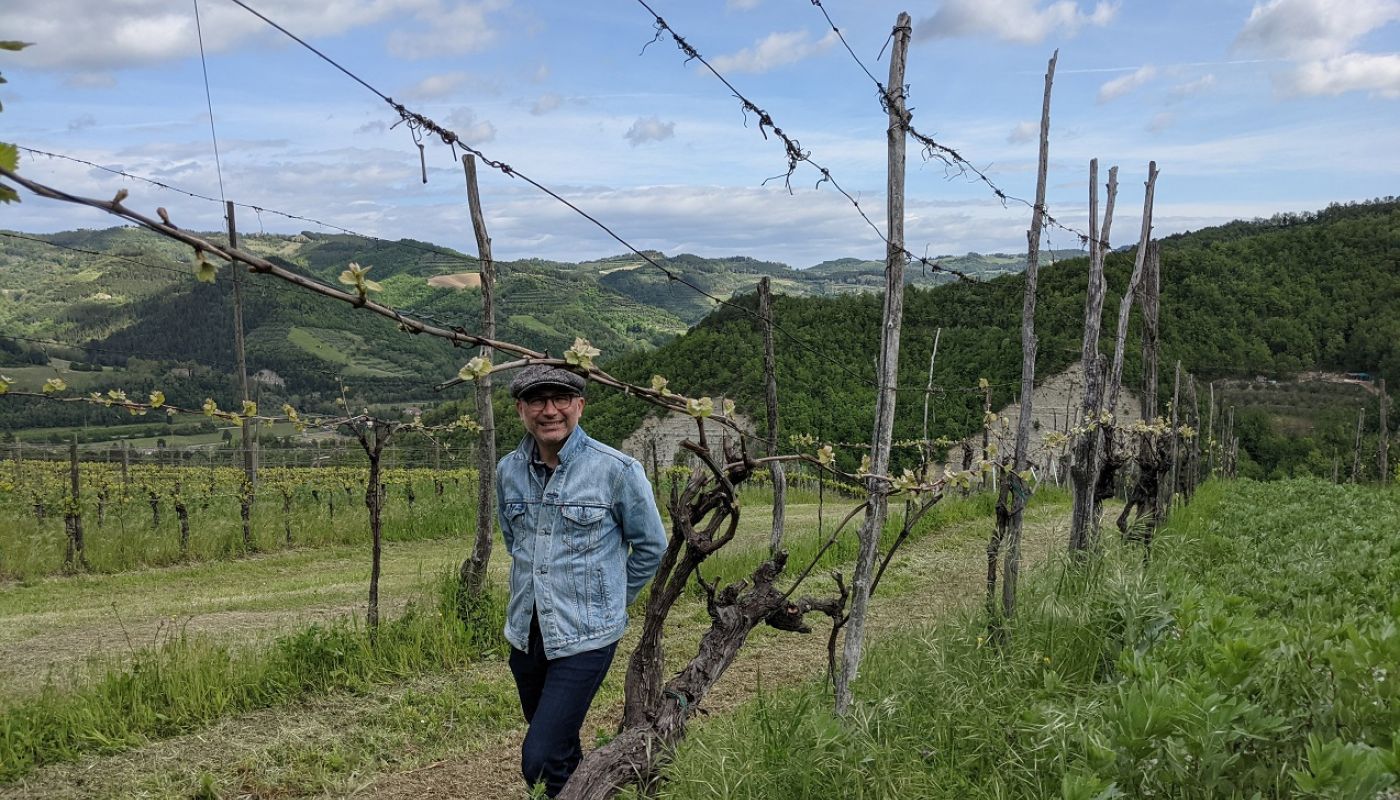
Stefano Bariani (pictured above), owner of Fondo San Giuseppe, is a bold man. A “Romagnolo”, who left his first wine-related job as personal assistant of Angelo Gaja to make wine in an unknown Italian wine-growing region: Romagna, his home.
The piece of land of his dreams, which he acquired in 2008, lies at 400 meters above sea level, with north-facing slopes and some grapevines planted in 1973 and 1993, so it is safe to say that he knows his way around old vines. The beauty of this fact is that he still makes wine from the same plants and has no plans to replace them in the near future.
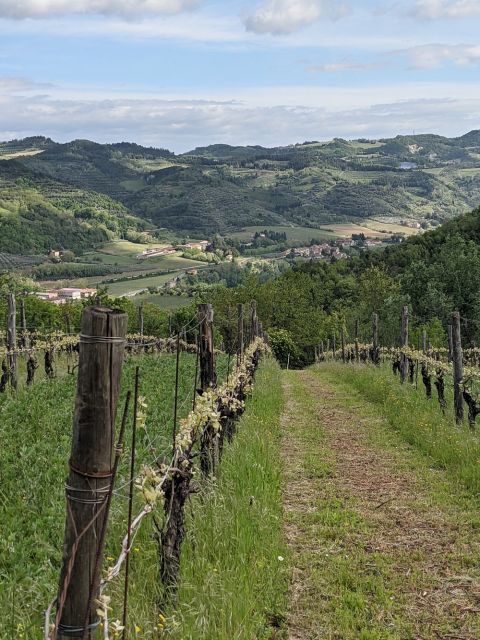
The vineyard would be interesting even without its old vines, since the 5-hectare land is surrounded by 11 hectares of forest. This – according to the owner – might be the very reason why the grapevines are living happily well over their expected productive lifecycle.
A natural forest is in balance. It keeps itself in balance, supporting life. According to Stefano, biodiversity is the main reason that devastating diseases and harmful insects are so rare in his vineyards. Nature has created a balance for itself, which man does not need to adjust, only understand, and support. To grow life, you need biodiversity – stresses Stefano multiple times during our walk.
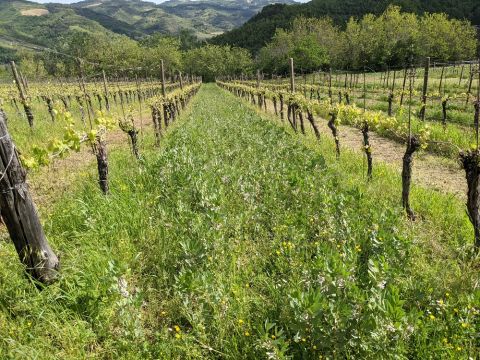
Biodiversity in the vineyard translates, for example, into keeping cover crop among the rows, to ensure that the grape gets enough nutrients from the soil. If the soil loses biodiversity, it loses its natural nutrients too. Without natural nutrients, humification and, by extension, life stops.
What is humification? It is the process of the generation of humus. Humus is the perfectly unified soil organic matter decomposed by microorganisms into inorganic minerals. These minerals are absorbed through the roots and nurture the grapevine – and every other plant in the soil. This process is called mineralization.
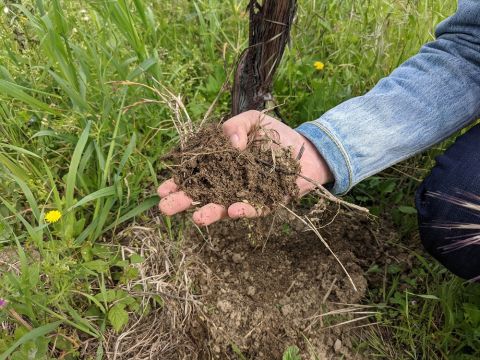
Some of the organic matter that has not decomposed transforms into organic polymers, resistant to the action of mineralization. These polymers are stable and constitute humus. Their stability will be part of the soil, improving it.
Although the continuous research for substituting humification with manmade products is at an advanced stage, we must not forget that the full composition of the humus is still an active field of study; make no mistake: we cannot produce what we do not know. While industrial fertilizers and industrial humus would certainly speed up growth, they just are not the real deal.
One of the grape varieties from 1973 in Fondo San Giuseppe is a local variety, called Albana. It lives with field beans between the rows. This cover crop, used already by the Romans, is efficient also because field beans release more nitrogen into the soil than they take, improve soil texture, suppress weeds, attract pollinators and, when cut down yearly, they provide the degrading vegetation that will keep humification active.
This Albana from 1973 together with the plantation from 1993 is used to make “Fiorile”, one of the flagship wines of Fondo San Giuseppe.

In 2021, though, Stefano had to make another bold choice: since he needed wine to sell, he bottled the juice of the older vines in March, separately.
The wine was made in the same natural way as any other vintage. It fermented naturally, without selected yeasts. Half of it was macerated in steel tanks, half in big barrels, called “tonneaux”, for six months. Then it got bottled. The wine, its colour or its marked acidity have not been altered in any way.
The difference between this year’s old-vine wines and the younger wine – from 1993 – two months later is palpable, even to untrained palates:
“The wine made from the old Albana transforms sugar better, leading to a higher alcohol content; it has more polyphenols, more flavour, more of everything. Obviously, the plants have developed a better process of transforming water, mineral salts, CO2 and sunlight than young plants.”
Still, Fondo San Giuseppe has not conceived a campaign to sell it differently. The price and label are the same; customers won’t even know that this is something special, if they don’t pay attention to the lot number on the label.
Fiorile usually is made from grapevines of two different ages: the ones from 1973 and those from 1993. The class of ‘73 grows on one hectare of land, yielding around 4000 kilograms. This is considered half of a standard yield. Old vines tend to naturally have a diminished production capacity; here this is also the result of planting density, another important factor, which, according to the owner, also contributes to the plants’ long life.
Planting density is, economically speaking, an especially important marker of every vineyard. More plants mean more wine, leading to more money. There are also suggestions that higher planting density forces the plants to compete for subsurface water and this stress diverts the plants’ energy from growing leaves to growing grapes, so again: more fruit, more money.
Back in 1973, though, the winemakers of Romagna knew nothing about planting density. There was – and still is – no wine academy in this region, like there is in Bordeaux or Piedmont; people just wanted to make good wine and, since they knew that Albana is a very vigorous variety, they allowed it to “breathe”.
These plants are like extroverts, says Stefano; if you keep them in a corner, they will live badly, get stressed and will not express themselves. They have huge shoots that need space to develop.
Planting density is, therefore, understood very differently here: to keep the vines happy there are about 2,5 meters between plants and about 3 meters between the rows. The distance between the plants is meant to allow them to grow, while the distance between the rows aims to allow the use of the traditional pergola Romagnola training system.
The pergola Romagnola consists of a series of vertically planted poles between rows supporting a horizontal roof, along which the plants can grow. It helps the vertical development of this almost uncontrollable variety (today the plants are trained on a more modern double-guyot system to avoid a huge disadvantage of the traditional system: letting too many bunches grow on a single plant, which leads to diluted juice and flavours.)
Caring for old and new vines is remarkably similar in Fondo San Giuseppe. The only big difference is pruning.
Old plants don’t like to be pruned. Change upsets them and they might even die from it: the goal is to keep cuts to the bare minimum, since every cut is a potential entryway for diseases, which might be fatal.
Stefano thinks and talks about old vines in a caring and understanding way:
“Why are old vines working better? Maybe because they have a deeper root system and because the remaining plants have more efficient mechanisms.
It barely needs to be said: old vines produce generally less fruit and, by producing less, they concentrate substances better. Because young plants are very vegetative, they produce a lot of leaves and are orientated towards growth. Paradoxically, an old plantation knows that its days are numbered, so it is much more orientated towards reproduction. That means that it must produce grapes to produce seeds and the grapes must be qualitatively better, because they need to nurture that all-important seed. The plant is orientated towards reproduction and the propagation of the species, just like humans. It knows that, by being efficient, it will help propagate the species. So, as it approaches the end of its life, it produces a better-quality grape with better-quality seeds.”
Maybe the plants repay this love by staying alive for so many years.
The photos are provided by Hajnalka Kis.
















