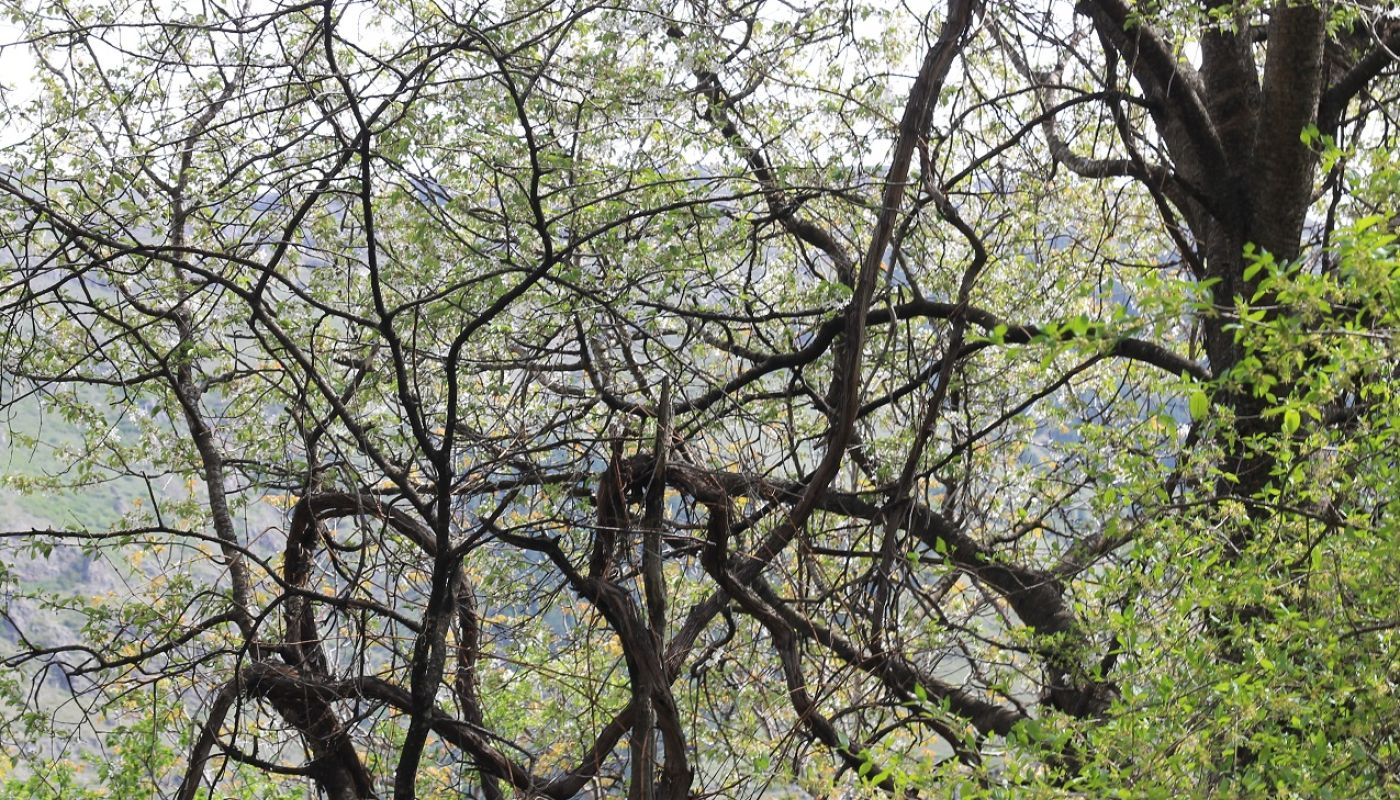
In 2015, I first became acquainted with Giorgi Natenadze when I insisted on meeting him after a friend in Tbilisi told me about this crazy grape-hunter she knew who made wine from Tskhenisdzudzu tetra grapes from 400-year-old vines. At this time, I was trying to meet as many winemakers as possible who might be interested in hosting the food and wine enthusiasts I planned to bring to Georgia through my wine and food tour business, Taste Georgia. I started my company in 2014, and it was the perfect time to be working with wine, in some capacity, in Georgia. Georgian wine had made waves in the wine world, thanks to writers like Alice Feiring and Simon Woolf (and their passion for this seemingly new category of amber wines) as well as MW Isabel Legeron, who made a film about qvevri wine and MWs Sarah Abbot and Lisa Granik, who have both been essential in promoting Georgian wine in the UK and US. Georgia was on track to be the next big thing in wine. For me, this meant people might be interested in visiting and meeting the passionate winemakers and having a chance to taste history.
At this time, most of my clients were booking full-day tours to Kakheti, which is Georgia's largest and most important wine region. I was interested in taking people to more isolated places, where history, wine and food merge into one thing. I didn't want to offer the same wine tours everyone else was offering. Since I have been in this business, my goal has always been to amplify small producers with vision. These small producers may not be on grocery store shelves yet, but I genuinely believe that I can offer once-in-a-lifetime experiences that larger producers can’t. It's not out of unwillingness -it is simply because they use hired help to guide their tours and the tours are the same for everyone. My first experiences in Georgia were so unique to me, because they came out of spontaneity; e.g., random visits that turned into an evening of song and dance. I suppose what I am saying is I want my guests to experience "real" Georgia. Not a scripted experience. Besides the experience, I hope that by bringing guests around to smaller, more obscure producers, the families and people who host us will also benefit financially. When they recall what a wonderful experience they had with a family, our guests could become our ambassadors.
Giorgi Natenadze is a lot of people in one person. With his outdoor clothes and thick hiking boots, he often looks like he is on safari. He has a passion for his region of Meskheti, which borders Turkey. He has been studying the region's wine history since he was a teenager. He spent a lot of his free time hiking up mountains and cutting through forests, searching for lost historic varieties with a goal and a dream to rebuild the landmark terraces that were once a common feature across the area. Viticulture and winemaking were almost completely lost to history due to invasions from Msekheti’s neighbors. They were either torn up or left abandoned. Giorgi was obsessed by the idea of reclaiming the past, when the cave city of Vardzia was prized for its wines, and winemaking was one of the most important productions.
During my first visit, my ultimate goal was to meet this young winemaker and visit these ancient vines I had heard about. Unfortunately, that did not pan out, but I did meet with Giorgi when he had just returned from an expedition of grape hunting, and he believed he may have discovered 3 new, lost varieties. At this time, he had found 24 varieties that had been genetically tested. It was late afternoon, and we tasted his wines and various fruit brandies; however, it was too late to visit the vines. He has found many vines ranging from 100 to 400 years of age in his region.
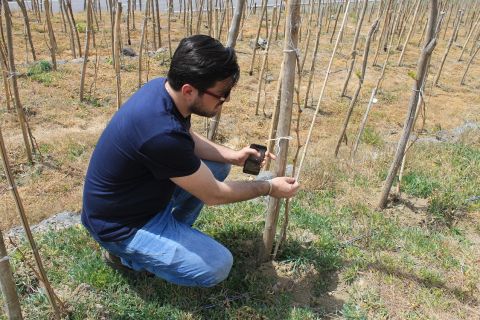
It was perfect synchronicity when, in April 2017, while on a three-week research tour with my business partner, Natia Khidasheli, and our colleague, Juliana, we came across Giorgi in his vineyards. We were driving from Batumi to Rabati, all of us pretty exhausted on this final leg of our trip. Natia was driving and casually pointed out that we were passing Giorgi's new baby vineyards. These were the new vineyards he had planted on those ancient, restored terraces. Natia slowed down for me to have a look, and that was when I spotted him getting out of his truck, so we decided to stop and say hello. It was so wonderful, because we were finally able to see his labor efforts in the flesh. We had a tour around the vineyards, and he explained the history and the terroir. The vines were young, but they were the ones that he had rediscovered that had been grafted. I mentioned the 400-year-old vines, and he said, "Oh, they are only 10 minutes from here," but he did warn us that we'd have to do a bit of off-road driving to get there. And just for good measure, he had one of his workers follow us and guide us, because it is not an easy place to get to.
This region is so beautiful and wild, and there are so many empty spaces; it has a beautiful silence. I can understand Giorgi's desire to protect and elevate this region. The ancient vines he makes wine from take you first to Vardzia, a spectacular, underground cave monastery built under Georgia's first female king (not queen), King Tamar, in the 12th century, to protect her people from Mongol invasions. Though most of this underground city is quite visible now, it wasn't always so. This was an underground city with 6000 rooms and tunnels that led to the river for escape. Archeologists have found the remains of what appears to be winemaking vessels. In 1283, less than 100 years after the city was constructed, an earthquake quite literally ripped the city in half, making the once-secret underground city visible, and thus it was abandoned.
A bit of off road driving was more akin to driving on an extremely narrow dirt road, driving over boulders and, at times, not having any kind of protection from sliding down a hill. The drive was a labor of love. I was not quite prepared for a hike that day. I was wearing a cotton summer dress and sandals, but that was not a worry for me. I had been waiting to visit these vines since I first heard about them. The weather was good, and it hadn't rained for days, so there was no mud. Our guide led us on a relatively flat, narrow trail that was easy to walk. About 10 minutes later, we arrived at a small rock hut that looked like a tree was growing out of, but it wasn't a tree at all, it was this ancient vine, with a trunk as thick as a tree, wrapping itself around boulders and trees, climbing towards the light. It was honestly hard to determine if this was one vine or many that had sort of melded together. I felt grateful and serene to be in the presence of a vine that had lived through (and survived) so much history. I felt this way once before, when I visited the Sequoias in California -grateful and humble. This vine had survived so much of Georgia's history, invasions from the south, isolation, the rise and fall of the British Empire, the birth of the United States, the rise and fall of the Russian empire, occupation, the Soviet era and, thanks to Giorgi Natenadze, it still provides grapes for wine enjoyed by people of today. This vine climbs up to the sky and snakes itself around an old rock-hewn cellar, where the grapes were crushed directly. It's a small but enduring living testimony to a time when Meskheti was dominated by the Ottoman Empire. They proceeded to cut down vines and prohibit the making of wine. And yet, Georgian wine endured. After the requisite photos, we leave the vines and plan to meet Giorgi in the evening, for dinner and a wine tasting, in Rabati, a 9th-century fortress in Akhaltsikhe, where he lives.
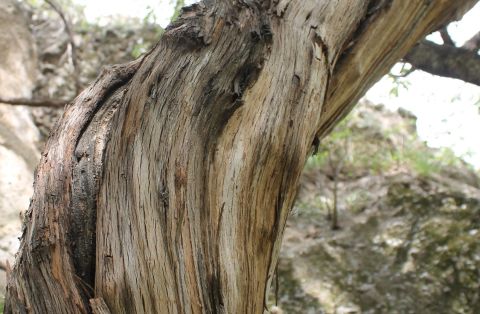
Giorgi brings bottles for us to taste, including the 2015 Meskhuri red made from the 400-year-old vine of Tskhenisdzudzu tetra, which are often referred to as wine trees. I am honestly exhilarated at this opportunity, and I can barely contain myself. All of Giorgi's wines have a wild characteristic to them. This doesn't mean dirty or flawed -it means they recall wild things and not just the flavors humans have cultivated for thousands of years. The taste of a wild strawberry in the mountains has much more depth than a store-bought one. All of his wines have this common thread, but the ancient wine has a depth unmatched by any wine I have ever tasted: ethereal, floral, with sour cherries and fresh garden soil. It's a noble wine with a presence. And it is lovely to taste these wines next to others made from younger vines.
Giorgi is a winemaker and a grape hunter. While we taste through his wines, he talks about his future plans. His main goal is to preserve the wine birthright of his region. This may mean interviewing elders about old vines they may remember from their childhoods and searching for them, or it may mean tromping through the area with a machete, on the hunt for lost vines. His most recent project restores the ancient vineyard terraces between 1000 and 1450 meters that haven't been used in 400 years. The goal is to restore 30 acres of terraces, and they have already completed 12, planting 24 historical, autochthonous varieties of wine grapes he has rediscovered. He also told us of his plans to restore Chadarkhi and the rock-hewn wine presses. He wants to restore these traditions and hopes the area will be revitalized by tourism, ultimately providing an income for locals.
Giorgi Natenadze's projects create a balance of the old and the new. He looks to the past to create a future, and he has pulled his region up from being forgotten and its wine history lost forever. While the bulk of his work isn't made from the ancient wines, the respect for them is evident. And these vines inform his choices today for his new vineyard that is also steeped in history. He inherited this and will leave behind a legacy that enriches Georgian wine culture in the future.
The photographs are all provided by Sarah May Grunwald.
















