Infinite Roots
One afternoon last May, I was fully immersed at home in the theoretical study of thousands of Argentinian wines when Xavier, my husband and personal angel, came back to home after work and stated: “We will go on holidays!”
Ohhh…this cannot be now! I still have so much to study!
Since I am finishing my Sommelier diploma degree in Barcelona, I was having really a hectic time preparing for the proficiency test I had in a few days. “No excuses!”
Actually, I had not seen my family in the months since the outburst of the pandemic and, not to forget, it would be my birthday on the 9th of May. It might be a good idea.
Although I was raised in the coast of the Andalusian province of Almería, in the South of Spain, my parents were both born in La Alpujarra, the region that Gerald Brenan visited on 1919 for the first time, where he lived during several years and that beautifully described afterwards in his book, Southern from Granada.

Many citizens from La Alpujarra migrated in the 1970s to the place where I was born. A lot more had previously fled away looking for a better life in America or in the big Spanish cities. As really engaged with their Alpujarran roots, my parents drove us almost on every weekend through the winding roads, slowly climbing up to the rounded mountains separated by deep ravines over two thousand meters. Getting sick after a few curbs was my curse as a child, but feeling better instantly after reaching my grandparents ‘cortijo’ in the nearby of Murtas. Refreshed by the chilly air full of aromas from the almond, olive and fig trees, from the rosemary, thyme and Mediterranean lavender. Being in La Alpujarra was always a good sensation.
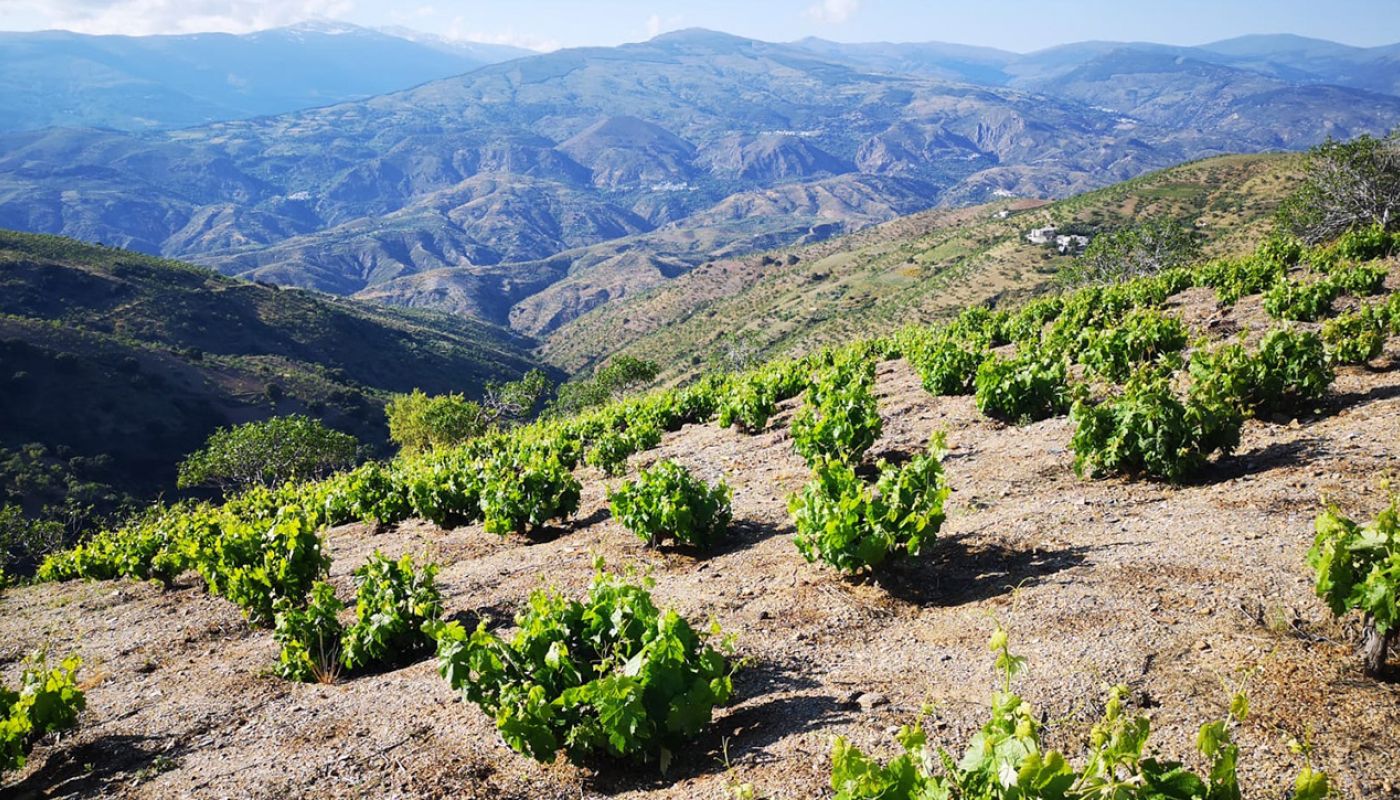
From the top of one of these rounded rocky waves, molded by the erosion for millennia, I can see the same sea where I learned to swim. Even further, the African coast can be contemplated from here on clear days, very far off. Turning around I have on sight the still snowy crests of the Sierra Nevada, where the highest peak of mainland Spain stands, the Mulhacen, and from which the undulating lines of the Sierra de La Contraviesa descend smoothly. Running West to East, this is a red shaly formation over a thousand meters high between the Guadalfeo river valley and the Mediterranean Sea, an unique and special scenery that yields particular wines, intense and structured, as the ground where these grapes evolve.
Having now my daily life full of wines, I look around searching for vineyards wherever I go, particularly intrigued by the old vines. Unfortunately, they are not so many left in La Alpujarra. About fifteen thousand hectares had been planted at the end of the Nineteenth century on these waving hills of mica shists, but the phylloxera plague killed them all. The first known case in Spain happened in 1878 only 130 kilometers far from this region, in the Axarquía mountains near Málaga. It spread so quickly that most of Alpujarran vines were killed by 1883. As far as I know, there are no pre-phylloxera vineyards in La Alpujarra.
To make matters worse, on 25th December 1884, on the Christmas night at 21:08 h, an earthquake measuring between 6 and 7 on the Richter scale struck La Axarquía and La Alpujarra. The caused damages were so devastating that it is known since then as ‘el terremoto de Andalucía’, the Andalusian earthquake.
People suddenly lost the few belongings they owned. Massive waves of migrants began, departing from the Spanish ports to America, carrying many searchers of a better future. Many cortijos remained empty and the vines abandoned.
After driving almost one thousand kilometers to my origins, I wanted to take advantage to visit some local wineries in Las Alpujarras. Unfortunately, it was Sunday and I had poorly planned any visit in advance. After a few phone calls I dismissed the idea. Suddenly, my phone rang. The second person I had talked to informed me that there was another wine maker who probably would be working in his cortijo, García de Verdevique, in the nearby of Cástaras.
We drove towards the heart of the Sierra de la Contraviesa on a tortuous dirt track for about two kilometers from the main road. The path was surrounded by vines on summits under the designated origin ‘Cumbres del Guadalfeo’.

At our arrival to the cortijo I met Antonio García, a dark hair young man in his thirties, who was about to bottle two racks of rosé wine, known here as the ‘costa wine’. This is typically a coupage directly from the vineyard of several local grapes: vigiriego, jaén blanco, jaén negro, perruno and even tempranillo, known here as ‘tinto varetúo’. It is made with some residual sugar to be more pleasing to the customers, he explained to me.
Although very busy at that moment, he looked after me solicitously. Since I expected easy wines such as the ‘vino costa’, I felt surprised after tasting his products. I found an interesting portfolio of mountain wines, monovarietals and coupages, from local varieties and ‘foreigner’ varieties, as they call in this area to Pinot Noir, Petit Verdot or Shiraz.
He also makes a sparkling from vigiriego, and a botrytized wine, made of jaén blanco on those years in which the weather is optimal. That knocked me off my feet. “I am oenologist”, he explained. Antonio left the cortijo a few years ago just to study, since he was always certain that he would return to his roots to make high quality wines.
By the side of the main road, I had seen a vine that appeared to be really old. I asked him for the age of his vines…Some of them were planted 126 years ago!

Then he told me the story of his great grandfather, José García, from the cortijo Los Garcías de Verdevique.
To rub salt into the wound, after the phylloxera and the earthquake, José received a recruitment letter for the war against Cuba. The conflict had broken out in February 1895 and the Spanish government had stated the forced conscription of the 19 and 20-years-old boys. José should had been tall and handsome, or at least without any physical impairment, since he could not elude his duty. Before he left in November 1895, he planted a vineyard with a mixture of local varieties that remains today.
I want to see that vineyard!
Still busy with the bottling, Antonio could no accompany us but explained to me precisely how to reach the vineyard. Excited with the perspective, we continued driving the previous dirt track climbing a gentle slope spotted with more almonds and fig trees. Although it was a bright sunny day, the air was so fresh on top of the hill that I was glad that I had taken my jacket with me when I tumbled out of the car.
I could not believe what my eyes were beholding in front of me. Covering the top of the hillock stands the most amazing vineyard I had ever seen. One thousand old vines on about a third of a hectare. Thick and gnarled trunks dressed with a bright green leafy mantle, proudly planted over the red glittering slatery soil.

It is said that the old vines suffer from low yields, but here the vitality and vigor are shining. Antonio has later explained that he gets three thousand kilograms per hectare. A bit more than five thousand when pruning shortly, without any reduction of quality.
Due to the very often strong winds, some trunks show spectacular shapes. I searched for the coordinates with my handy and recorded them diligently. I did not want to miss that exact place.

What kind of urge should have felt great grandfather José when planting this vineyard without any certainty of coming back from war. It may have been the need to leave a legacy to his family. How often did he recall these newly planted vines from the distance? Did the new American feet solve the phylloxera issue? Would any of the vines failed and needed to be replenished?
Due to a reason that I did not get to know, this old vineyard belongs to Antonio’s neighbour. Antonio looks after it, makes wine from it and wish to buy it very soon. They are in talks at the moment.
There was an embankment separating this vineyard from a much younger trellised one bellow, owned by Antonio. Some of the centenary vines are situated very near of the unevenness. Perhaps I could see something interesting, I thought. After a couple of carefully calculated goat leaps I found myself on the lower level looking at the vines above.
I was amazed to see that two of the vines show long airy roots, made of resilient wood. By talking to the earth for longer than a century, that radicular network has penetrated the hardness of the thick slatery coating, getting deep into the softness of the richer and lower lime layer.
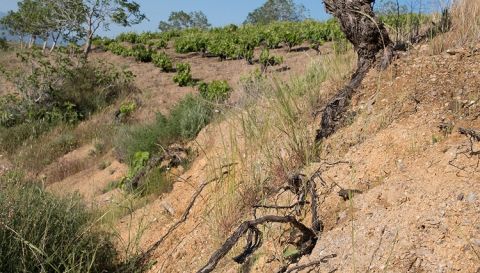
The old vines best kept secret is simply the depth of the roots into the soil. This brings a constant injection of water and nutrients to the plant in both easy and difficult crops. The yields after approximately thirty years become very much reduced and the plant intelligently distribute the resources captivated from the ground all over the plant to few grapes. The result is a reduced production of high quality grapes vintage after vintage.
At the same time, being more capable of getting more diverse nutrients from the ground, it yields grapes with high potential of great complexity. This is only possible when the roots grow sufficiently in depth like these ones I had in front of me.
José García returned from the Cuba War. He probably arrived sick at a Spanish port, as the majority, according to the historical records. The navigating conditions were extreme. Perhaps his wish to touch again the vines planted with his own hands aided him to resist the sea crossing and the final journey to the cortijo.
He saw his young vineyard again. And he never left La Alpujarra.
José’s great grandson, Antonio, cultivates these vines in the same way as his great grandfather did. Due to the strong inclination of the slopes and the plantation framework the vigneron is obliged to do the plowing with mules. Anyhow, Antonio likes the natural way. According to his winemaker philosophy, his wines are chemical-free.

In front of these stately roots, I looked into the distance to the East. Behind these ridges just a few kilometers far, my grandparents cortijo once existed. My grandfather made some wine in that place too. I recall an enormous foudre in his cellar that would probably not seem so big today to me as the one in the memory of a child. I do not remember his vines. They should have been there and they nay have looked like these. I felt instantly reconnected to this land through these infinite roots. My roots are here as well.
It is now that I have returned to Barcelona having those centenary roots in mind that I have realized how disconnected I have felt from this land, my parents and grandparents land. It has taken both moving away and moving back to receive the clarity that I have lived like ‘rootless’ in many ways.

I feel blessed and grateful for the splendid moment walking among those fabulous vines. Although not fully certain about the path I will follow within the wine world, I have decided to explore more old vineyards. I like their resilience, their constancy and their connection to the soil in which they live. Needless to say that I love the wine produced from them.
Looking forward to repeating that experience as many times as possible.
The photos were taken and provided by Ana Rivas.
















