See my tasting notes on a wide range of Austrian reds.
Austrian white wines have been the darlings of the world's more sophisticated sommeliers for some years now, but are wine drinkers ready for Austrian reds? Right there in the lion's den, in San Francisco, the cradle of California wine, the Chronicle devoted a long article to them last month. The forum on my website has been animatedly discussing the burning topic 'Are Austrian reds poised for a popularity explosion?' Last August a high profile blind tasting was held with the top tasters of Singapore, who ended up preferring Austrian Pinot Noirs to many a famous red burgundy.
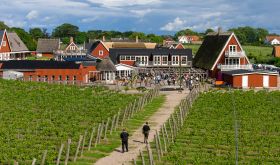
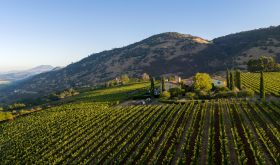
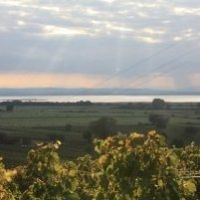
For the first time ever therefore I decided at the recent generic tasting of Austrian wines in London, an event held every year at the Institute of Directors with typical Austrian efficiency and hospitableness, to ignore the whites made on the Danube upstream from the capital and to taste only red wines – most of them made south and east of Vienna where Pannonian warmth spreads in from Hungary. (The picture below is of vineyards of revitalised producer Alexs leading gently down to the Neusiedlersee.)

I can report that these wines must be particularly absorbing because my tasting speed seemed to be only about half what it usually is and I ended up for the first time ever being shooed out of the tasting room by the men from Sensible Wine Services ostentatiously gathering up bottles, glasses, spittoons and ice buckets around me.
As for the quality of the Austrian reds on show at the IOD, I found some that were really, really exciting, but perhaps not quite enough for me to make a blanket recommendation that wine lovers should head decisively for the Pannonian plain for red wine thrills – it does seem to be worth paying a bit extra for single-vineyard bottlings, which generally sell for closer to £20 than £10 a bottle. That said, I have noticed at generic tastings in London that potential exporters have clearly been told so often that the UK market is dangerously competitive, and British wine buyers horribly penny pinching, that some tend not to bother to show their top wines. (This was manifest, for example, at the even more recent inaugural generic tasting in London of, believe it or not, Turkish wines.)
What Austria can offer, however, is a trio of truly distinctive dark-skinned grape varieties that are more Austrian than from anywhere else. One of them, Zweigelt, is capable of making exuberantly fruity wines that, in their usual unoaked form, can provide charming, easy drinking for less than £10 a bottle. A good introduction to Zweigelt's juicy flavours would be the regular 2009 from the admired Thermenregion red-wine producer Johanneshof Reinisch. This is a big, bold wine that somehow tastes as well as looks purple – perhaps because it seems to be stuffed with the fruit of purple-coloured berries.
I found myself admiring two much more serious examples of Zweigelt, however. K+K Kirnbauer's Girmer 2008 is made from 52-year-old Zweigelt vines whose roots burrow as deeply as 25 metres below the Girmer vineyard in Mittelburgenland. Chock full of energy, it was aged for 18 months in barrels made from oak grown in a forest owned by the same family, making it truly a local product. Franz Leth, whose vines are grown on the deep loess soils of Wagram, makes particularly striking Zweigelts. The unoaked Leth Klassik 2009 is modelled on the exuberant reds made in Austria before the late-twentieth-century invasion of the fruit snatchers, otherwise known as small oak barrels. (One of the reasons that the time may be right for Austrian reds is that Austrian winemakers have recovered from their love affair with barriques and now have a much more balanced relationship with oak.) Leth also makes perhaps the most dramatic Zweigelt of all, in really successful vintages only, in Gigama, late picked, carefully selected grapes from which maximum flavour is extracted and the result given almost two years in barriques but is not dominated by their influence. (Just over the border into Hungary, in Sopron, Raspi makes another sumptuous Zweigelt.)
Another Austrian red wine grape speciality is St Laurent, whose origins are obscure but whose wines are unusually velvety. The wines tend to lusciousness and can taste a little sweet, lacking the structure and perhaps longevity of Austria's finest Pinot Noir. Again, Johanneshof Reinisch of Thermenregion made one of my favourite examples, their Holzspur 2004, which fully mature wine actually tasted almost more like a Côte Rôtie, so smoky and satin-textured was this marvel made from very low yielding vines planted by the grandfather of the current incumbent Michael Reinisch. In Burgenland to the south, on the shores of the Neusiedlersee, both Pittnauer and Umathum also make very fine, if plumper, St Laurents.
But the grape variety that is probably most likely to put Austrian reds on the map is Blaufränkisch, known as Kékfrankos over the border in Hungary, and Lemberger in southern Germany and Washington state. It has the most attractive, and currently fashionable, combination of medium rather than full body, a refreshing aroma, and the ability to transmit quite subtle differences in terroir with precision – in Austrian anyway. The greatest concentration of fascinating Blaufränkisch is in Burgenland, with the wine produced in Leithaberg on the western shore of the Neusiedlersee being so distinctively mineral-soaked that it has earned its own special appellation.
One of many exciting examples I tasted recently in London, Pala 2009, was made from grapes grown across the border in Hungary by the specialist in the variety Schiefer. For this reason it has to be labelled as an EU Tafelwein rather than anything grander. I loved this and all four Austrian Blaufränkisch bottlings presented by Schiefer at the Institute of Directors. Other superior Burgenland producers of fine Blaufränkisch include K+K Kirnbauer, Moric, Pichler-Kruzler, Pittnauer, Prieler, Triebaumer and Wohlmuth.
And then there is the exceptional Spitzerberg site in Carnuntum from which Muhr-van de Niepoort seem to be able to demonstrate an almost Pinot Noir-like aspect to this very promising grape variety.
Grüner Veltliner may be even more difficult to pronounce than Blaufränkisch but its success has probably partly been due to its frequent abbreviation to Gru-Ve, or simply GV. I fear the most obvious initials are unlikely to work the same magic on the variety that might eventually come to be seen as its red wine counterpart.
Favourite wines from the tasting
Johanneshof Reinisch, Holzspur St Laurent 2004 Thermenregion
Jurtschitsch Sonnhof, Pinot Noir 2007 Kamptal
K+K Kirnbauer, Das Phantom 2008/Girmer (Zweigelt) 2008/Vitikult Blaufränkisch 2007 Burgenland
Leth, Gigama 2008 Donauland
Moric, Neckenmarkt Alte Reben Blaufränkisch 2008 Burgenland
Muhr-van der Niepoort, Spitzerberg (Blaufränkisch) 2008/Syrah 2007 Carnuntum
Pichler-Krutzler, Weinberg Blaufränkisch 2008 Burgenland
Pittnauer, Rosenberg Blaufränkisch/Alte Reben St Laurent 2008 Burgenland
Prieler, Blaufränkisch 2008 Leithaberg
Schiefer, Königsberg*/Szapary/Reihburg Blaufränkisch 2008 Südburgenland
Ernst Triebaumer, Blaufränkisch/Cabernet 2009 Neusiedlersee-Hügelland
Umathum, St Laurent 2007 Burgenland
Wohlmuth, Privat Rabenkropf Blaufränkisch 2007 Mittelburgenland
*Schiefer's racy Königsberg Blaufränkisch 2008, at £12.49 from Raeburn of Edinburgh, has to be the bargain.
See my tasting notes on a wide range of Austrian reds.