
Before I get to the news, I’d like to mention some events we are hosting, our friends are hosting and that we’re very much in support of. Last week I told you about our team’s event on 30 October at The Morris in San Francisco. Jancis, Alder and I are also gathering on 29 October at CIA Copia in Napa for a panel discussion on the California wine industry, 25 years of JancisRobinson.com and anything else you’d like to ask us about. After the panel, we’ll meet you for a glass of English fizz. You can purchase tickets to these events at JancisRobinson.com.
For Londoners, we will have an event in mid November but you will have to wait a bit longer for details on that. In the meantime, you could sign up for an incredible Loire walk-around tasting on 4 November being put on by our friends Beverley Blanning MW, author of Wines of the Loire Valley, and Rebecca Gibb MW, the Loire specialist for Vinous Media. The line-up of producers pouring wines looks incredible. There’s also a raffle going on in the UK right now for War Child UK – an organisation raising funds for children affected by conflict around the world. The prizes include some top-notch wines and fine-dining experiences in London donated by wineries, restaurants and fine-wine merchants. I’ll link to all these events in the transcript of this newscast.
New EU proposal to help farmers
On 16 September the EU published a proposal to increase the competitiveness of farmers in the EU. This proposal would, I quote, ‘reduce the administrative burden on Member State authorities regarding marketing authorisations for plant protection products’ as well as establishing faster and clearer procedures for drones, biocides, feed additives, hygiene rules, and official controls.
Last week I discussed how ANSES, the French Agency for Food, Environmental and Occupational Health & Safety, had failed to renew marketing authorisations for 20 out of 22 copper-containing fungicides that are considered by many farmers to be vital to the French wine industry.
The way this new proposal reads, much of what member states currently authorise in terms of farming would instead be decided by the European Commission, which is trying to address the unequal availability of plant-protection products for farmers in the different member states, and is concerned about the limiting of protection products when there are no viable alternatives.
If you are a farmer in the EU and you’d like to support or oppose this proposal, Brussels is taking public comments until 14 October. I’ll include the link to submit in the transcript of this newscast.
UN refocuses health guidelines
On 25 September the UN held its fourth High-Level Meeting on Noncommunicable Diseases and Mental Health. The result was a political declaration that will guide global health guidelines through 2030. Journalist Felicity Carter of Drinks Insider was there and reported that this declaration does NOT include commitments to raise taxes, restrict availability or include cancer warnings on alcohol. In fact, it doesn’t even include language implying all drinking is dangerous. It very reasonably focuses on harmful consumption. This is a huge relief to the wine industry.
British Columbia strike hurts wine industry
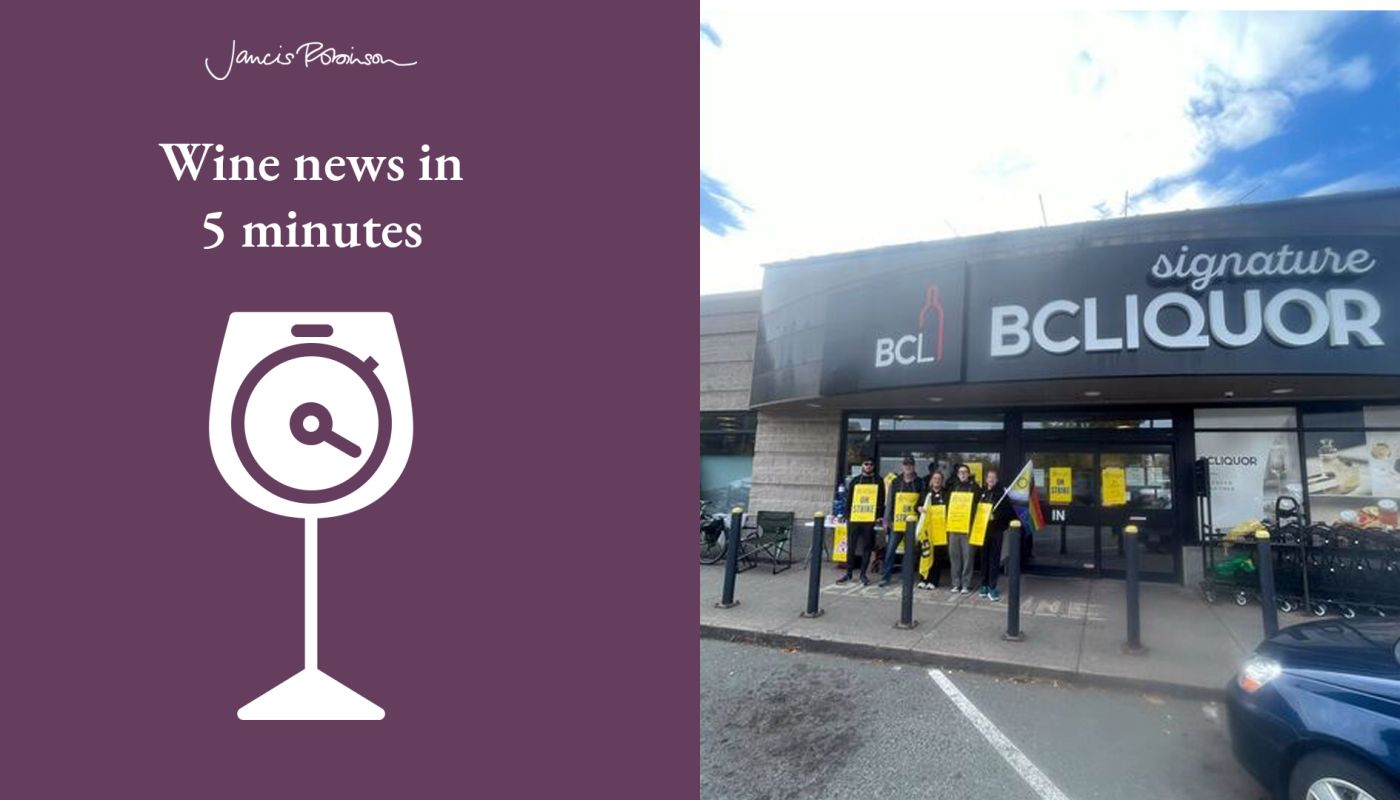
On 2 September the BC General Employees’ Union (BCGEU) went on strike, demanding wage increases in line with inflation and cost of living. Union president Paul Finch says they originally targeted government operations while minimising disruptions for the public, but when the provincial government refused to come to the table, they expanded the strike to target front-facing operations including the alcohol industry. On 22 September the BC Liquor Distribution Branch (BCLDB) announced the temporary closure of its Head Office, Distribution Centres and Wholesale Customer Centres. This effectively gridlocks BC’s alcohol industry. The BCLDB has a monopoly on distribution of imported products meaning that liquor stores, wine shops and restaurants cannot order imported products; they can only order from local wineries or distilleries who have their own distribution networks. Businesses are able to collect revenue from selling current inventory and local products, but the reality is that the majority of sales for are imported wine and liquor. Meanwhile the importers themselves cannot collect any income but are still required to pay warehousing and transportation costs to the BCLDB. Thank you to news listener Pablo Sanz for explaining this to me, I had no idea how badly this hurt importers.
If you are Canadian and you care about your local restaurants, wine retailers and importers, I encourage you to call your MLAs (Members of the Legislative Assembly) and insist that they negotiate with the union as soon as possible. Rumour is that the provincial government has not even started negotiations.
Late extension for ‘Crafted in BC’ wines
Back in January 2024, a cold snap caused freeze damage to vines across British Columbia and all but wiped out the 2024 crop. In July 2024, the Ministry of Public Safety and Solicitor General announced a temporary measure had been passed to allow BC’s ‘land-based wineries’ or LBWs, to sell wine made with imported grapes, grape juice or unfinished wine and label it ‘Crafted in BC’. That measure was set to expire 31 March 2026. On 23 September, the government announced that it would extend the measure for another year in order to make up for the fact that the province is 10,000 tonnes short of meeting market demand. (This is due in large part to replanted vineyards not yet yielding a crop.) While this would be welcome news to most wineries, it’s a bit late! 2025s harvest is well underway and many wineries who might have bought grapes from Washington or Oregon would have called their picks weeks ago. It seems that if they want to capitalise on this, they’ll have to scramble to buy unfinished wine.
UK duty hikes result in loss for Treasury
Back in 2023 the UK’s government pushed through the largest alcohol tax hike in nearly 50 years. They also came up with the ridiculous duty escalator that went into effect in February of this year. In 2024 the Labour Party took over and raised duty 3.6%. The government has said they were doing this to increase Treasury revenues. Miles Beale, chief executive of the Wine and Spirit Trade Association, warned the government that the duty hike would depress sales for an already struggling industry and result in less Treasury revenue. On 19 September his predictions were confirmed. His Majesty’s Revenue and Customs latest alcohol duty receipts show that revenue has declined 4.3%, with wine dropping 6%, spirits 5%, and beer 2.5%.
Beale was quoted by Harper’s saying, ‘Instead of bringing in more cash to plug the black hole in public finances, they have carved out a loss of over £220 million in the first five months of this financial year compared to the same period last year…The only way to break the cycle of tax duty increases depleting Treasury funds and fuelling inflation is to freeze excise duty on wines and spirits at the November Budget.’
Perhaps the government will listen to him this time.
That’s all I have for you in terms of news. I’ll be gone for the next two weeks and the wine news in five will be on break until I return. That does not mean you shouldn’t email me news! As soon as I get back, I will be sorting through all your emails, answering you and putting together a jam-packed newscast for 17 October. So please send news to [email protected]. And if you enjoy this newscast and would like to see it continue, please become a member of JancisRobinson.com.
Photo at top of employees on strike outside a BC liquor store.
This is a transcript of our weekly five-minute news broadcast, which you can watch below. You can also listen to it on The Wine News in 5 Podcast. If you enjoy this content and would like to see more like it, please become a member of our site and subscribe to our weekly newsletter.