February – Postbag swollen by letters from every Bordeaux château imaginable inviting me to come and taste the glorious first vintage of the new millennium.
March 19 – Masters of Wine meeting in London. One MW has the hot news: 'Quinault L'Enclos's out', and the increase is 'only' five per cent. Mind you, the price hike for the much less remarkable 1999 vintage of this garage wine (tiny quantity, giant price) was far more, so this is hardly an act of charity.
March 24/5 – First unmistakable signs of an incipient cold.
March 26 – (A relatively easy day, I realise later.) Early flight to Bordeaux, coughing all the way. I recognise at least eight British wine-traders on it but there must be more. Sit next to a young Hong Kong wine-lover who tells me he was in Bordeaux for the 2000 harvest. He picked impeccably healthy grapes for the J P Moueix empire in sunny weather and then went to work at Ch Cheval Blanc as a cellar rat, staying at the nearest Relais et Châteaux hotel.
Straight to taste and lunch at Ch Haut-Brion. No pain. Lovely deep colours, ripe fruit and ripe tannins although Ch Haut Brion itself is not showing as well as its traditional rival, now sister, Ch La Mission Haut Brion which is particularly opulent. Director Jean-Bernard Delmas claims 2000, a less prolific crop than its predecessor, is better than 1989 and 1990 which, considering those vintages for Haut Brion, is quite something. This traditionalist is particularly proud of not having one of the popular new machines designed to concentrate juice in a dilute year. 'We're in the vineyard every day to taste the grapes and see from the state of the skins how ripe they are,' he says with undisguised pride.
Next stop the negociant Descaves, with Marie-France Chauvin doing a pretty good job replacing Madame Descaves who died on Christmas Day 1999 in her 90s. Lots of producers from the outlying regions represented here, many of whom are following this trend to make supercuvées, a selection of the most concentrated wine, bottled separately. I find no fewer than five instances in which I prefer the regular to the exaggerated 'special' bottling.
Now a drive up the Médoc to recently restored (by the family behind Chanel) Margaux second growth Ch Rauzan Ségla. Director John Kolasa reports they had been planning to do some trials with a concentrator in 2000, but nature did the concentrating for them. The firm will hold the deposit over to 2001. The wine is excellent, as fine and silky as a Margaux should be, but we all want to know how much it will cost. 'We'll sell at the same price as Léoville Barton,' says Kolasa, citing the Médoc's usual benchmark price of reason, and clearly troubled by the international effects of Bordeaux's recent greedy pricing. 'Bordeaux's really out of line at the moment. We need friends. It's bonkers that some super-seconds [the most lauded second growths] are thinking of coming out at 220 francs.' If he is right, then this would translate into an in bond price of £350 a case for Cos d'Estournel, for example – quite a hike on last year's price of £280.
Just up the road, Ch Palmer is swarming with potential buyers, still blissfully ignorant of the price (most prices will not be released until later in the month – specifically in some cases sometimes only after the American wine guru Robert Parker has pronounced).
At first growth Ch Margaux Paul Pontallier reminds us how dismal things were in the early summer. Until mid-July Bordeaux was unusually cool and wet with mildew at its most threatening for more than a century. Constant spraying saved the vintage. It was only the uninterrupted warmth and sunshine of late July until mid-September that created all this ripeness we are tasting.
And at Ch Margaux it is not just ripeness but real elegance too, a soaringly perfect, subtle, many-layered wine that could not be anything but a Margaux. There is clearly masses of tannin (more than in either 1986 or 1995 according to Pontallier's analyses) but the tannins are so ripe as to be completely swamped by intricate, ripe fruit. 'Honestly, I think 2000 is a new reference, a new form of classicism for Margaux,' says Pontallier. (He said this last year too but we believe him this time.)
Ch Prieuré Lichine down the road, now sold by the Lichine family, provides a complete contrast. This is my first head-on collision with the new style of Bordeaux: cold maceration before fermentation, a whole month in the fermentation vat, malolactic fermentation in barrel (simply to make these en primeur samples taste rounder), stirring of the lees also in barrel and even a spot of microbullage, injection of tiny amounts of oxygen – also to soften the wine prematurely. Well it certainly makes an impact. This is dramatically thick and sweet, quite brutal and briary with none of Margaux's trademark feminine grace. The wine will probably garner high scores because it is so flashy, but to me it verges on grotesque, a sort of sex-change Margaux.
Over dinner at his father's elegant townhouse in the middle of Bordeaux, young Jean-Guillaume Prats is in remarkable shape considering he received 240 visitors at Ch Cos d'Estournel that day (Haut Brion reckon to pour about 100 bottles worth of samples during the week). He shows the ingredients that will go into the final blend for the 2000, including press wine, the last wine to be squeezed from the grapeskins, that is far removed from the harsh, tough stereotype. He claims that none of the samples of 2000 being shown this week will be exactly the same blend as the final wine (a common complaint about these en primeur tastings of wines more than a year before final bottling) and that everyone will add more press wine later.
The blended 2000 Cos we are shown is long, rich and velvety, much gentler than the heavily extracted wines that have resulted from some of their previous efforts with the concentrator. No need for the concentrator in 2000 since this was the driest vintage since 1989. A tiny revitalising shower in the Médoc at the end of August, some more on 19 September and then a little more rain at the end of September after Merlot was picked helped the Cabernet Sauvignon to ripen fully before being picked in perfect conditions (a relative rarity in Bordeaux) before 11 October when rain set in until April (much like Britain, then).
Over Roederer Cristal and Cos 1990 and 1982 Jean-Guillaume gives a heart-rending account of how much production costs are rising now that everyone has become so quality conscious, citing in particular the team of 60 needed to snip off surplus bunches during early summer to concentrate the crop. The vast gap in cost per bottle and price per bottle hardens my heart to this, however.
Talk inevitably turns to the garage wines, now spreading across the Gironde from St Emilion and Pomerol. Jean-Guillaume maintains stoutly that they have been good for Bordeaux because they have raised everyone's game. Some of his peers are less charitable.
A call is taken by one of our party during dinner (the curse of the mobile phone) from James Suckling who is in Bordeaux to report on the vintage for the American magazine Wine Spectator, posting the all-important scores out of 100 on the website. He is asked, with an arch look at Jean-Guillaume, what he has given Cos. The answer could not be better: 95-100. Monsieur et Madame Prats are aglow. Jean-Guillaume sounds as though he is at the Oscars. 'My first reaction is that this is a great reward for my team. I'm very happy for them, all 69 of them.' Stéphanie Prats's first reaction is to use her cellphone to ring her sister whose pc is in working order. 'We've got 95-100! Please, chérie, look up winespectator.com and see what the other super-seconds got.'
The most amazing thing, I think as I brush teeth blackened by the assault of all this inky infant wine with its record charge of tannins and colouring matter, is that my gums are not actually aching. Those tannins must be ripe. The cough worsens but the all-important nose is clear.
March 27 – Another day in the Médoc, one more grand lunch and a relaxed BYO dinner over which a bottle of Le Pin 1988 brought by the young Hong Kong enthusiast is served blind to the owner of Le Pin, who pronounces it from a very good vineyard but not a particularly good year.
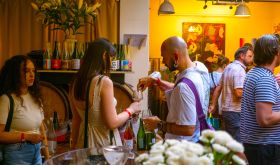
What distinguishes this day is the crowds at the Union des Grands Crus tastings, great bunfights organised by each appellation whereby a château gives over one not-quite- large-enough room to a big tasting of all the members' wines (non-members such as the first growths insist on showing their wines at the château). They were queuing outside the Margaux tasting by 9.20am. It would be so easy to gatecrash these tastings, I think, but then who would want to?
At the Pauillac, St Estephe and St Julien one (talk about too much of a good thing) the shortage of spittoons made things positively dangerous. We all have disgustingly black tongues, black teeth, purple fingers on our pouring hands and little purple wings on our upper lips where glass hits flesh. No wonder romance so rarely flourishes over the spittoon.
This last tasting is very impressive. Of course there are winners and losers (see my top ten) but overall the quality of wine coming from the Médoc classed growths is very, very high – beguiling, ripe, naturally concentrated wines for the medium-to-long term, with a real kick of acidity, presumably the result of all that concentration in the vineyard.
The UGC tasting of lesser Médoc wines is interesting too, mainly because of the amount of sheer effort that has clearly been put into making the wine – quite a contrast with years gone by. So long as they are modest in their price increases, wines such as Chx Belgrave, Chasse Spleen, Fourcas Dupré and Poujeaux may be some of the best buys of this vintage.
March 28 – Amazingly, the head and nose are clear in the morning. This is by far the most punishing day, spent entirely on the opposite bank of the Gironde from the Médoc in St Emilion and Pomerol, a hotbed of garagistes with a particularly noticeable tally of Asian tasters. During the day the palate is battered by more than 100 wines from these opulent appellations (23 by 9.50), far too many of them made to variations on the new recipe outlined above for Prieuré Lichine. They tend to taste awfully similar: inky black colour, a sweet almost sickly start followed by an uncomfortable whack of dry tannins, quite different in quality from the sappy, ripe tannins of the best Médoc wines.
The most obvious counterpoint comes at Vieux Château Certan where Alexandre Thienpont draws the most perfect Pomerol from one of his barrels: pure, round, lively, utterly direct flavours in perfect balance, with both charm and ripe tannins.
March 29 – Feel not so much hungover as poisoned by alcohol and tannin. A range of wines tasted at J P Moueix's offices immediately after 'Uncle Bob' (as Christian Moueix calls Robert Parker) revives my flagging right-bank palate. Ch Magdelaine is almost a caricature of a traditional, fine-boned St Emilion, while Ch Lafleur is utterly seductive and sumptuous, managing to combine all that richness with being appetising as well. Pétrus less expressive.
Over lunch Christian Moueix explains the difference in tannin quality on the two banks. 'I don't think there could be a very, very great wine anywhere in Bordeaux in 2000 because although August and September were good, July was just too cold. And in the summer it was too dry – especially on the plateau of Pomerol. We were praying for rain and if we'd had even one inch, like the storms they had in Margaux at the end of August, it would have rebalanced the vines. People thinned the crop as usual and then the hot weather concentrated everything even more. And then this new tendency to pluck leaves meant the vines were even more stressed. Instead of maturing, many grapes were simply concentrated on the vine, meaning deep colour, very dry tannins and high acidity. It was a great mistake to use heavy extraction techniques in the winery.'
So that's why so many of these right-bank wines tasted so unbalanced. And some producers even covered the vineyard with black plastic in an effort to concentrate the fruit even further. Even St Emilion's cooperative has released a garage wine in 2000, the 3500-case Aurelius. There is madness abroad on the right bank of the Gironde, but a great deal of thoroughly delicious wine too.