
Before I get to the news, congratulations are in order! The winners for the 67 Pall Mall Global Communicator Awards – the Pulitzers of the wine writing world – were announced today, and our Julia Harding MW won the Gusbourne Award for Best Global Wine Communicator in Long-Form Writing for The resurgence of Pico’s magnificent wines!
Congrats are also in order for the other winners of course: Marianna Hunt won the short-form writing award for her work in Glug Magazine. Vincent and Lisa Anter of the V is for Vino Wine Show won the award for long-form video. Desiree Harrison-Brown won the award for short-form video for her work as @winonoire on Instagram. Felicity Carter of the Drinks Insider podcast won the audio award. And finally, Jamie Goode took home the award for Best All-Round wine communicator. And, before you go feeling bad for me because I lost to Jamie – the man put out a TV show this year, hosts a podcast, keeps his website updated and managed to write for WINEMAG.CO.ZA – I’m truly happy to see his work rewarded…and I’m coming for that trophy next year. Congrats to everyone who won!
Napa wildfire extinguished
According to CalFire’s website, Napa’s 6,819-acre (2,760-ha) Pickett Fire is 90% contained. However, according to firefighter and winery owner Christopher Morisoli, who emailed Jancis on 3 September, the fire is out entirely. There was no damage done to buildings or people. Smoke taint concerns are currently confined to a small number of producers in Napa Valley’s Howell Mountain AVA and in the Pope Valley area. Producers in this area told the San Francisco Chronicle that they would begin testing for smoke taint this week.
Galicia wildfire update
On 31 August El Español reported that the fires that ravaged Galicia in August, burning through 78,551 ha (194,104 acres) are now officially extinguished. These were the largest fires in Galicia’s history and affected vineyards in the DOs of Ribeiro, Ribeira Sacra, Valdeorras and Monterrei. Noah Chichester reported this week that while many vineyards burned around the perimeter, affecting this year’s crop but leaving the majority of the vineyard unharmed for future vintages, this was not the case for the Alvaredos-Hobbs winery – who saw the whole of their vineyards affected. Co-owner Paul Hobbs was quoted as saying, ‘I have a feeling we’ve lost more than one vintage.’
Tariffs, continued …
On 29 August the US Court of Appeals in Washington DC ruled 7-4 that Donald Trump had overstepped his authority by imposing global tariffs. This is the same conclusion that the US Court of International Trade came to earlier this year. The appeals ruling voids reciprocal tariffs as well as tariffs imposed on goods from Mexico, Canada and China in response to what Trump views as those countries’ roles in the fentanyl trade. The US Court of Appeals stated on the 29th that their ruling would not take effect until 14 October – giving the Trump administration time to file with the Supreme Court, which they did on 3 September. D John Sauer, solicitor general of the US, has requested that the Supreme Court decide by 10 September whether they will hear the case. Provided they will, he requested that they schedule oral arguments in the first week of November.
The outcome of this case, filed by five-small businesses including New York-based wine importer VOS Selections, will affect the entire wine industry. Tariffs have negatively impacted every facet of the wine business, from international producers who rely on the US market to import their wines, to their US-based importers and distributors, and the US wine shops and restaurants which stock their wines, to US producers who use imported equipment to process their grapes and mature and package their wines. The trade war has also lost US producers their biggest export market – Canada. It is my hope for our industry that, should the Supreme Court choose to hear this case, they rule with the US Court of International Trade and the US Court of Appeals.
Potential EU–Mercosur trade deal
On 3 September the European Commission presented an EU–Mercosur trade accord (the Mercosur bloc includes Argentina, Brazil, Paraguay and Uruguay) and an updated EU–Mexico trade agreement for approval. If at least 15 out of the 27 EU member countries approve these trade agreements it will create the world’s largest free-trade zone. The European Commission estimates that agri-food exports to Mercosur would grow by almost 50% as a result of drastically reduced tariffs. One of the main beneficiaries would be the EU wine industry which would see tariffs reduced by up to 35%. This deal would also strengthen protections for EU Geographical Indications in both the Mercosur bloc and Mexico.
It is worth noting that while many European farmers oppose this deal – saying that it will lead to cheap agricultural imports that are not forced to comply with the same food-safety standards as EU agricultural products – the European Committee of Wine Companies (CEEV) has spoken in favour of the agreement and cited strong growth potential for exports of European wine to Brazil and Mexico.
Hail devastates Gers
On 31 August, just a day before harvest began, an intense hailstorm swept through the Gers region in south-west France. Crop losses are estimated at up to 80% and the co-operative winery in Condom reports damage to 500–600 ha (1,230–1,480 acres) of their member vineyards.
Austria hits organic vineyard milestone
This week the Austrian Wine Marketing Board announced that 25% of the country’s vineyards are now certified organic – equating to 10,524 ha (26,000 acres). This is a larger percentage than any other major wine-producing country. The closest runner-up was Spain with 17.8% of vineyards certified organic.
DO Cava achieves organic goal
Spain’s DO Cava announced this week that all Cava de Guarda Superior wines – an umbrella category that includes Reserva, Gran Reserva and Cavas de Paraje Calificado – entering the market from 2025 onwards will have been produced entirely from certified organic vineyards. Due to ageing requirements for the wines, this means that this applies to wines labelled with the 2022 vintage and beyond.
Harvest starts in northern Italy, northern Spain, Beaujolais and New York
On 29 August Harper’s announced that the largest DOC in Italy, Delle Venezie, had begun harvest. Quality is expected to be good with yields 5–10% more than they were in the 2024 vintage.
In Beaujolais harvest began on 23 August for Chardonnay and 25 August for Gamay. When I emailed Natasha Hughes MW, author of the recently published The Wines of Beaujolais, for more details she told me that yields this year are low and many producers have already completed their harvest. Quality looks to be good.
In Oregon’s Willamette Valley, winemaker Kim Abrahams of Archery Summit texted that harvest has been ongoing in Willamette Valley since the end of August.
In New York State, Brian Barmore, winemaker for 21 Brix Winery in Lake Erie AVA, emailed to say that their harvest started 3 September with Pinot Noir for sparkling wine. They will be harvesting Marquis (a hybrid bred by Cornell) today, 5 September.
Finally, Noah Chichester has posted a photo essay of harvest in the Valdeorras DO on his Wines of Galicia website. Despite the fires, it seems that the Godello harvest was well underway by 22 August.
That’s all for this episode of the wine news. If you enjoy this newscast and would like to see it continue, please become a member of JancisRobinson.com. And if you have breaking news in your area, please email [email protected].
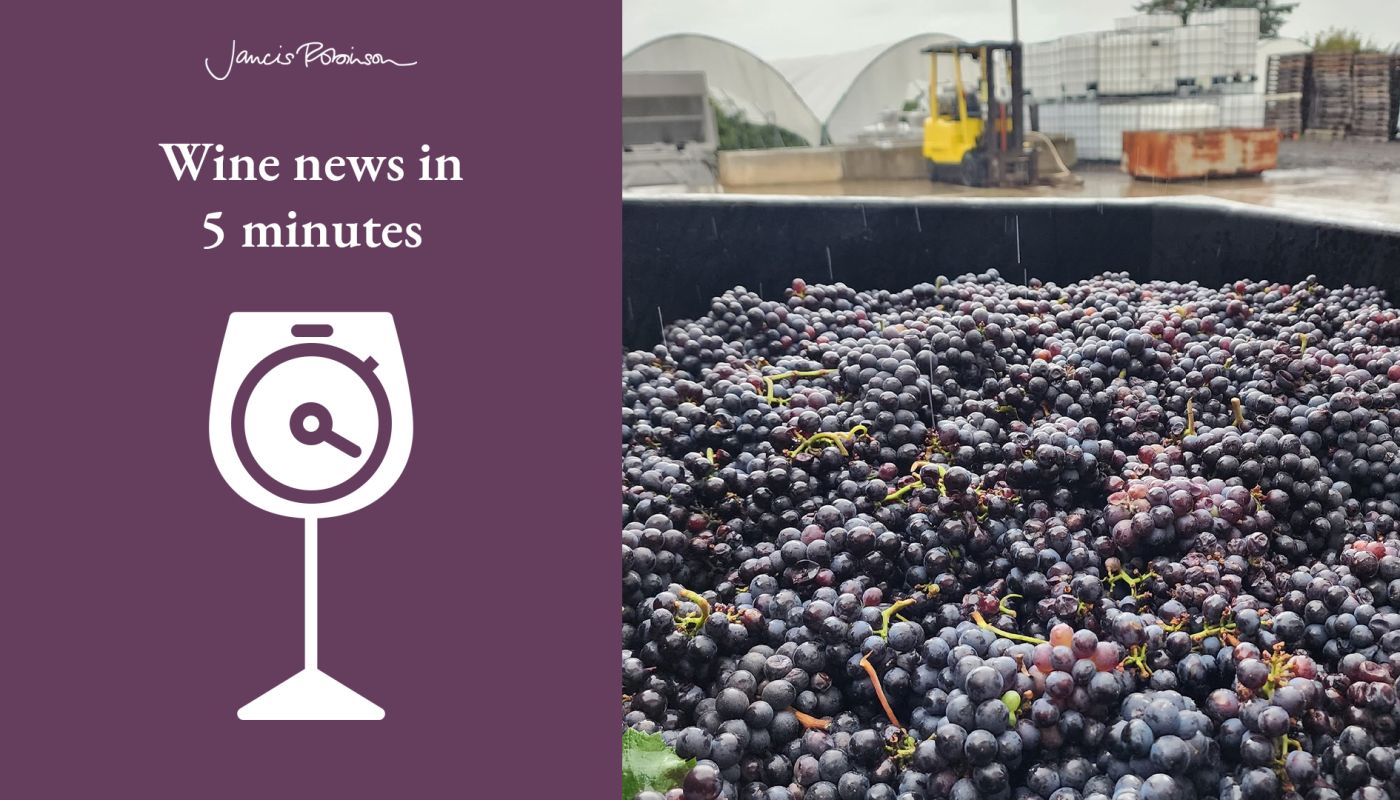
Photo at top of Pinot Noir harvest courtesy of winemaker Brian Barmore of 21 Brix Winery in New York State.
This is a transcript of our weekly five-minute news broadcast, which you can watch below. You can also listen to it on The Wine News in 5 Podcast. If you enjoy this content and would like to see more like it, please become a member of our site and subscribe to our weekly newsletter.