23 December 2018 An addition from Garry Crittenden of Crittenden Estate.
Jancis, a footnote to your column last Friday about the dilemma facing the Mornington Peninsula.
In September 1982 I planted five acres of vines on my property at Dromana: four of Cabernet, half an acre of Merlot and a quarter each of Pinot and Chardonnay. In so doing I doubled the aggregated plantings of all the vineyard area on the Peninsula at the time from five to 10 acres. (Today there are 2,500 acres.)
They were collectively made up predominantly of Cabernet with a little Chardonnay at Baillieu Myer's Elgee Park, Nat White's Main Ridge (which also had a little Pinot), George Kefford’s (Nina Caplan's uncle, I seem to recall) Merricks Estate and Brian Stonier's Stoniers.
I chose to plant Cabernet in particular because of the Cabernets I had seen made by the short-lived but legendary Stephen Hickinbotham from Elgee Park fruit, but also when I did a homoclime study for my location from nearby long-recorded climatic data it clearly said 'Bordeaux', reinforced by the maritime climate as distinct from a Burgundian continental one.
All went along swimmingly, with James Halliday even choosing my second harvest 2005 Cabernet (with no Merlot blended in) to represent Australia in the Qantas Cup, a three-way competition between California, Australia and South Africa, where it performed admirably.
It’s worth noting that I had chosen my site at 150 feet elevation based on a long assessment of Peninsula soils, elevations and aspects.
As the years passed and Peninsula plantings increased somewhat randomly, they gravitated towards the higher, cooler elevations where deep red volcanic soils predominate. But still people planted Cabernet, with Pinot just beginning to make some headway. The Cabernets from these locations were routinely picked, of necessity, under-ripe with aggressive tomato leaf and green capsicum characters brought about by the compound methoxypyrazine. This was due to being considerably cooler than the lowlands but also because of the shading of fruit in the canopy caused by uncontrolled vegetal growth.
Not surprisingly the wines were dismissed by the market and even a luminary such as James Halliday said the Peninsula is, quote: 'unsuited to Cabernet'. WHAT??
Our Cabernet sales gradually declined as a result of this mantra but we persevered until our last vintage in 2009, aptly labelled Les Adieux. Back label below.

We are now predominantly planted with Pinot and Chardonnay along with with the rogue Albarino/Savagnin and have just grafted the last of our Arneis to Chardonnay as well – but that’s another story (told here). And don’t get me wrong, happy to be so, but unsure what the long-term effects of global warming hold.
I still delight in pulling out the occasional masked Cabernet from the 1990s for visiting wine trade and commentators only to be told. 'it's very kind of you to pour an old Bordeaux for us but were really here to see what you make from your own vineyard.'
Say no more.
Last week I pulled from my cellar a 2001 Shiraz I made from fruit from a nearby vineyard. Bloody delicious even if I do say so myself.
A couple of other non-related comments.
- In the days when I was a viticultural consultant I was approached by Rob Kirby of Village Roadshow asking if I knew of a suitable property he might purchase to grow grapes on the Peninsula. Oddly enough a 100-acre block almost entirely plantable had just come on the market to be auctioned. I had coveted this acreage for years even before I purchased my own modest farm 37 years ago and had long seen it as possibly the best block for grape growing down here. I told Rob about it, and the rest, as they say, is history. Welcome Yabby Lake.
- When I was on the board of Domaine Chandon I would occasionally be in Épernay and on one such occasion Richard Geoffroy asked if I would like to meet Dom Pérignon. I was escorted to the inner sanctum where the monk himself sat behind his desk in a cloistered room – a wax effigy that is. Richard took my photo with my arm around the Dom. Even to this day people ask me which one is DP and which one is me.
21 December 2018 Some current releases from Victoria's answer to Burgundy.
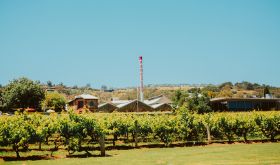
Mornington Peninsula's location is both a blessing and a curse. Just south of the cosmopolitan, affluent city of Melbourne – Australia's Edinburgh to the scruffier, more Glasgow-like Sydney – it is reliably cooled by breezes off the ocean shown above, so is a fine spot for the early-ripening Pinot Noir and Chardonnay, which it grows to the virtual exclusion of all other vine varieties.
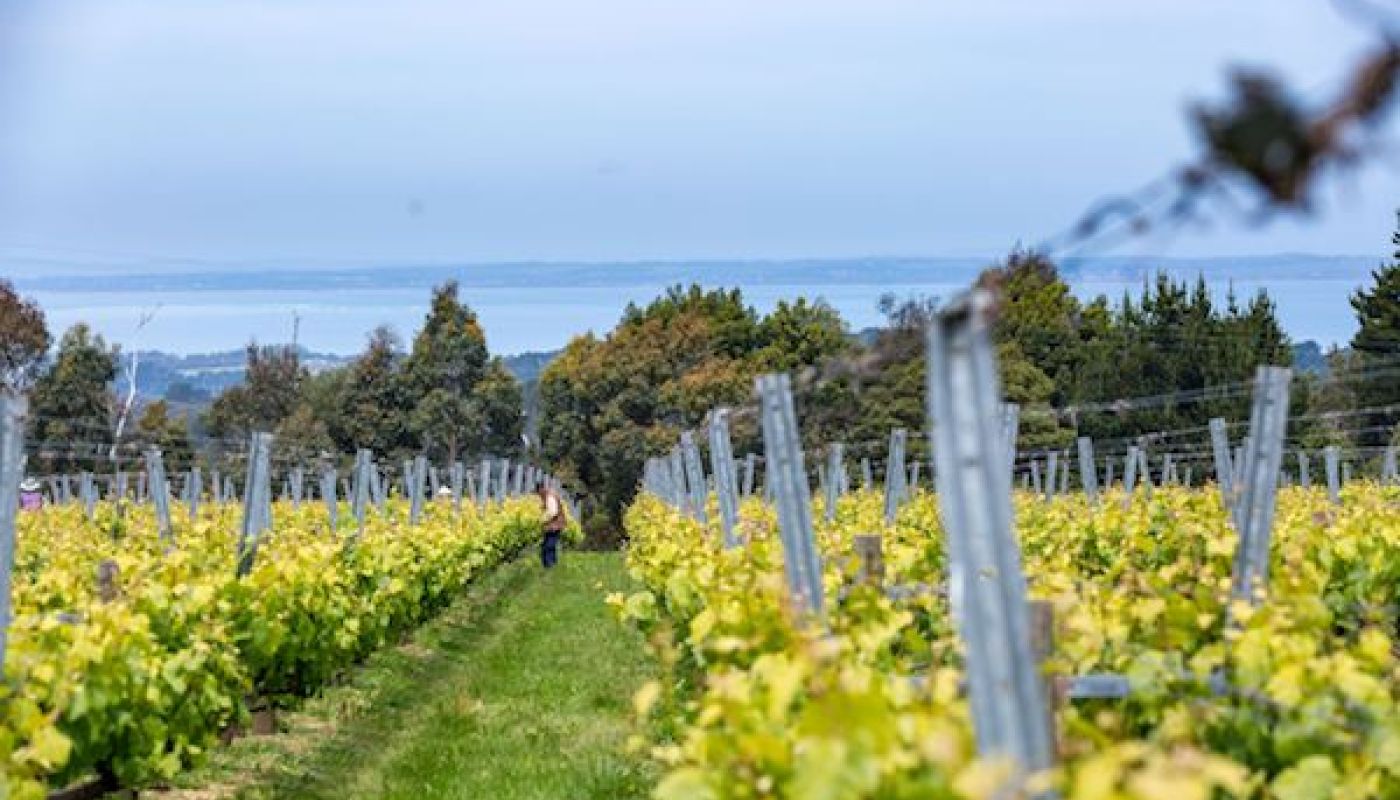
But, unlike the much more extensive Yarra Valley to the north east of the city, land prices in this Melbournian playground are almost prohibitively high so the region will never produce cheap wine. The potential for vineyard expansion is extremely limited, and it can be very difficult to buy grapes. So while the Yarra has become an exciting place for younger wine producers to experiment (admittedly with phylloxera present and necessitating considerable replanting), Mornington is pretty set in its ways. You can see the evidence of the coolness of the climate there below.

Not that those ways are remotely bad. As I wrote in Mornington Peninsula's delicate Pinots after visiting there in 2009, the area is producing some really very fine examples of the two famous grapes of Burgundy. But I think the producers are currently feeling a little overlooked in the UK. Last September a few of the more notable ones came en masse to London to show off their wares.
Perhaps the highest-profile of them is the award-winning Tom Carson of Yabby Lake, who conducted a special tasting of his 2016s and some of his 2012. But his personal project, Serrat, is a slightly Viognier-influenced Shiraz – in the Yarra. This is a really exciting wine, as well it might be at A$200 a bottle and up.
Carson reported that vintage in Mornington is now a full four weeks earlier than it used to be. It has gone from early May to late March at Yabby Lake. Some sites are now harvested as early as late February now, and 2016 was a hot vintage that was picked particularly early. Acid additions were fairly common for 2016 Pinot Noir, although Mornington Chardonnay very rarely needs acidification. Many producers are using a certain degree of whole-bunch fermentation to add zest to their Pinots. This was initially tried in the 1990s that were fairly cold and wet, so some were put off the technique altogether. Carson expressed concern that Mornington might eventually become too warm for Pinot 'so we'll all have to make Shiraz'.
One exciting exception to Mornington's varietal duopoly is mentioned below. The Crittendens got caught in the Albariño-that-turned-out-to-be-Savagnin saga, and instead of ripping out their Savagnin, or grafting it over to a more familiar variety, they have been researching the wines of the Jura and have been making a very creditable version of Savagnin aged under flor. See this wine of the week. The latest version is also very impressive.
The 29 tasting notes below are grouped by colour and then listed in alphabetical order of producer name but you can change this.
WHITES

This was the second vintage of this wine; there was none in...
From two blocks of Chardonnay planted in late 1980s with the I10...
Very difficult vintage with lots of rain. Picked a full four...
Probably about 20% new oak.
Fresh and lively and not too...
Very pale. Delicate and lively. Long, and fresh. Great balance –...
Deep straw. Crisp and yet with sufficient undertow of ripe fruit...
This was the notoriously wet south-eastern Australian vintage...
Low-key nose and lightly vegetal on the nose with marked acidity...
Rather unusually rich nose. Nice now – delicate and fresh. Long...
I10 and V5 clones. No sulphur until bottling. 12 months in...
Cheesy nose and excitement. Lots of development. Still lots to...
100% P58, the Penfolds clone. They are now picking earlier to...
They normally have 45 tractor-days in a vintage but in 2011 they...
More depth to this wine than the Red Claw 2016 and a bit more...
Tom Carson's second label. The earliest vintage ever; a warm...
One of Tom Carson's favourite Chardonnays. This has hardly aged...
REDS
Fourth vintage of this bottling from vines planted 35 years...
Northerly site, fairly sandy (‘ancient seabed’) and only 50 m...
Named after a tigress cub. Made on the same site as the grapes...
Warmer vintage (than 2017).
Floral note. Very clean, pure fruit...
Paringa Estate owns 60 acres and also buys in. Small yield...
Seeking organic certification. Waxed top. Highest vineyard in...
Single vineyard on a long-term lease at 170m. Fairly low but it...
Mid garnet. Much more intense on the nose than the other Pinots...
Jimmy Watson winner.
Still with firm ruby colour. Serious damp...
Very pale garnet. Extremely pure and haunting nose. Cool...
Mid garnet – deeper than the 2016. Vegy, leafy nose...
Very good vintage.
Nicely evolved nose. Firm and fine. Quite...
Transparent garnet. Pure, spicy and fruity nose. Grainy tannins...