Two stalls by the estuary in the fishing village just to the north of Cha-Am in Thailand would delight any chef or lover of seafood.
Behind the first sat a woman swinging her axe at a mound of oysters. Once the shells had been prised apart, she used a small knife to remove the meat that was then put into a plastic bag filled with water. A bag of twenty oysters cost less than a pound (about €1 or US$1.50).
The women and children behind the next stall responded to our order for blue swimmer crabs by running to the narrow bridge and hauling them up in buckets from the water, each crab's claws carefully contained by an orange elastic band, the colour that they would turn once steamed. These cost five pounds a kilo, although for an extra 50 pence someone would carry them to another stall just opposite to have them steamed.

Cha-Am has become a favourite destination for many Thais because of its beaches, some of the longest in a country blessed with more than its fair share, combined with its location, only a two-and-half-hour drive south west from Bangkok, on the Gulf of Thailand. As a result, many living in the capital have holiday homes here.
And while the town has less in the way of the shopping and night life than exists in so many other resorts, it more than makes up for it by giving full vent to the Thai passion for eating.
This pastime became obvious on my visit to the town's night market that is now one of the biggest in the country but caters almost entirely for the local population. Here the stalls selling inexpensive clothes, mobile phone covers and toys seem to be far outnumbered by those selling all types of food, some I simply did not recognise, as well as some particularly garish sweetmeats.
The full bounty of what is available locally only really became obvious at 8.30 am, however, when I followed Thanunya Kaikaew into the town's large food market.
Kaikaew, 24 (in orange in the distance top left and below), has been cooking since the age of seven, her obvious passion enhanced by an apprenticeship at The Mandarin Oriental, Bangkok, before her current position as Thai Executive Chef at the Alila Hotel just outside Cha-Am. She was to be responsible this morning for my first lesson in Thai cooking.
 Our first stop was the fish stands at the back of the market, where we bought half a dozen seawater prawns whose size surprised Kaikaew and would have shocked any European chef. They were vast, the size of my forearm, and immediately dictated a change in the menu. Instead of pad thai, the national dish of noodles, diced prawns and peanuts, these monsters would now be grilled and served with a tamarind sauce. Into her shopping bag also went a sea bass, clams and scallops that, topped with diced ginger and soy sauce, would be cooked for precisely two and a half minutes in the hotel's pizza oven.
 Next to the prawns were two local specialities. Stingray, which I said I would pass on, and horseshoe crab, gunmetal in colour, which is grilled to release the eggs that lie under the shell. This would later be served with a sauce of chilis, green mango, sugar, lemon juice and Chinese celery and, although it delighted the local chefs back in the hotel kitchen, it is not a dish I would order again. All texture and not enough flavour.
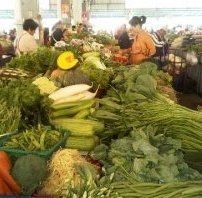
But for anyone living in the northern hemisphere, it was the stands we next moved to, and spent far less money at, that were, for their colour and sheer vitality, even more exciting. These were the ones piled high with galangal, wild ginger, Thai basil, a local basil with a strong verbena aroma, mounds of mint, small, green Thai aubergine, green papaya and green mango, coriander, the root of which is common to many Thai dishes, powerful dill, limes, and morning glory, the wonderfully invigorating green vegetable of south-east Asia. Like chefs in any market anywhere in the world, Kaikaew bought nothing without touching, squeezing or smelling it beforehand.
En route back to the hotel I saw three other different types of cooks getting ready for a busy Saturday's business.
There were the men in front of large, open barbecues, energetically turning the wooden poles on to which were linked chickens, three to a row, that had been opened and flattened, or whole pigs, above high flames. At the beachfront were the female cooks rather more sedately ladling out Thai rice soup, a breakfast staple, in one case to a policeman. Finally, back by the fishing village were the low, wooden restaurants whose menu was contained in their fish tanks full of what the two fishing boats nearby had just landed.
Back in the kitchen, I began by shelling the prawns, removing the central vein and then cleaning all the scallops and clams. I watched in admiration as Kaikaew elegantly removed the entire bone structure of the sea bass before stuffing it with long, thin slices of ginger and coriander and then pouring chicken stock, soy and oyster sauce over it and finally some white pepper. It would be steamed for 15 minutes.
I then turned vegetable chef, dicing shallots, ginger, coriander and squeezing the limes before the fun started: my 15 minutes of fame as a wok chef.
This stint included making a tamarind sauce with tamarind- infused water,
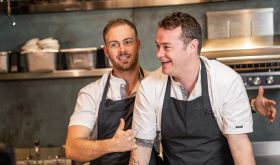
 palm sugar, ginger and fish sauce; stir-frying the medium-sized prawns with chopped garlic and soy; turning the wok up to cook the clams with lemon basil, oyster sauce, chilli paste and chicken stock; and in a pan I made a local soup with the smallest prawns, diced Thai aubergine and wild ginger, shallots and shrimp paste, all ground together in a pestle and mortar, and very hot stock. [You may spot some members of the JR.com, inc progeny, in this picture.]
But for what seemed like the simplest dish, cooking the morning glory, I had to make way for an expert. This necessitates turning the wok to its highest heat and into my place stepped a female chef, far smaller but obviously far more experienced. It took her 90 seconds to transform the raw material into a delicious dish that I had no qualms about eating in about the same amount of time.