
In the music world, the term ‘residency’ conjures up images of well-established divas belting their way through endless greatest-hits runs on the Las Vegas strip: Adele, Streisand, Sinatra (by this stage, one name is usually sufficient). But in the world of food, it indicates quite the opposite – up-and-coming talent still trying to make a name for itself, bright young (and not so young) things whose repertoires have yet to atrophy through habit, mass-appeal conservatism and the paralysing worry of bricks-and-mortar overheads.
More Russian roulette than Caesars Palace, restaurant residencies can be a chance to get in on the act before fame’s inevitable dousing of cheffy fire. Of course, there’s always the chance of a duff one proffering avant-garde reindeer schnitzel and anchovy custard but you takes your chances. Much rests on the skill of the host venue in nosing out real talent. And the Compton Arms has an exemplary track record in that regard: Dara Klein’s Italianate Tiella, before that Four Legs (now permanently unipedal at The Plimsoll) and Reece Moore aka Belly London.
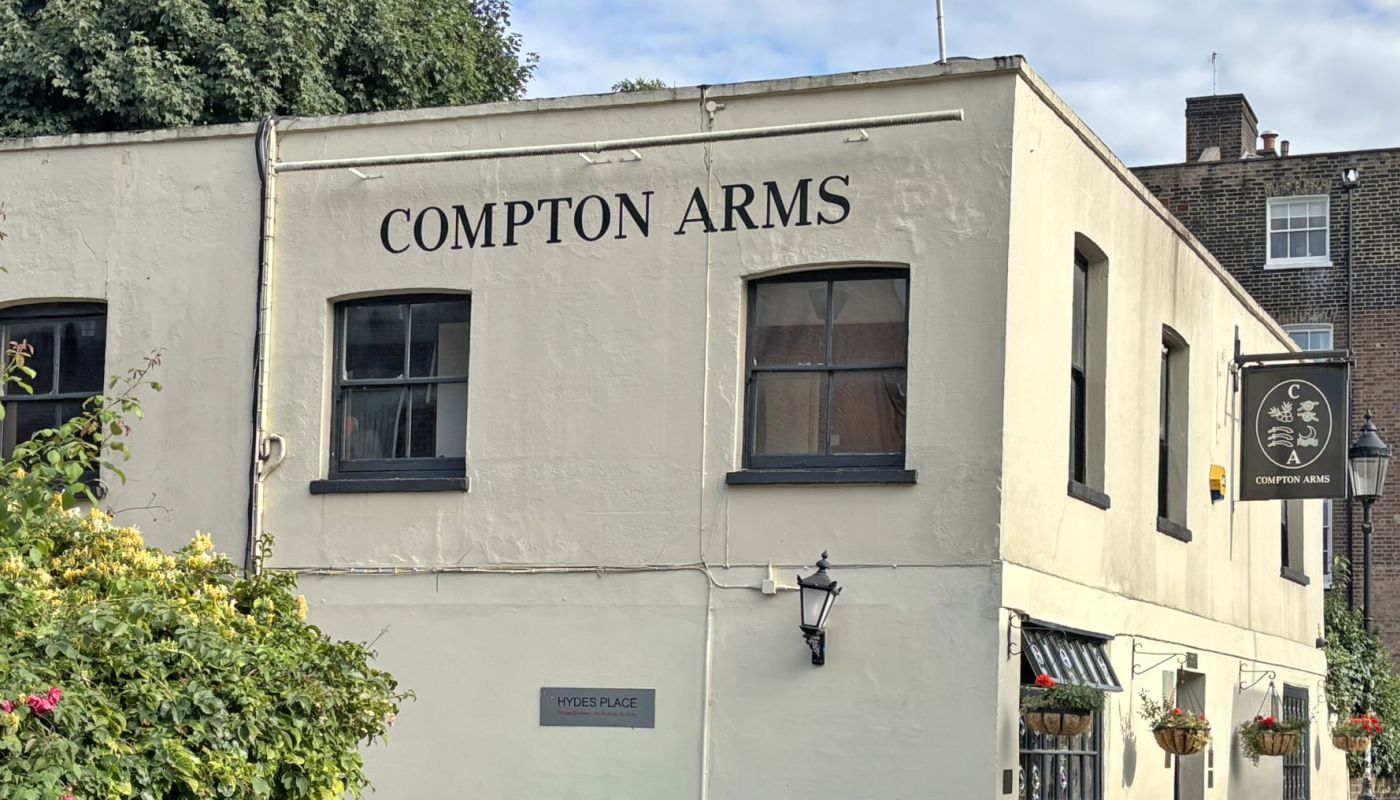
The pub itself is a relatively anonymous boozer behind the Union Chapel as Islington shuffles off towards Highbury. Its off-the-main-drag position keeps the hullabaloos of Upper Street nicely at bay, exactly as George Orwell noted in the 1940s (the place was inspiration for The Moon Under Water, his Platonic ideal of the British pub). The interior is pretty much what you’d expect: random foliage in milk bottles decorating prop-and-slurp perches in the pubby bit and squat-’n-gobble tables in the ‘snug’. But it’s done with disarming honesty and the minimum of white-washing gentrification.
In true contemporary style, you can stand out front to sip your aperitif/pint, round the corner from the industrial bins, carefully avoiding furious middle-aged accountants on bikes (don’t-look-now Lycra and anger issues being quite the thing round here). But it’s safer out back, in a quintessentially London pub garden. What in Orwell’s time had been a rambling, tree-strewn expanse is now a tiny yard prettified with abstract tiles and a few potted plants.
The pub’s kitchen is now the hands of Rake (London) marching under a banner of ‘Old World Food, New Age stylin’’. I wondered if I wouldn’t rather have ‘New Age Food, Old World Stylin’’ as I took my seat but on balance I think they have it the right way round. Their slogan goes on, ‘All Fish – No Frills’ which is puzzling given the far from exclusively fishy menu. Concerned that ‘fish’ might be some ominous Islington patois, I cranked up that old favourite the Urban Dictionary. To my surprise there were 586 pages of alt meanings for the word ‘fish’. No obvious candidates, though: new prison inmate, online poker player and annoying tourists from Illinois being some of the more repeatable options.
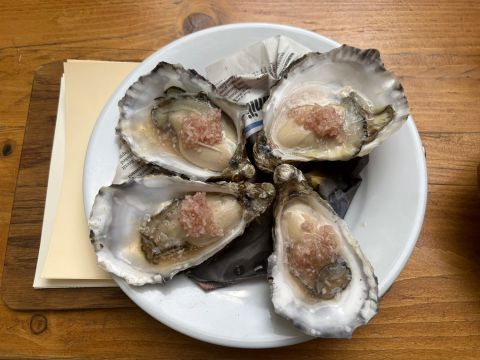
I was still chewing this over when the first of our dishes appeared: actual seafood, in the shape of oysters. A regular on Rake’s menus – baked into a rarebit or served Kilpatrick/Kirkpatrick with bacony, Worcestershire-saucery – they were being offered with shallots and a splash of Riesling that week. Despite the hot summer and there being no R in the month, I convinced myself that modern farming methods and proper fridges were on my side. Reassuringly, M F K Fisher (in Consider the Oyster) was content to eat them far from the sea in the summer and liked them with ‘cold Alsatian wine’, too (Riesling, probably). It’s almost as if she’d been to N1, I mused, as the cold iodine of the oysters slipped down. Sadly, the shallot overpowered any potentially interesting wine notes, masking the buttery, cucumber lilt of the plump Pacifics into the bargain. A wasted opportunity, especially as shellfish had been something of a house speciality back in Orwell’s day.
A forgettable Bourgogne Aligoté was no match for the allium onslaught, either: it was so underwhelming that even the wine list couldn’t bring itself to provide details beyond ‘FRA 2023 12.5%’. We quickly traded down in price and up in value to a straw-yellow Catarratto from Maremosso. A straightforward Terre Siciliane, it was leesy, yellow-appley and blousy but promised to be a good foil for fried things like the beer-battered cockles and clams. These, however, turned out to be ‘All Frills – No Fish’, their light rock-pool character having drowned in the industrial fat fryer. Two cockles and a clam clinging to a glorified bamboo toothpick – three to a glass – didn’t read as generous either. Even for Islington.
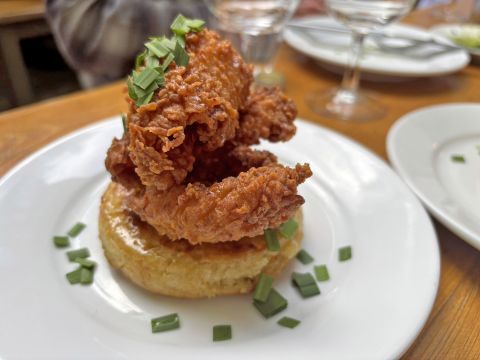
On a more successful note, ‘ray wing tenders on crumpet with hot golden syrup’ was an iconoclastic triumph. The term ‘tender’ usually refers to chicken and loosely covers any goujon-like breaded cut. Here, they were reimagined as soft filaments of ray flesh encased in a nicely seasoned crust. Sitting atop goodly crumpets and anointed with syrup, they made a lovely, playful nod to US diner chicken ‘n waffles.
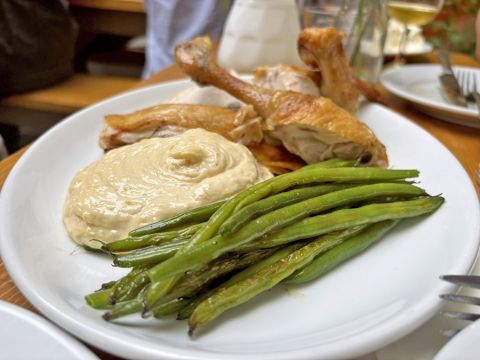
To go with, we ordered the Cornish Red chicken with marigold. From the other end of the culinary spectrum, this was cooking liberated from modish reinterpretations of junk food. Classical even, the chook was tender and savoury with perfectly burnished, three-weeks-in-Marbella skin. The marigold element was a generous spoon of yellow-flecked aioli, the petals adding a distinctive peppery-citrus note in place of more trad flavourings like saffron. Served plainly with French beans, this was homey bonne femme cooking. An accompanying ‘simple salad’ was self-explanatory, and a dish of peas came as whole charred pods, the little jewels inside to be slipped out between your teeth like peculiarly British edamame. Proper-sized chips with chip-shop-curry mayonnaise brought up the rear: piping, crusty, tasting of sunflower oil and misspent youth, just as they should.
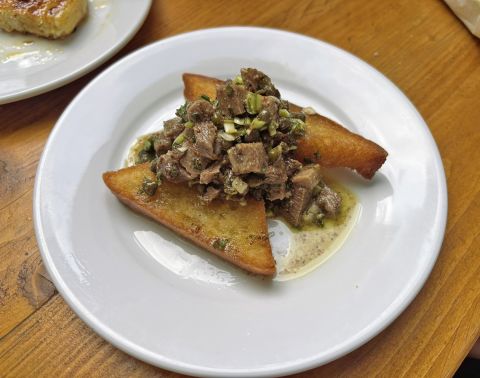
La cuisine bourgeoise took a left turn into the greasy spoons of the East End via the gentlemen’s clubs of St James with another joyous disjunction of a dish: ox tongue with capers and fried slice. Recasting the golden croutons of bistro cooking as a kind of Ian/Kathy Beale breakfast special with English-savoury pretentions is the kind of wicked license only to be encouraged. Such contrary cooking called for an equally nonconformist red, in this case the cherry and rubber tires of a Pipeño Tinto 2021. An old-vine Chilean País, it managed to be both light and brawny, perfect to cut through rich offal-y depths. Chilled, its ambient-yeast, unfiltered bravado was rather appealing; as it warmed, the tannins roared into action with a bolshy machismo that made the Duralex tumblers in which it was served seem almost effete. Like much of the wine list, it was bold and relentlessly ‘of the people’.
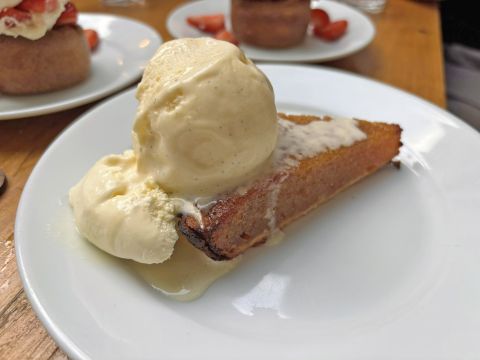
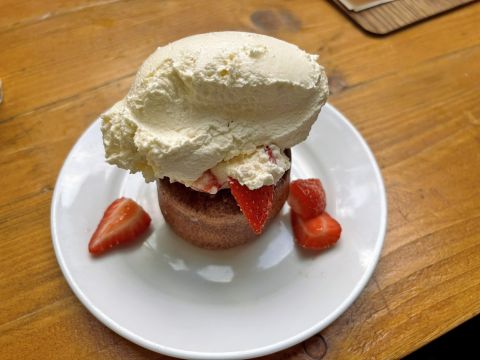
Puds came in the shape of a treacle tart gilded with clotted cream and vanilla ice cream, and something called a Hooligan accompanied by strawberries and more cream. A reference to the hoodlums of Upper St? Mercifully, it bore no relation to Miss Hooligan’s cake, the confection immortalised in Joyce’s Finnegans Wake that could ‘kill a man twice after ’ating a slice’. It was just a buttery friand, benign and with something of a cream-tea gentility about it. More Rake than Wake.
It made a suitable ending to a meal I’m tempted to label iconoclassical Brit food, London grub(by) even – the latter a more refined, thoughtful evolution of dirty-food deliciousness. Whatever you call it, Rake’s cooking cleverly doffs its baker-boy cap to influences wherever it finds them: France yes, but also US diners and the UK vernacular of seaside chippies, tea rooms and c 19th-century eating houses. Roaming across both geography and history, this is the kind of nomadic cuisine that epitomises a good residency yet to settle down into a familiar groove. Instead, reimagined standards fight for the spotlight with experimental, prog-rock dishes bold enough to risk the odd bum note or overwrought delivery. Best of all, there are no signs of tweezer-wielding prima donnas here, nor shadowy Svengalis in thrall to off-shore holding companies. And for avoiding that particular brand of Orwellian restaurant nightmare, hearty applause and a couple of encores are definitely in order.
Supper with generous wine and half shares in a pud, £62 per head.
Rake @ the Compton Arms 4 Compton Ave, London, N1 2XD; Wednesday to Sunday.
Ben is covering restaurants this month while Nick Lander is on vacation; see his review of Beach House in Wales last week, and sign up to our weekly newsletter to keep tabs on where he goes next.