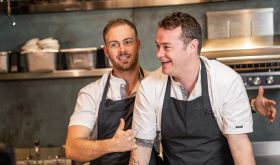
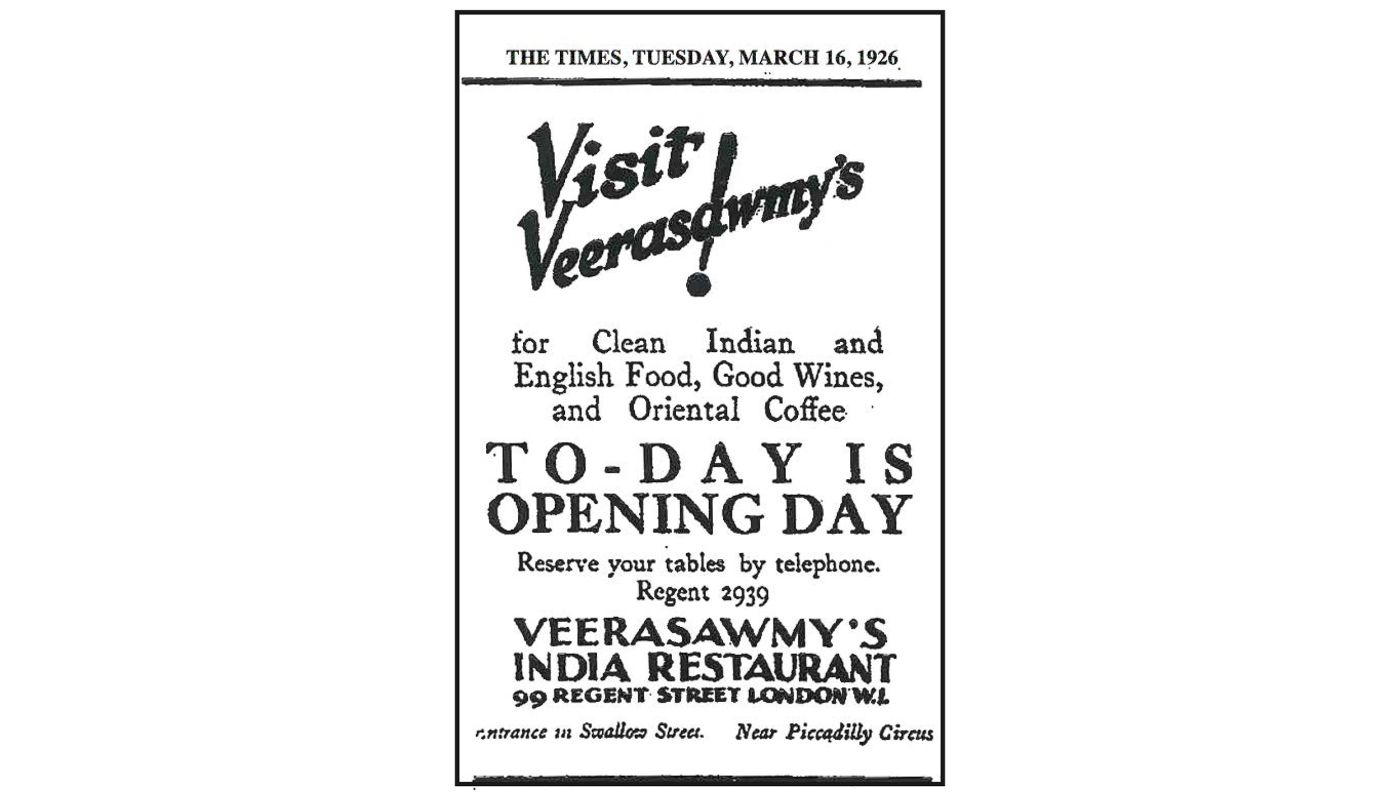
I decided to book a table for us at Veeraswamy for several reasons.
The restaurant has been in the news recently because of a dispute with its landlords, the Crown Estate, over the possibility that a new office development could deprive it of its ground-floor entrance between Regent Street and Piccadilly. Since Veeraswamy has been serving Indian food in this location for 99 years, this would be a great shame. (It opened in 1926, the same year as L’Escargot in Greek Street opened as London’s first French bourgeois restaurant.) An upcoming centenary made the restaurant seem worth investigating.
A facsimile of an early menu posted in the penultimate page of their current all-Indian menu reveals that originally much was on offer besides Indian dishes. Their five-shilling (25-p!) three-course menu offered, alongside lamb, lobster and game curries, a long list of such alternatives as lobster mayonnaise, roast chicken and jugged hare as well as diplomatic pudding.
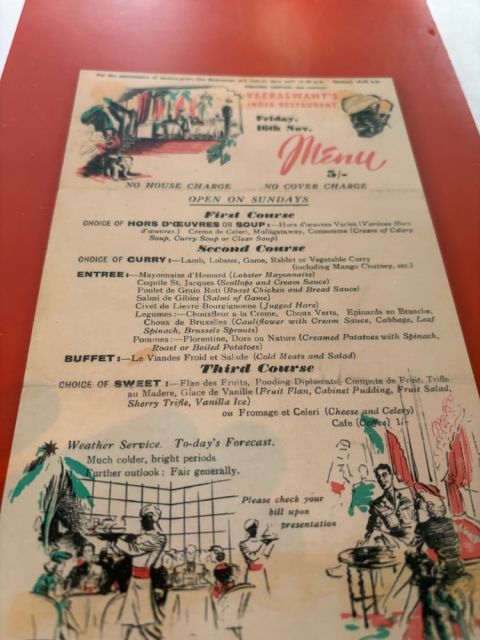
When JR asked the charming maître d’ why this was, his reply led straight to my third reason for choosing this restaurant, ‘In those days, ma’am, not everybody enjoyed Indian food.’ Today, however, everybody enjoys spicy food. It is the biggest change in restaurants over the past 40 years, bigger even than the rising cost of eating out. And the UK, with its close connections to India over the past three centuries, is the first country to witness and to enjoy this. Shamil Thakrar, who, with his cousin Kavi, founded Dishoom 10 years ago and introduced us all to the charms of a spicy Indian breakfast, told me that last week alone his group of restaurants served 120,000 customers in their 10 branches in the UK.
Veeraswamy sits at the apex of a group of Indian restaurants controlled by Ranjit Mathrani, his wife Namita Panjabi and her sister Camellia Panjabi, which manages the less expensive Masala Zone group, Chutney Mary and the one-off Amaya restaurant in Knightsbridge. Veeraswamy has a Michelin star.
This may explain its quite aggressive welcome when you go to book online. The first item on their website in black capital letters is MINIMUM EXPECTED DINNER SPEND of £60 per person. Since many of their first courses begin at £20, their main courses at £30 and their service charge is a high 15%, this seems rather unnecessary.
This is followed by a list of proscribed clothing – no sportswear, no shorts (men), no torn or scruffy clothes (either gender) – which again I found heavy-handed and not in the least welcoming. Next up is a pretty strong anti-children policy: none under 11 except at the weekend when it is none under seven. Nevertheless, I persisted.
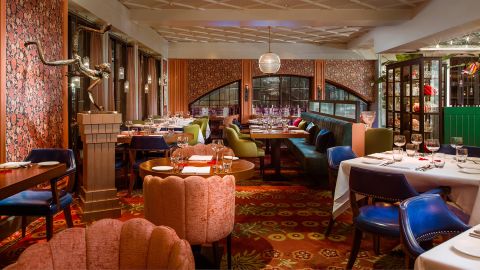
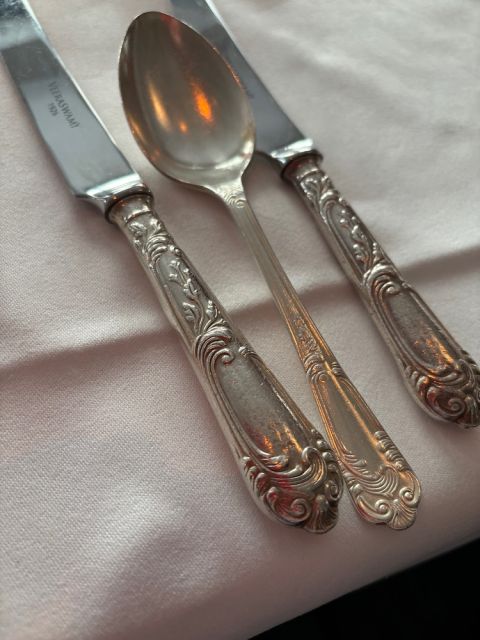
We were welcomed at the entrance by an elderly man in a bowler hat, rather than the Indian in a turban that I remembered from the past, and took the lift to the first floor where the restaurant is situated. It was quite dark, with busily patterned carpet and wallpaper, and already full and busy at 7.15. All the tables are laid up with rather old-fashioned cutlery on thick white tablecloths and a white undercloth. The waiting staff are all dressed in black.
We were taken to our table and were left with the cocktail list. They clearly like customers to order a cocktail from the bar before their meal and the waiting staff seemed rather surprised that we didn’t, but the list also, fortunately for us, includes their wine-by-the-glass programme, all offered by the 175-ml pour.
The selection is excellent. They have an impressive array by the glass which includes an Etna Bianco 2023 at £19, a Chapoutier Condrieu 2023 at £37, a 2024 Riesling from Eva Fricke, a Barolo Albe 2021 from Vajra and a Bee-Side Grenache 2022 from Domaine of the Bee. There are also two headings, ‘Fine’ and ‘Classic’, which include wines from Au Bon Climat in California and from Alain Michelot in Burgundy.
But my enthusiasm was somewhat eroded by a line that appears at the bottom of their wine-by-the-glass page which reads, ‘All the above listed wines are also available in 125-ml serve for the same price as the 175-ml.’ I bet they are! This is the first time I’ve ever encountered such a cunningly ungenerous pricing policy.
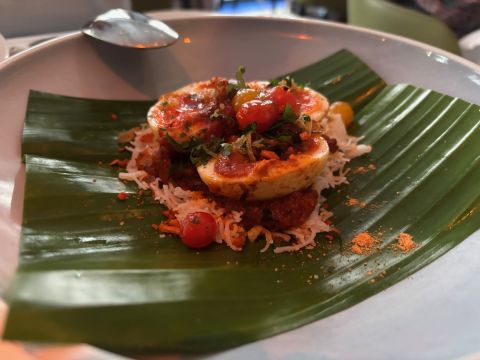
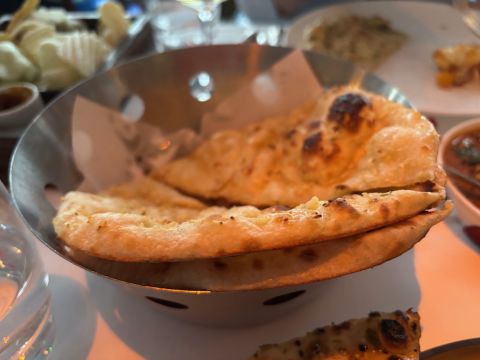
Their menu is extensive but I had already made up my mind what I would order before I had sat down. I would start with the mulligatawny soup, based on a recipe from the original chef, and then I would move on to a dish called ‘lampreis’ whose description had fascinated me. JR, as ever, chose two starters: a spinach leaf chaat consisting of layers of crisp spinach leaves topped and surrounded by yoghurt, and, for the very first time in our marriage, an egg dish – the egg roast masala, above, a Keralan dish of eggs roasted in masala gravy. With this, she ordered the bread basket – we are both huge fans of naans and roti – oblivious to the fact that this item alone would constitute 10% of our total bill and we ate only a small fraction of it. Below is what was left of our three naans.
The mulligatawny soup was very good, poured from a jug onto a bowl with warm rice at the bottom. It was not too spicy: none of the food was, and the thread of sweetness that runs through all the food would anyway temper any excess spice. Or perhaps they have come to appreciate just what their customers, principally American tourists on the night we ate there, will tolerate.
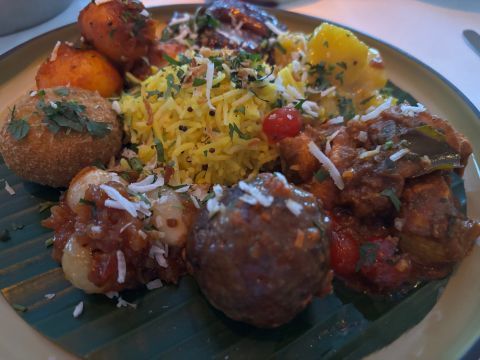
Lampreis or lamprais – as opposed to lampreys, the local speciality of Bordeaux – is a dish that sounds wonderful on paper. Its origins lie in Sri Lanka where the Dutch settlers conceived of curries, rice and various other accompaniments all baked in a banana leaf. What arrived was a plate of various unrelated ingredients – crab cake, chicken curry, pineapple, pickled onions – which had been placed round a mound of rice on top of which a pristine banana leaf had been deposited. Below is what it looked like after I removed the upper banana leaf. It was definitely not a dish that was more than a sum of its parts and it left me disappointed.
I normally relish Indian desserts – I am a sucker for a kulfi – but we had had enough and I asked for my bill which, when it was presented at £232.30, came as a shock. We had had three glasses of wine – one at £37 – three starters and one main course, one bottle of sparkling water, £8.50, but no dessert, tea or coffee. The papadums and small pots of three chutneys were £8.50, while for the privilege of being served three naan, the result of a quick transformation of flour, yeast, nigella seeds and some yoghurt, I was charged £20 or in fact £23 once the 15% service charge had been added.
I left Veeraswamy disappointed and angry, two sentiments I do not normally associate with visiting a restaurant in central London. The disappointment came not just from the poor quality of the cooking but also from the brazen attempt to rip me off. The profit margins on the bread basket, the papadums and the bottle of mineral water are excessive in my opinion.
My anger was somewhat different and perhaps due to the fact that I had visited India in the past year. Why was Veeraswamy persisting in projecting an image of a country and its cuisine in an atmosphere that is dark and clubby, reminiscent of an India of the past? Today, it is a country that is colourful, modern and forward-thinking and it possesses the chefs and the cooking to match. It is no longer a vestige of the Raj, as it is portrayed by Veeraswamy today.
Veeraswamy Mezzanine floor, Victory House, 99 Regent Street, London W1B 4RS; tel: +44 (0)20 7734 1401
Read more of Nick on Indian food and restaurants.