Victoria Vigliotti writes an Italophile with a passion for wine, I earned my DipWSET earlier this year and have industry experience spanning wine marketing, events, hospitality, education, and cellar work. Though I retired from writing after high school (when it was no longer a required class), my biggest fan has encouraged me to write every day since then. I saw the topic for this year’s competition and knew it was time to come out of retirement. Thanks for the push, Grammy.
The grape awakening
Having lost a wheel to the bumpy cobblestone streets of Florence, I drag my three-wheeled suitcase to the door of my new home for the next five months. Lugging overweight bags up four flights of Italian stairs is no joke—especially when you think it’ll only be three flights to get to the “fourth” floor. I open the door to be greeted by my five friends, who clearly, have also just experienced the Italian phenomenon of the piano terra. It didn’t take much to convince the group that unpacking could wait, and it was time for an early dinner and drinks—we are in Italy after all.
At the table, I’m immediately handed a Bible—a thick, hard-covered list of elaborate names each spanning the entire width of the page. Jet-lagged and overwhelmed with options, I simply choose the first red wine on the list. “Un bicchiere di Chianti Classico, per favore,” I recall from Italian class. “Certo, è la specialità della Toscana.”
“Cin cin!” We clink our glasses together and toast to the first night of our semester abroad. I go in for a sip of wine and think, mmmmmm, I could get used to this. In that moment, I felt the warmth of the Tuscan sun awakening something in me. I knew nothing about tannins or terroir—I just knew it tasted like Italy and I was exactly where I was supposed to be.
Wine soon became a staple in our Florentine apartment—dinners at home just weren’t complete without it. Conveniently for us, our apartment overlooked a piazza with a local supermarket.
“I’ll go on a wine run,” I volunteer. Passing the self-squeeze orange juice machine, the bounty of fresh produce, and the alluring cheese counter, I stumble upon the motherload: shelves lined with wine as far as the eye could see. Overstimulated by the cornucopia I just entered, I feel a sense of serenity when I finally lock eyes with a familiar name. I bring a few bottles of Chianti Classico, and our blossoming friendship, back to the apartment.
We ignore the foil and puncture it with the infamous winged corkscrew, pressing both of its arms down until we hear the pop of the cork coming out—music to our ears. We spent that night, like many others that semester, sipping on our Tuscan liquid treasure, laughing about the grammar mistakes we made that week in Italian class, and people-watching through our open window.
One of the many incredible benefits of studying abroad was the opportunity to join immersive, often gastronomic-themed, class trips through the city. Some involved hair nets and making gelato, while others called for aprons and risotto, and some gifted us mini cups of olive oil.
“Start by swirling the oil around in your cup,” the instructor demonstrated, “then bring it to your nose and inhale deeply. You’ll notice the subtle almond, herbs, and spice.”
Almonds? Herbs? Spice? Isn’t this just olive oil in a plastic cup?
“Olive oil is like wine,” she continues, “each with different flavors and aromas, meant to be savored, and shared.”
And so, when in Rome, we did as she did: swirling, smelling, tasting, and savoring the olive oil in our cups. And you know what? She was right.
I decided to trade my fruit set outlook for her véraison mindset. I read online that Sangiovese grapes are known for red cherry and red plum flavors layered with savory notes of dried herbs, balsamic vinegar, and earthiness. I kept this knowledge in my back pocket and brought it with me each time I ordered wine. I began to truly taste the wine, not just drink it. My appreciation for wine ripened slowly over the next few months, as did my desire to learn more.
By the end of that semester, my interest in wine was ripe for the picking: I researched classes, decided to formally study wine, and have never looked back.
And so, this is my love letter to Sangiovese.
To the grape variety that awakened me from a dormancy I didn’t know I was in,
to the variety that planted a curiosity in me,
to the variety that ripened my interests into a path,
to the variety that’s lively, versatile, complex,
to the variety that reminds me of me,
grazie mille.
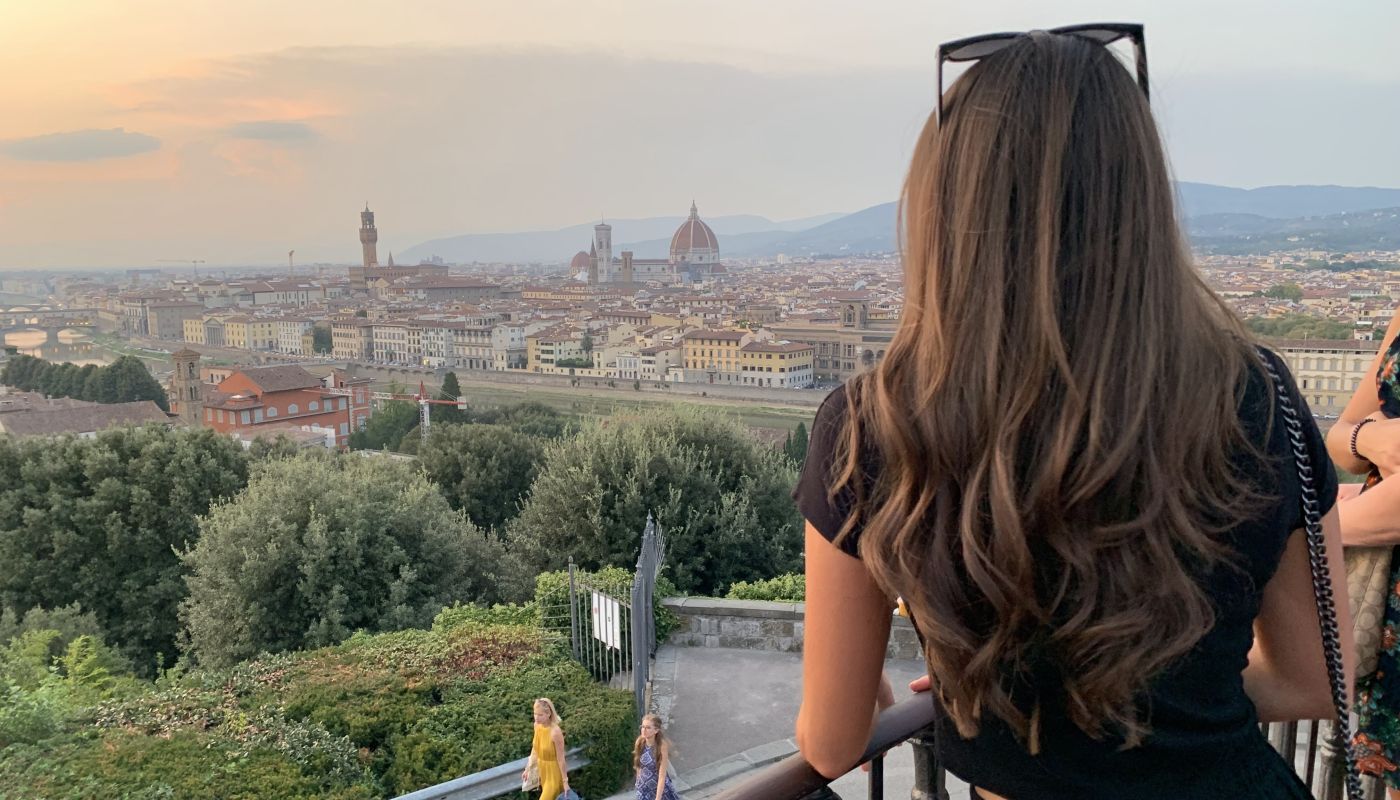
To most, a glass of Chianti Classico probably tastes like red cherry, red plum, dried herbs, balsamic vinegar, and earth. But to me, every glass of Chianti Classico still tastes like seeing the Statue of David for the first time, overlooking Florence at the top of Piazzale Michelangelo, and yes, it even tastes like losing a suitcase wheel to the city’s cobblestone streets—and not even being upset about it.
The main image is courtesy of the author.
















