Giovanni Di Guardo writes my name is Giovanni Di Guardo. I am from Italy where I live in Pontremoli, a tiny medieval town in Tuscany. Since my college graduation in Catania in 1984, I have been travelling all over the world for my job as naval logistics specialist. In 2005 I earned my MA at St. John’s University, New York (NY). I began to follow my life-long passion - wine - since my early retirement. Therefore, I decided to deepen my knowledge and I am now WSETL3, CSW, Sommelier (AIS). I currently work as Sommelier in a gourmet restaurant in La Spezia, Liguria.
The king of Mount Etna: Nerello Mascalese
I grew up in Catania, a lively town situated along the eastern coast of Sicily in a unique position, caught between Ionian Sea and Mount Etna. In Catania I studied until my college graduation, I learnt to swim and to ride a motorcycle. And there I had my first coup de foudre for a girl and I sipped my first glass of wine.
I still remember - fifty years later - the stunning sensation of that very first glass of wine.
That one night I decided to ride my motorcycle with my girlfriend up to Mount Etna. It was a one-hour ride to reach the hamlet of Randazzo, in the north slope of the volcano. We were in the late seventies, the teenagers rode motorcycles without wearing a helmet, there was no google maps to drive us, there was no guide to indicate a place in which you could have a bargain meal. So going around for a student like me was almost an adventure.
That night I found that typical trattoria only by chance. I still remember its name: “La Stella Mattutina” – The Morning Star. It was a wooden cottage, sitting on top of a lava bench at a bend of a mountain road, in the middle of a moon-like scenery. I do not have distinct memories about the food we had, although the fresh pasta with mushrooms was surely worth the stop. At that time college students, even in Italy, were used to drink beer and I made no exception. But the waiter told me that they did not serve beer: what they had was wine. Wine? That was something that did not seem appealing to me at all but I had no choice. The waiter brought us some wine in a carafe with two cheap glasses. I had no previous experience with wine but as soon as I started smelling that liquid I felt caught in something fascinating. I smelled and I smelled again then I had my first sip of what I learnt to be an Etna red, based on Nerello Mascalese grape. My then untrained palate felt a wave of earthy flavors, forest berries, mediterranean spices and mountain flowers. In that inexpensive glass of wine, I felt the lava, the volcanic soil, even a scent of a distant sea breeze. I felt the whole Etna landscape.
My passion for wine sparkled that night and never abandoned me ever since.
Many years later I became a certified sommelier. One day, while I was focusing on concepts such as “terroir” and “autochthonous grapes,” that first glass of wine suddenly came to my mind. Sure! I realized that there was no better example of terroir than the Etna viticulture and nothing could match the autochthonous king of its grapes, intrinsically tied with its terroir: Nerello Mascalese.
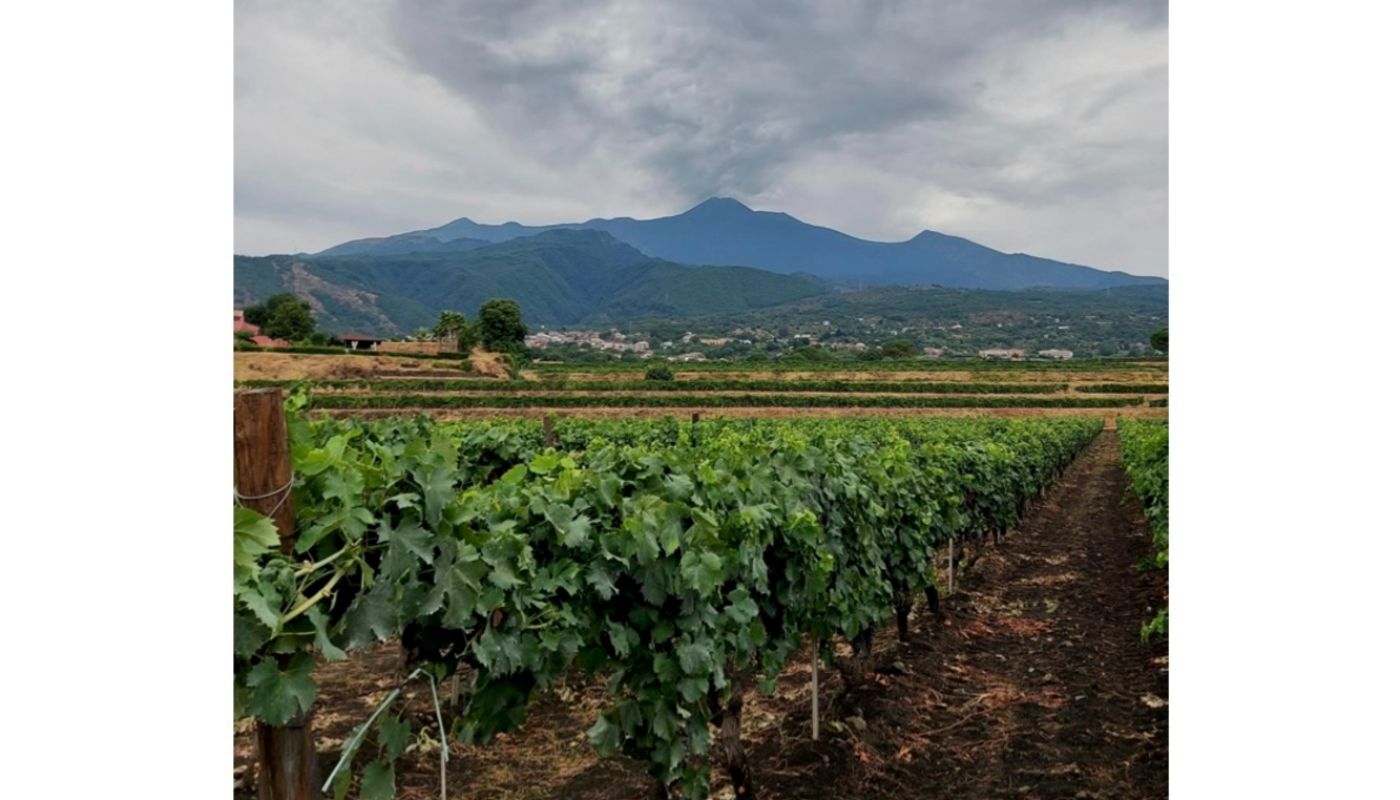
The late-ripening Nerello Mascalese, a natural cross between Sangiovese and Mantonico Bianco, is wild and untamed just like the volcano it thrives in: it has a striking acidity, it is resistant both to water stress and to extreme raining conditions, it is capable of ripening even up to 1.000 mt. asl in the sandy lava soil.
Nerello Mascalese takes its name from the tiny hamlet of Mascali from where - through the coastal town of Riposto - the Etna wine was shipped to the main mediterranean ports. Curiously, over the years the Etna wines did not develop a reputation for their quality. The fact that my first Nerello wine was coming out of a carafe was pretty much the rule at that time and the bottled wine the exception. Although the DOC had been established in 1968, the first quality Etna wines appeared only during the eighties due to a bunch of inspired producers.
The Nerello Mascalese vines were traditionally free standing alberello (bush). This way the vines could get all the heat coming from the lava ground, stay safe from the cool northern winds thus achieving the ripeness in vineyards often close to 900 mt. asl. Of course, with this kind of training the grapes of Nerello had to be collected by hand. But at the end of the sixties there was a massive emigration of the vineyard workers to the north of Italy where they could get better salaries working in the industry. The necessity of introducing less labor-intensive cultivation led to the mechanization in the Etna vineyards. This caused a large modification in the training method of the Nerello Mascalese vines that eventually led to the adoption of the VSP. But here and there it is still possible to see some alberello vines spread without a geometric pattern or traditionally placed with the quinconce system (the vines are disposed like the number five in a dice with a vine in the center and four vines in the sides).
Nerello Mascalese resisted fiercely to the Phylloxera pest, in this helped by the sandy volcanic soil, so it is still possible to taste some wine coming from 140-year-old vines. Here Nerello shows its being reflective of the volcano and its changes. The Prephylloxera Nerello wines show a deep ruby color with layers of aromas and flavors of black cherries, plum and mediterranean spices with fat tannins. The grafted Nerello wines have a gentler color and a complex aromatic profile of cherry and forest berries, finer tannins, and often a brackish closure.
And more recently Nerello adapted to the changing tastes of the wine lovers without giving up its racy character and its close ties with the volcano. The contemporary Nerello proved its versatility becoming fruity and earthy, in its seductive rosé version, vibrant and refined in its traditional method sparkling wines, and even opulent and sumptuous but still refreshing when vinified with the appassimento method.
Refined or rustic, vivid or bold, still or sparkling I love you, charming and savage Nerello Mascalese, king of the grapes of Mount Etna. Thank you for showing me the path of wine that became my life-long passion!
The photo of a Nerello Mascalese vineyard is the author's own.
















