Meg Siobhan writes Meg Siobhan is a wine educator and storyteller on a mission to uncover America’s best-kept wine secrets. Through her brand, American Wine Rebel, she explores off-the-radar regions, independent wineries, and celebrates the stories of the people and places behind every bottle.
Memories of Marquette
I knew we’d met before. Even in the dimly lit production room, crowded with mismatched tanks and wine-splattered concrete floors, I could smell him- blackberry and pepper with that smoky, restless edge I hadn’t forgotten.
I had been 21. He was quiet, but confident. He was rebellious in a reserved way. I might have overlooked him like many of my friends had. Most opted for more exciting choices, taking tequila shots and lemon drops to the backdrop of loud music and flashing lights. As the years passed, these same friends leaned into refinement, trading solo cups for bottles of Bordeaux. Even as I was dazzled by the array of fine wine I grew to appreciate, I always knew I would eventually return to him.
Some people fall in love with Pinot Noir. I fell for Marquette.
When I was younger, my mum took a job at a local family-owned winery in Michigan. The production facility was little more than a glorified garage in the backyard of the couple’s home. As a family-run business, it was all hands on deck, including my brother and me when we were home on breaks from college. As I carried boxes of bottles to the assembly line where we would manually fill and label the bottles, I had to dodge the family cat, who had a bad of habit of being underfoot whenever anyone was carrying something.
There was always a fight for who would get the aux cord to the single speaker near the bottling line. Would today be a day for the Beetles or a top 40s pop playlist? Regardless of the music, bottling felt like a race. Don’t be the one to hold up the line. If we finish before 5:00pm, we all have time for a glass of wine.
The wines we bottled and drank on the porch of the owners’ home while we were still sweaty from working weren’t ones most people would recognize. The grapes that grew in cold mid-Michigan were a gang of often-mispronounced misfit French-American hybrid grapes with names like Niagara, Catawba, Cayuga, and Marquette.
Marquette is a grape that’s cold-hardy, disease-resistant, and is almost never added to the wine list. While Cabernet dazzles in Paris and Napa, Marquette is growing quietly in places rarely thought of when it comes to wine, like Michigan, Vermont, and Minnesota.
In a world where American wine is condensed down to two buckets: cheap mass produced “red blend” table wine, and pristine Napa Chateaus, Marquette offers a third option. Marquette embraces the sense of terroir as not just a sense of place, but a sense of people. Scrappy winemakers across all states coming together with their families to craft wine from local grapes and share those wines with the community.
This isn’t the type of wine that looks like sexy dinner parties and rooms full of cocktail dresses, shrimp hors d’oeuvres, and fine shiny stemware. Marquette is a wine you open on a Tuesday with a friend after a long day of work. It doesn’t ask for pretense, only presence.
Now, as I crossed the production garage in the craft winery I was visiting, I stepped over hoses twisting across the concrete floor and reached out my hand to take the glass of Marquette the winemaker had offered to me. I saw him out of the corner of my eye watching me intensely as I brought the glass to my lips. I took a sip. First the tart cherry hit, bright and punchy. Then came the pepper, dancing on my tongue with the subtle tannin. It tasted like the winery where I grew up. Like the cold Michigan nights. Like the space between underdog and icon.
“These vines are planted just over there.” The winemaker gestured to door leading out of the production room to the small vineyard outside. “We considered pulling them up to plant Cabernet Sauvignon, but we decided to experiment with the Marquette first and see where it takes us. Right now, we’re playing around with a rosé!”
As I stepped outside and looked toward the vineyard, I could feel him again. Marquette. Not in the glass, but in the air. In the quiet defiance of those vines still standing where another vineyard of Cab could have been. It seemed to represent equal parts hope and grit.
I’d spent years chasing the flashier wines, the ones that got all the attention. But somehow, I always came back to him. And if I’ve learned anything from my years exploring wine, it’s that the ones that stay with you aren’t always the loudest or the most expensive.
Sometimes, they’re just the ones who were there all along, quietly filling your glass, bringing you together with the people you love, and asking for nothing in return but your time.
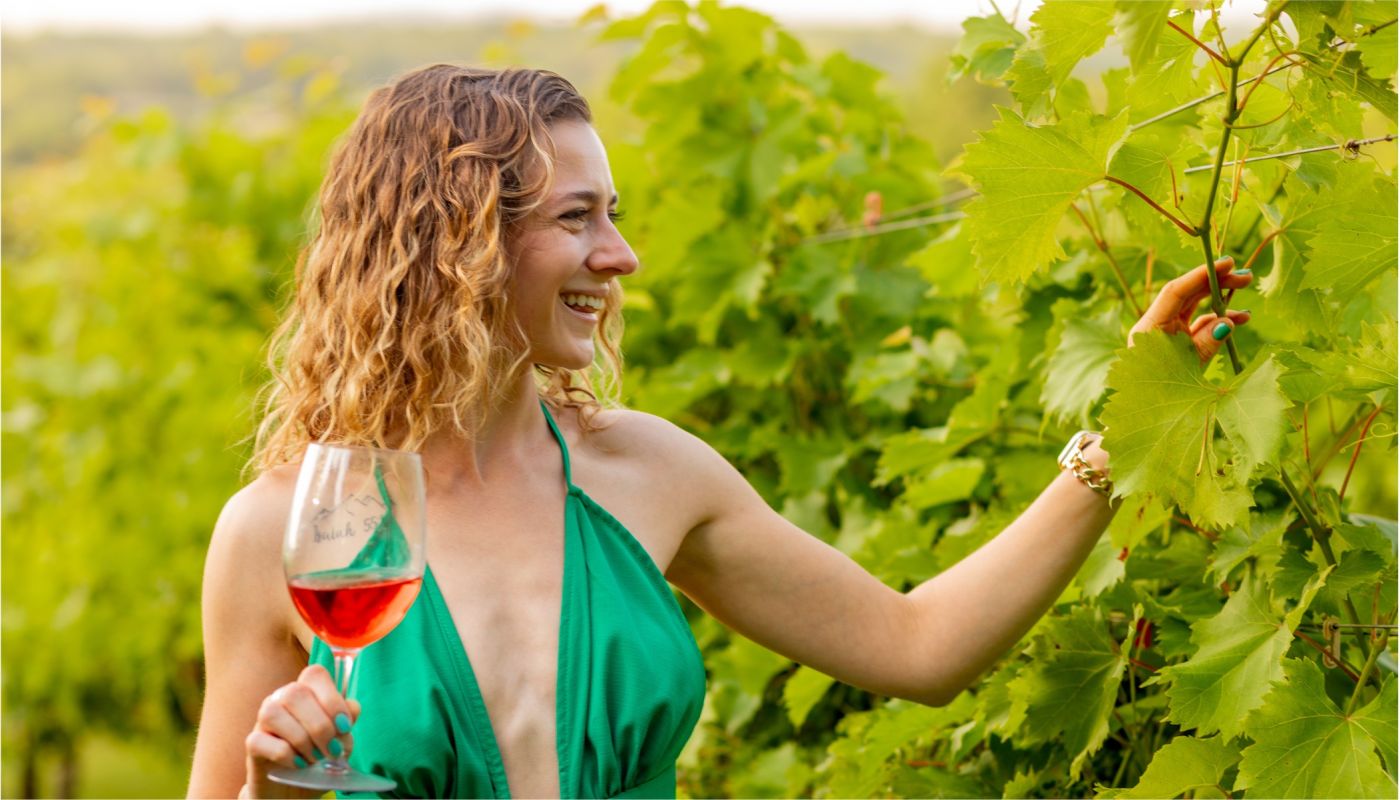
The photo is of the author (credit: Gina Co. Photography).
















