Sophia Longhi writes Sophia has written about wine for The Guardian and Telegraph Travel, as well as a number of leading wine publications. Sophia loves discovering and sharing wines with a curious audience, and she has hosted wine tastings in a variety of settings and stages, as well as communicating on Instagram as @skinandpulp. Sophia won the inaugural IWSC Emerging Talent in Wine Communication Award and was listed as one of Drinks Retailing’s 100 Most Influential People in Drinks in 2024 and 2025.
Time for Susumaniello
“You can always go back to a place, but you can’t go back to a time” is a good saying. When I first heard it, I did a little internal nod. We all do it: when we experience something wonderful, we want to recreate it somehow. The Christmases that we try to repeat time and time again. The holidays where we return to the same spot, with the same people and do the same things, because it was so great the first time. We smile and laugh along, retelling the memories, trying to recapture some of that intangible magic. It’s nice, of course, but it’s never the same, and every time we do it, the original moments get a bit further away until they become little flickery scenes, like on one of those old cine film projectors. Still, they’re lovely to watch.
I, however, have found a hack.
Wine is one of the few things that takes you back both to a place and to a time. The sensory world within us performs its gymnastics and its mysticism, and we’re right back there; we can taste it.
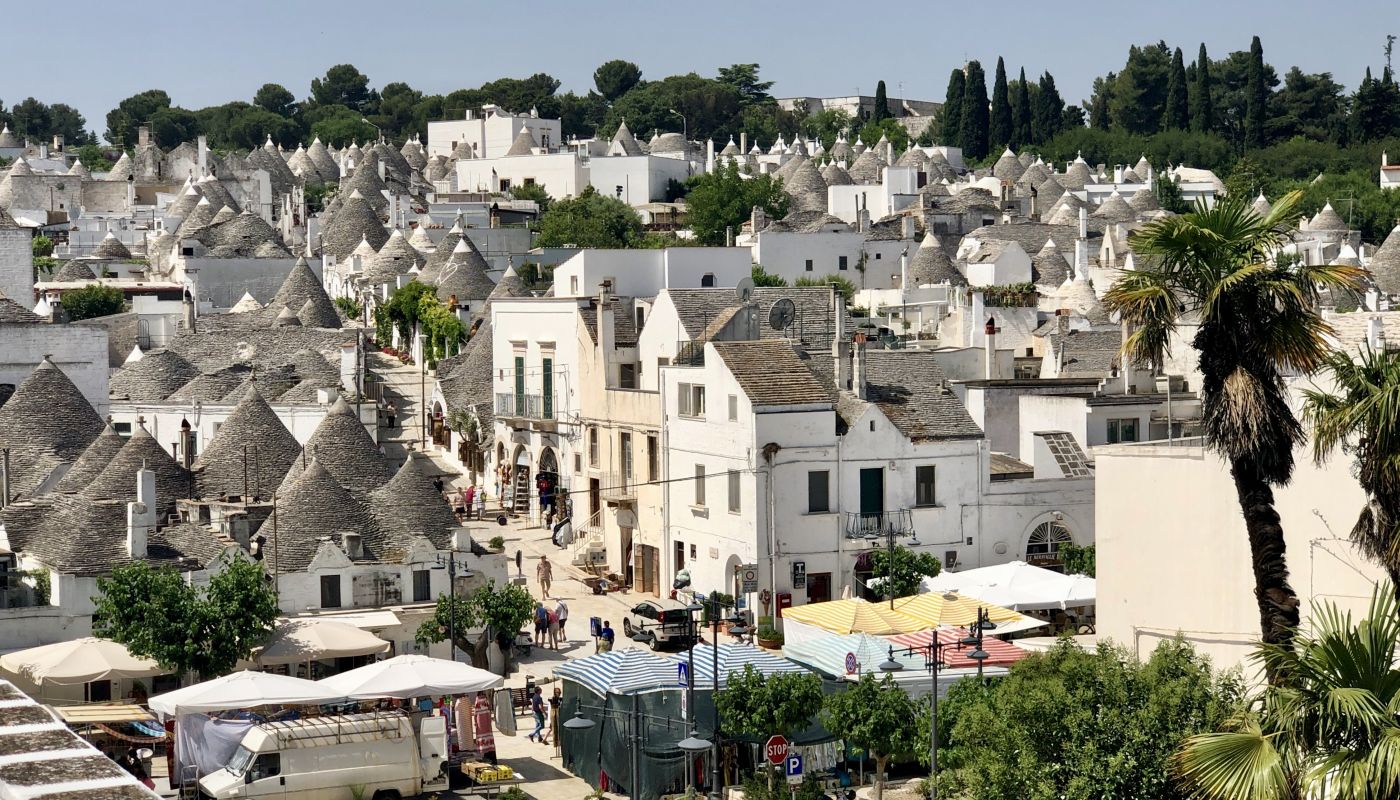
I have this visceral experience when I open a bottle of Susumaniello. I smell the black cherries, the vintage leather and the mulling spices and I’m there, back in Puglia in 2019. I can feel the 27 degree heat on the nape of my neck; I can see the view of trulli right in front of me, the old stone roofs pointing skywards like conical bras amid the white-walled village-scape of Alberobello.
Of all the wines I tasted that day, it was Susumaniello that drew me close. Was it the story of this ancient native grape, which, after falling out of favour in modern times, had been rediscovered and reloved? Was it the charming name? Meaning “small donkey”, bunches of the productive Susumaniello apparently resembled overloaded donkeys in the eyes of the vineyard workers (none of whom are around to corroborate the assumed etymology, but it sounds credible). I do like a grafter and I love a hardy underdog tale. Call me unimaginative, but I don’t think it was any of this that aligned my soul to this particular grape variety, though. I think it was purely the taste of it on that particular day at that particular time.
As much as I welcome fresh wines in hot weather, sometimes I like to experience the heat of a place. I want something rustic that tastes of the earth and of the sun. The Valle d’Itria in central Puglia is dry and hot, where gnarled, crooked olive trees are the majestic guardians of the land. Susumaniello shows you the baking sun in its ripe-to-nearly-bursting fruit and you can almost sense the dusty red soil in its tannins. But, we can’t forget that Itria is a land of two faces.
Where there’s sole-searing sand underfoot, there is also the benevolent, fertile plains that bear voluptuous, peppery-fragranced tomatoes, rich, fleshy aubergines and nutty, oily artichokes. I feel this generosity when I taste Susumaniello. It doesn’t hold back; it gives and it gives, even when it’s unfashionable to give. It shows you who it is; violet streams in deep ruby, leaving an ink stain around the glass. Big, open and warm: it’s not a wine that slinks across the tongue; it practically hugs it. Susumaniello is everything that makes Puglia Puglia and makes the Pugliese Pugliese.
But, don’t mistake it for burrata. It’s not formless; oozing everywhere at one poke of the blade. Susumaniello vines are neighbours of the Adriatic, whose lapping, salty waters have forged a rocky, rugged coastline, which is reflected (poetically, I admit) in the structure of these wines. They can be tidal in their power and, when treated with understanding and respect, can age very gracefully.
The tasting room at I Pastini winery is the place I can go back to, within its cool, stone walls, where I tasted Susumaniello for the first time. I can look out through the archway onto the walled garden, towards the shady Virgilian oak tree. That will still be there when I return. When I taste Susumaniello, though, I can also sink back to June 2019 and to the excitement of being one of six friends - three couples - on holiday together, pre-marriage, pre-babies. There was a taut energy in the air and an engagement ring in a pocket, which can be made out through a pair of jeans in a photo. It wasn’t taken out in Puglia in June, though. It finally got its airing three months later, because timing is everything. Time is everything. And, wine is one of the few things that will allow you to travel through it, even if it’s just for a fleeting sip.
The photo is captioned: 'view of trulli in Alberobello, Valle d'Itria, Puglia'.
















