
Last week, Sam reported on the wildfires in Corsica, a few days before I’d tasted Yves Leccia’s latest wines – wines I’ve loved for a number of years. It made me think that perhaps it’s time I talked about them.
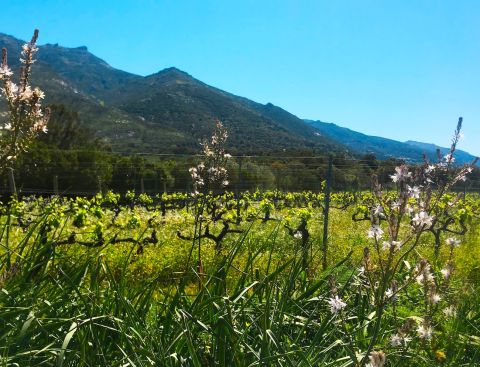
Maquis, or machja in Corsican dialect, is a dense, shrubby, evergreen ecosystem of vegetation particular to the Mediterranean, and Corsica is home to maquis – home to more than 2,500 species of aromatic plants and wildflowers, so intensely scented that it is said you can smell the island from out at sea. It is one of the world’s most wildly abundant aromatic ecosystems.
The island, the most mountainous in the Mediterranean, is also home to huge forests of chestnut trees; chestnuts in all forms, from flour to honey, beer to soup, have been one of the island’s staple foods for centuries. Then there are the Corsican cheeses, olives and olive oil, shellfish, charcuterie. I say all this because the maquis shapes the wines, and the cuisine of Corsica has, of course, had an indelible impact on the wines, too.
The fourth-largest island in the Mediterranean, Corsica is only 12 km/7.5 miles from Sardinia, and 80 km/50 miles west of Tuscany, making it much closer to Italy than to its homeland of France (it’s 170 km/105 miles south of Nice). Being very strategically positioned for battle, Corsica has cultivated and made wine that has, since ancient times, supplied succour, sustenance and the promise of silver to its inhabitants as well as wave after wave of marauding, invading, occupying, exploiting and trading garrisons, battalions, warlords, kings and merchant ships which have come and gone for centuries. It has, as Anthony Lynch describes it in The Oxford Companion to Wine, a turbulent history. It’s still, in fact, campaigning for its independence from France.
The question is why Corsica is so underrecognised for its wines and wine culture when compared with the three other large Mediterranean islands of Sicily, Sardinia and Cyprus.
One of the answers may lie in these waves of occupations which often brought disease while pushing the native population into poverty and, significantly, exile. Sustained production of wine, let alone quality wine, on any scale but subsistence, was next to impossible.
World War One had a profound impact on this island, in great part because Corsica rallied to the Allied cause with (think about this) more men per capita than any region across all the allied nations: it is estimated that 50,000 men out of a population of 300,000 went to fight. More than 20,000 died. I wrote this and wondered if any of my readers might feel, as I did, that recognising this deserved a moment of silence.
There was also a huge exodus from the island in the early 1920s, with many moving to southern France, and wealthy Corsicans colonising Algeria and Indochina. In World War Two, the island was occupied by Italy in 1942, Germany in 1943, and became an Allied air base in 1944, and it’s this seemingly minor historical fact that may well mark the turning point for Corsican viticulture.
During their occupation of the island, US army engineers managed to eradicate the malaria that had long plagued the coastal marshes of Corsica. Not only did the population become healthier and stronger, but people were no longer confined to the mountains. Flatter, more accessible areas of this very mountainous island became safe to cultivate. So, in the 1960s, when Algeria gained its independence from France, Corsican colonials returned home, many of them bringing the winemaking knowledge and experience they’d gained while making wine for the French empire. This meant, in many cases, that they also brought techniques, varieties and attitudes adapted to maximising yield rather than quality: they replaced indigenous varieties with French ones, and vineyard plantings and industrialised production grew exponentially. Damage was done to Corsica’s reputation as a wine region, to indigenous varieties, clonal diversity and genetic material.
But despite this turbulent history, Corsicans seem to have held on to a sense of who they are, and it is now fiercely reflected in the some of the wines coming from the island – such as those of Yves Leccia.

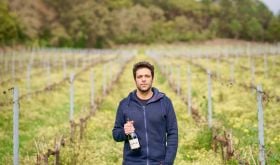
Leccia studied oenology in the 1980s and as a young man came to work at his family’s wine estate. In 2004, he set out with his wife Sandrine to set up their own wine estate, and from the outset he broke with convention and set his principles and convictions, quite literally, in the ground. Leccia believed in the revival of the Corsican wine industry, and he believed that this meant terroir-driven wine made with indigenous varieties. He’s invested time, money and expertise into preserving old vineyards and making mass selections of indigenous varieties such as Biancu Gentile (meaning ‘noble white’), a variety that had been thought extinct until Leccia found a parcel. Leccia now produces Biancu Gentile and successfully petitioned the INAO to allow Biancu Gentile in IGP wines from Corsica.
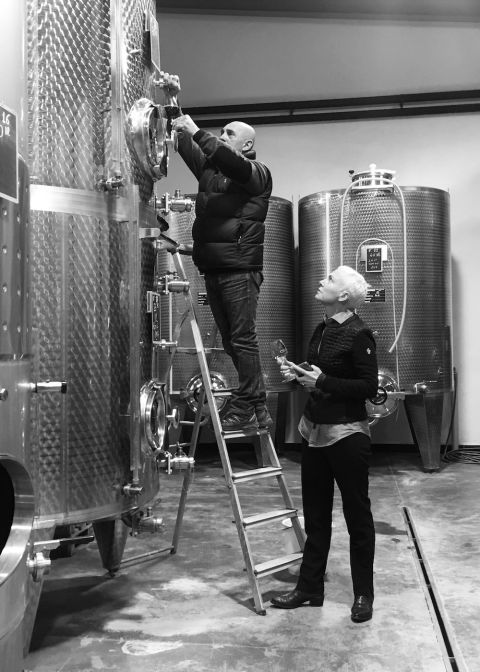
Right from the start, he eschewed oak, wanting his wines to taste of the grapes and the place only. He also believed in the uniqueness of Corsican terroir and was one of the first to bottle single-vineyard wines. His vineyards have been organic since 2013. His winery is now also a certified 3E Equalitas Sustainable Winery.
I’ve chosen a pair of Leccia’s wines from his YL range as the wines of the week, the rosé and white, because they are delicious, less expensive than his other wines and representative of this new age of Corsican wine – clean, vibrant, interesting; reflecting, so brightly, the sunshine, salty sea winds, fragrant maquis and coastal freshness of the place; scrumptious with shellfish, cheese and charcuterie.
But if I had managed to find L’Altru Biancu (his varietal Biancu Gentile) or, quite frankly, any of his other wines, red, pink or white, I would have made any one of them my wine of the week. I love that Yves Leccia is championing his island’s wines, making them in the most transparent way possible.
I also love that Yves Leccia was a founding member of the Corsican polyphonic group A Filetta. He gave it up because international travel meant he had to choose between wine and singing fame. He chose wine. We lucked out.
The YL rosé is made from Nielluciu, which is Corsica’s name for Sangiovese. Leccia hand-picks organically cultivated grapes from vines grown on clay-limestone over schist and vinifies them in stainless steel. The wine is tight, mouth-watering, clenched, and 13.5% alcohol; blood orange with a smudge of blackcurrant and a scribble of ink dust. Pair it with something that glistens – cheese, fat, oil, tomatoes – or charcuterie, as I mention in my tasting note.

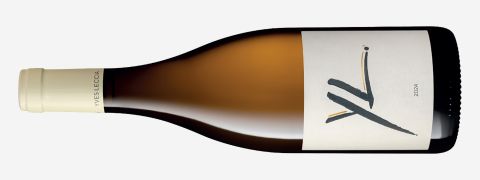
The YL white is a blend of Vermentinu (Vermentino/Rolle) with Biancu Gentile from Patrimonio, which Leccia believes is the ‘grand cru’ of the island’s terroirs. My tasting note reads, ‘White flowers and green apple, creamy green olives, the sweet-spice green of bay leaf. Green almonds. A tidal push and pull of contrasts. Softness in the jasmine, the petal texture of the wine, acidity that feels like a sigh, the almond cream. But then there is the hiss of saltiness that races up and in, like foam on waves that crash on the beach. There is a glitter of bitterness. A sea-glass stoniness that won't give way. The bite of white pepper on the end.’ All his white wines showed that lunar/tidal energy, that play of flowers and salt and white nuttiness. Pair with mood. Or with bitter leaves and crisply fried oily fish.
Vinatis ships both the white and the rosé to the UK and Millesima in the UK stocks a number of Yves Leccia's wines. In the US, the wines are imported by Kermit Lynch Wine Merchant. You can also find the wines in Australia, Austria, Denmark, France, Germany, Greece, Hong Kong, Italy, the Netherlands, Portugal, Spain and Switzerland. Although I've written about the 2024 vintages for both wines, the 2022 and 2023 vintages will be just as good.
Check out more Corsican wines in our tasting notes database.
The photos above are from Kermit Lynch's photo gallery.