14 March 2017 See also Richard’s review of Austria’s indigenous reds.
Last August I tasted all the 2015 Erste Lage wines produced by the members of the Traditionsweingüter in the regions in which this private association has members – Kamptal, Kremstal, Traisental and Wagram. The big Austrian tasting in London last month gave me the chance to focus on other regions, mainly the Wachau and Styria, with a few wines from the Thermenregion and a run of Roter Veltliners from Wagram. And at the end of the article below are my notes on the Ebner-Ebenauer wines from the Weinviertel that winemaker Marian Ebner happened to send me prior to the London event.
The wines were mostly from the 2015 and 2014 vintages, with a handful of older wines such as Domäne Wachau’s 1997 Kellerberg Riesling Smaragd reinforcing how well Austrian whites can age. There were also a handful of 2016s.
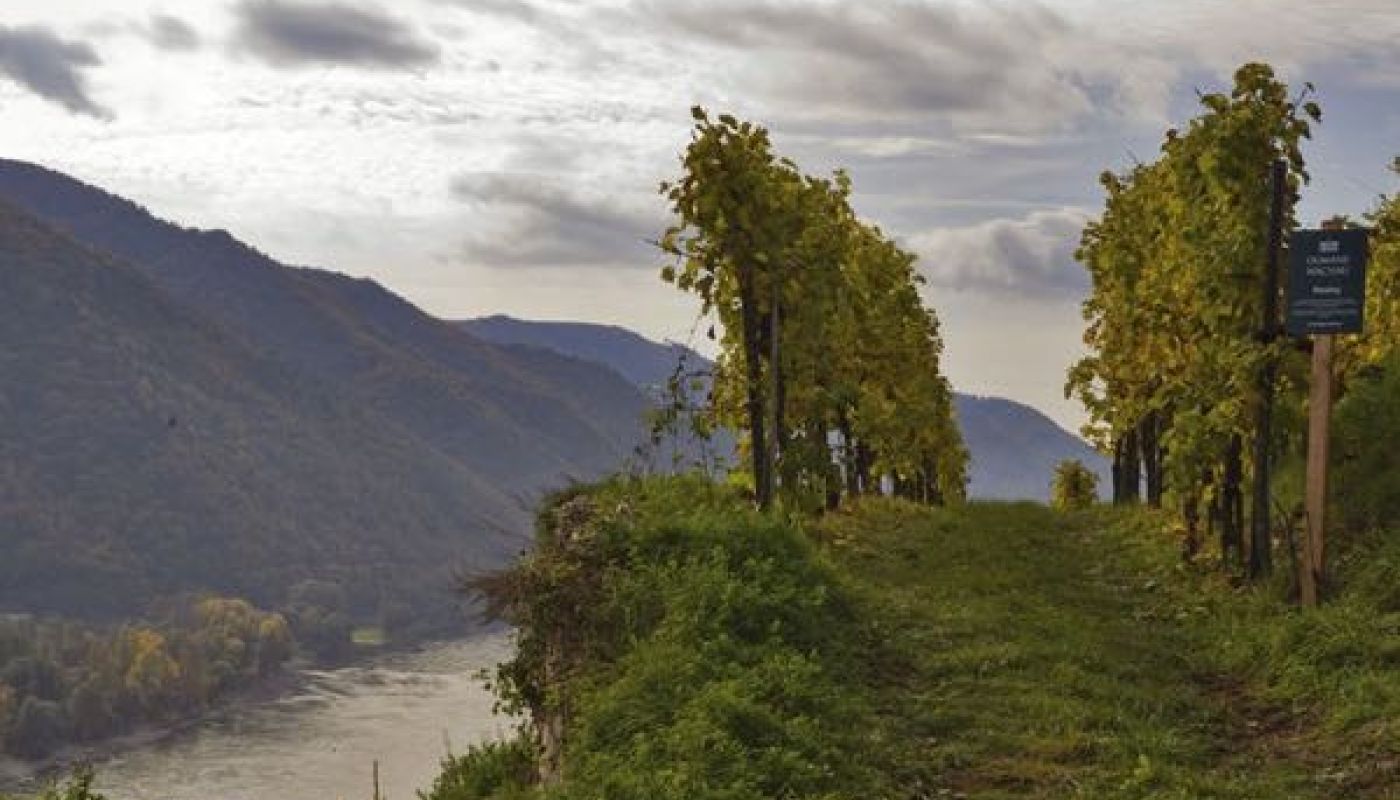
It always surprises me that the Wachau wine region, a UNESCO world heritage site, is so small (1,350 ha/3,336 acres, less than 3% of Austria's total vineyard area) when it has so much recognition and may well be the first Austrian wine region wine lovers think of when asked about the country. Its terraces are particularly dramatic, as seen in the photo above of the Achleiten vineyard (courtesy of AWMB/Gerhard Trumier), and the vineyards are dominated by Riesling and Grüner Veltliner, as reflected in the notes below. For an explanation of the classification system used by the private growers’ association Vinea Wachau – Steinfeder, Federspiel and Smaragd – see this entry in the online Oxford Companion, and see the Vinea Wachau website for a detailed interactive vineyard map of the region. There were some stellar wines here among the 2014s as well as the 2015s, though I have a feeling that the most successful 2014s, such as Pichler-Krutzler’s Loibenberg, may well age longer than their 2015 counterparts.
Südsteiermark (southern Styria), bordering Slovenia, has 2,340 ha (5,780 acres) of vineyard and the varietal mix is completely different from that of the Wachau: Sauvignon Blanc dominates and the other main varieties are Muskateller, Weissburgunder, Morillon (Chardonnay) and Riesling. Although my general tendency is to prefer indigenous to international varieties, this tasting reminded me of how exciting and distinctive Styrian Sauvignon Blanc can be: complex, mineral and, in some instances such as Manfred Tement’s single-vineyard Zieregg and Grassnitzberg bottlings, seriously ageworthy. Eric and Walter Polz’s excellent Grassnitzberg confirms what a great vineyard this is for Sauvignon Blanc. The Styrians also have their own classification system (for more on this knotty topic, see Austria wrestles with vineyard classification), with 1 STK equating to Burgundy’s premier cru and G STK to grand cru (STK stands for Steirische Terroir & Klassik Weingüter).

Among the wines from Thermenregion and Wagram, I reverted to type and focused on indigenous white varieties, mostly Roter Veltliner (no relation of Grüner) from the latter and Rotgipfler from the former, which is its place of origin. Both produce wines that tend to have riper fruit flavours and be more mouth-filling than the majority of Rieslings or Grüners, giving powerfully satisfying flavours.
The Ebner-Ebenauer wines represent an impressive if very selective picture of the Weinviertel, which is such a big area (13,356 ha/33,000 acres under vine) that it is hard to define a specific style for its dominant variety Grüner Veltliner, although an attempt has been made to do this via the awarding of the DAC classification for this variety back in 2002, which specifies the following taste profile: ‘aromatic, spicy, pepper notes, no botrytis, no oak notes’. The DAC Weinviertel Reserve, awarded in 2009, on the other hand, should be ‘dry, full-bodied, subtle botrytis notes and oak ageing allowed’. Ebner-Ebenauer choose to use the much bigger Niederösterreich designation – which encompasses the better-known names such as Wachau, Kamptal and Kremstal – for almost all their wines, mainly because there is greater immediate recognition of the name, especially on export markets, but also because the Weinviertel has yet to establish a reputation for top-quality wines. However, as winemaker Marion Ebner says, this is not the reality on the ground: 'If you desire to work without any compromise then you also have the chance to make beautiful wines', adding that it is getting better and better – 'there are some lights in the sky'.
A look at these different regions and their specialities highlighted the fact that there are very strong regional identities within Austria. It may seem that I am stating the obvious but a typical focus on Austria’s two top white varieties – Riesling and Grüner – on wine lists, for example, might sometimes obscure this diversity and not do justice to the depth and strength of Austria’s perfectionist and locally patriotic producers.
The 84 tasting notes below are grouped by region and then alphabetically by producer (sur)name but you can re-order as you wish.
WACHAU

RS 3.5 g/l, TA 5 g/l. Richer and spicier on the nose than the...
RS 1.4 g/l, TA 5 g/l. Subtle pear fruit and just a touch smoky...
RS 6.3 g/l, TA 6 g/l. As on the Steinterrassen, a lightly...
RS 3.4 g/l, TA 6.9 g/l. Lightly smoky and mineral. Bright citrus...
RS 1 g/l, TA 5.9 g/l. Fresh peppery citrus aroma with a fine...
RS 1 g/l, TA 5.9 g/l. Less primary fruit aroma here compared...
RS 3.4 g/l, TA 5.8 g/l. Aromas are a little more developed than...
RS 5.8 g/l, TA 7.3 g/l. The note of honeyed citrus does not...
Delicate dusty citrus. Then a strike of intense citrus on the...
This vineyard is on the border of Kamptal and Wachau, which is...
Most of the Malat wines are from the Kremstal DAC but here the...
RS 3 g/l, TA 5.8 g/l. Complex aroma of spice and lemon/orange...
RS 6 g/l, TA 4.9 g/l. Like the Im Weingebirge Grüner, lots of...
RS 3.3 g/l, TA 6.2 g/l. Intense and almost peachy on the nose...
Smells more honeyed and oily than the Steiner Hund (oily in a...
RS 5 g/l, TA 6.2 g/l. Seems very restrained on the nose. Just a...
RS 1.5 g/l, TA 5.9 g/l. Leaner than the 2015, more piercing and...
Mainly loess and flatter vineyards. Tank fermented. Earlier...
Tank fermented. Still plenty of citrus but a little more creamy...
Slightly higher vineyards (250-300 m) and more limestone in the...
Very difficult to describe this complex aroma. Spice, citrus but...
More straightforward and obvious fruit compared with the...
About 12 hours' skin contact.
So different from the...
Their entry-level Grüner. Fermented in tank with just 3-5 hours'...
A little smoky at first. Honeyed citrus on the nose then super...
Delicate fresh lemon fruit. Pure and zesty. Very primary but...
Oily mineral spice on the nose. Complex and rich but with...
Just a hint of development here but there are only a few cases...
65-year-old vines. Fermented in 840-litre oak. RS 1 g/l, TA 5.7...
Entry-level from a flatter vineyard. Mostly fermented in tank...
His highest vineyard at 450 m. Half in stainless steel, half in...
Early harvest of the non-botrytised grapes, therefore high...
RS 2.1 g/l, TA 5.8 g/l. Riper and not quite as open as the...
RS 1.8 g/l, TA 5.4 g/l. Intense and ripe fruit aromas, yellow...
'One of the best vintages in the last 30 years, along with 1999'...
RS 1.6 g/l, TA 6.1 g/l. Delicate aromas – a little peppery but...
RS 3.5 g/l, TA 7.3 g/l. Already a little honeyed on the nose but...
RS 1.8 g/l, TA 8 g/l. Bright stony citrus aroma. Attractively...
RS 1.6 g/l, TA 5.4 g/l. Just bottled.
Very expressive dusty...
RS 12 g/l, TA 7.2 g/l. Already showing a honeyed character on...
SÜDSTEIERMARK (SOUTHERN STYRIA)
This is from wines planted by Manfred Tement on the Slovenian...
Less expressive than the Jakobi but much more interesting on the...
Herbal, lively and fresh, but less distinctive than some. Has...
RS 1.1 g/l, TA 6.5 g/l. Sophisticated and restrained oak on the...
This is classified as Erste STK Lage (ie premier cru) in the...
This is classified as Grosse STK Lage (ie grand cru) in the...
Very herbal and expressive with a light smokiness (partial...
This is classified as Erste STK Lage (ie premier cru) in the...
Blend of Pinot Blanc and Chardonnay. Now they tend to make...
This is classified as Erste STK Lage (ie premier cru) in the...
Their 'village' wine. Clay/marl. One year in big oak (Austrian...
This is classified as Grosse STK Lage (ie grand cru) in the...
This is classified as Grosse STK Lage (ie grand cru) in the...
55 vineyard parcels, mainly limestone. 80% in tank, 20% in...
RS 1.7g/l, TA 6.4 g/l. After the Tement Sauvignons just tasted...
RS 1.8 g/l, TA 6.5 g/l. Restrained but still aromatic...
THERMENREGION
They call it Rheinriesling to distinguish it from the Klassik...
Limestone soils. RS 3 g/l, TA 5.3 g/l.
Pure, lightly smoky...
50% fermented in big oak, six months on lees. RS 1.2 g/l, TA 5.6...
The older vines from the Rodauner vineyard, one year on lees and...
50% Rotgipfler, 50% Spätrot (a synonym for Zierfandler)...
From the Harterberg vineyard. Spontaneous ferment in second-fill...
8% fermented in used oak, of which 50% is acacia. RS 4.9 g/l, TA...
100% Gewürztraminer although the label does not specify that it...
60% Zierfandler, 40% Rotgipfler. This is the classic blend of...
RS 3 g/l, TA 6.1 g/l. Honeyed-pear richness on the nose. Lovely...
RS 8.5 g/l, TA 7 g/l. A light creamy overlay on the nose then...
RS 3.9 g/l, TA 5.4 g/l. This wine really shows the honeyed...
WAGRAM
Haide is a part of the Eisenhut vineyard. Fermented in tank with...
The same fruit as in the Haide but here with three weeks on...
Creamy lemon and peach nose but also a ripe fruit character and...
This is the first vintage he has released this as a single...
This wine is normally labelled as Scheiben but they lost about...
WEINVIERTEL (EBNER-EBENAUER)
Loess soil from two vineyards in the village of Poysdorf...
From the Birthal vineyard in Poysdorf, sandy soil. Harvested 20...
Single-vineyard wine from Poysdorf, all vines 30+ years old...
Single-vineyard wine from Poysdorf, all vines 50 years old. On a...
Single vineyard on loam soils and gravel, planted in the early...
From the Von der Luessen vineyard on slate and loess soils...
Like the Black Edition Pinot, this is in an unnecessarily heavy...
From the Alte Geringen vineyard on loess with limestone. Planted...
From the Steinbergen vineyard planted on gravel alluvial soils...
Like the other Black Editions, the ‘front label’ is unreadable ...
Fifty-year-old vines. This variety – the non-aromatic version of...