Philip Harper is a great advertisement for the rejuvenating properties of sake. Although now 42, he still looks just like the recent graduate (Oxford, German and English Literature) he was in 1988 when he went to teach English in Japan as part of only the second ever intake of JET students unleashed on Japan’s unsuspecting youth.
Like two out of three of his fellow English teachers, he has married a Japanese, but he has arguably made a greater commitment to Japanese culture than any Englishman before him. He is Japan’s only Western toji, or Master Brewer of sake, a product steeped in tradition and even secrecy. This is a role he takes extremely seriously, unlike anything else. With his wild curly hair, mousey beard and ill-fitting suit, he gives the impression of 100% ingénu, which is apparently how he was regarded at the beginning of his long road to being recognised as having the potential to make award-winning sakes.
He claims to have learnt his Japanese mainly in bars, and it therefore felt a logical step to look for sake-related work after his two years of teaching. He accordingly spent some time “hanging around sake breweries”. Eventually the owner of one “only let me in because he thought I’d be gone in a few weeks. I stayed for 10 years.” He is now working at his fourth brewery, one of Japan’s 1,200 sake breweries, virtually all family owned, near impenetrable, and venerable. In his time he has worked with a 55th generation brewery owner, which puts even such historic wine dynasties as the Antinori (14th century) in their place. Sake making has a 2,000 year-old history.
He claims that his hobby is making sake and his work is drinking it, but he is clearly besotted by every aspect it. “ I’ve been drinking it for 20 years now and it’s never boring.” A typical email is signed enthusiastically, “just back from tasting a very old, very good sake”. He is now fully accepted – one of his dai ginjo sakes won a gold medal in this year’s Annual New Sake Awards in Hiroshima (see picture below), quite an achievement in his first year in a new brewery – and amazingly sees as only a slight drawback the intensity of the brewing season just begun. From last Monday until April he effectively goes into purdah, for sake brewers are expected to live in the brewery “in an undead zombie kind of way....” working seven days a week during the winter brewing season. “I do enjoy being part of this peculiar old industry even if a lot of things about it drive me mad,” Harper told us at a recent tasting held by the British Sake Association in London to celebrate one of his rare visits back to visit his Cornish cleric father and family recently.

He whizzed us through seven different sakes in not much more than an hour, carefully checking them first. His enthusiasm is certainly infectious. The assembled crowd, which admittedly included representatives from Britain’s six sake suppliers, could hardly wait to try more samples when his talk finished. The UK is arguably well behind the US in its appreciation of sake. Nigori sakes – cloudy, sometimes fizzy, rice-hazed ferments that feel as though they may rupture your digestive system to judge from the one he served us – are particularly popular with American sake drinkers. Harper describes them as ‘a minor but durable genre in Japan’ in the glossary of his admirably approachable and lively A Book of Sake – A Connoisseur’s Guide.
Perhaps the most common question from sake debutantes is whether sake should be drunk warm or cool. Harper is characteristically libertarian on this issue. “You can drink sake, even the same one, at lots of different temperatures, but it’s a sad fact that even in Japan if you order hot sake, you’re likely to be served the cheapest sake they have. The pendulum of fashion has swung firmly towards cool sake. More important perhaps though is that sake is so intimately connected to Japanese food. It’s impossible to cook Japanese food without sake, and in fact sake goes with lots of other cuisines too – even Indian.” Harper cites in particular the umami character in sake, the savoury aspect that is so obviously present in, for example, parmesan and monosodium glutamate.
The average alcohol level of sake is 15%, so hardly stronger than many wines nowadays, although some sakes are as high as 20% alcohol. “Getting fermentable sugar from grains of rice involves cooking it to rupture the starch grains to make them soft and edible, which is much more difficult that fermenting sweet grape juice. The thing that transforms the rice grains is a mould (a bit like cheesemaking) called koji. We sprinkle spores of it on to the rice to break it down and give fermentable sugars. This is the most difficult thing we do when brewing sake. Rice keeps much better than grapes, so the length of our brewing season is quite distinctive, and it’s all much less frenetic than winemaking.
“The fermentation temperature is very low: 15 degrees Centigrade, and higher grade sakes may be fermented under 10 degrees Centigrade in extreme cases, possibly for more than 40 days. Water is a very important ingredient and most breweries have their own water sources, involving lots of mystery and history. We currently use springwater from the side of a mountain. Japanese water tends to be extremely soft, which tends to produce sweeter sakes, although nowadays you can adjust this.
“One of the big factors in sake production, along with increasingly powerful yeasts, is the rice polishing ratio; the more you polish the rice, the more expensive the resulting sake will be. Dai ginjo is the highest grade of sake, with the rice polished to less than 50% of its orginal size. Sake labels may specify the proportion of rice remaining, so the lower it is the fancier the style.”
Harper had already pointed out that the variety of rice is much less significant in sake production than the grape variety is in wine production, but what about vintages? Are they significant, I wondered. “Yes and no,” said Harper. “With wine, people know generally whether a vintage is likely to be good or not. But with rice, it’s not so clear. There are good years and bad – but it’s very localised and you can’t know in advance. Typhoons can affect quality, especially since many of the rice varieties most suitable for sake production ripen quite late in the harvest season. The vintage date is rarely stipulated on the label, by the big companies anyway, although in Japan the bottling date has to be.” Most sake on the market is only one or two years old.
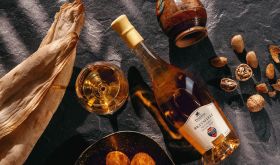
My favourite sake of this tasting was Osagekko, a Namazake sake that sells for around £50 a bottle unfortunately. It’s unusual because unpasteurised. Pasteurising sake was standard practice in the ancient capital Nara as long ago as the 16th century apparently – “long before Pasteur”, as Harper pointed out chirpily.
How to taste sake? Sake is traditionally tasted not in glasses but in white porcelain cups with a cobalt blue swirl in the bottom, but such was Harper’s keenness to press on to the next sake that I never learnt how to do it.
A Book of Sake – A Connoisseur’s Guide by Philip Harper, Kodansha International, 2006