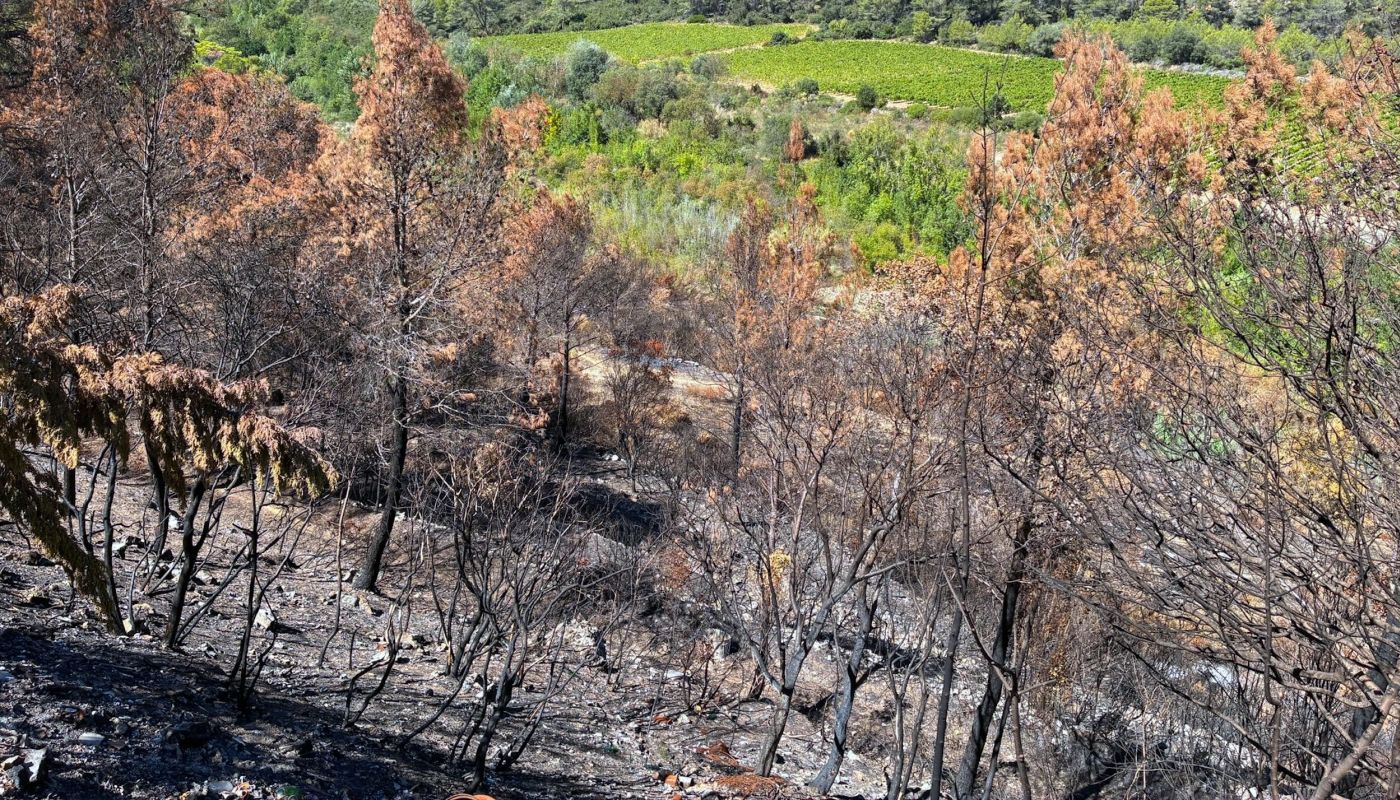
‘The Clos has gone up in flames. End of story.’
A WhatsApp message. Sophie, to the Vinifilles group. The Corbières fires had swept through her vineyards.
What else do you say when your life, your world, your last 25 years of every molecule of muscle, sweat, belief, principle, blood, soul, and every last cent, has been invested in a place, a living place, that has been burnt to the ground?

What caused the fires?’ I asked a consulting oenologist who has been working on damage limitation (including dealing with smoke taint) across the affected areas of Corbières. He looked at me steadily and went silent for a bit. And then he said, ‘Some people light fires for fun.’
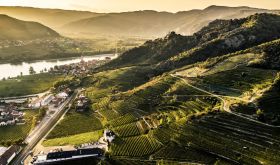
It’s hard to comprehend. It’s hard to comprehend why anyone would feel a sense of power or relish in burning 17,000 ha (42,000 acres) of native forest, garrigue and vineyard across a wild and beautiful part of France – or anywhere in the world. It’s hard to comprehend why anyone would relish, or even be indifferent to, watching people’s lives and livelihoods go up in flames and smoke. And whether or not the fires were deliberately or carelessly lit, it’s impossible to comprehend what it must feel like to watch your life’s work, your vines, burn to cindered spectres. Just weeks before harvest.

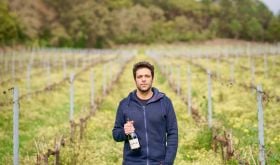
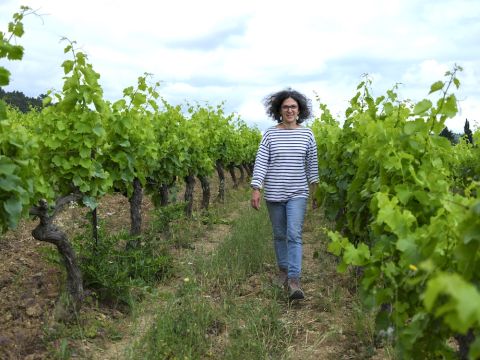
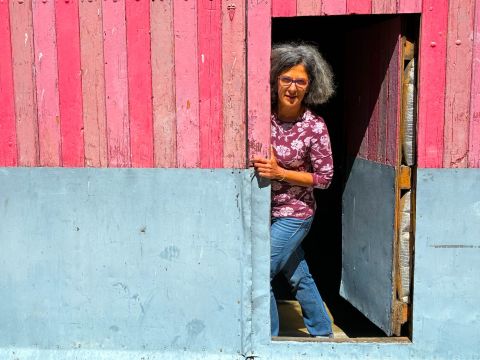
Sophie Guiraudon worked as an oenologist for Dubernet Laboratoires, a wine analysis and consulting company in Narbonne, until she decided to strike out on her own. In 2000, with her partner at the time, she bought some vineyards and established Clos de l’Anhel. She proudly calls herself ‘a winemaker for zero generations’.
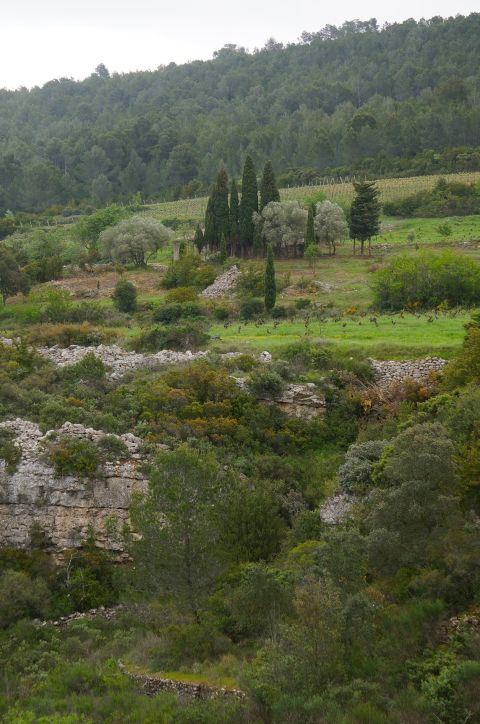
Guiraudon poured her heart and soul into Clos de l’Anhel, 10 ha (25 acres) of vines set into the wild, aromatic garrigue of Val-de-Dagne in northern Corbières. She has farmed under organics and biodynamics right from the start, but over the years, she’s gone much more than organic. In 2020 she wrote, ‘I’m getting more and more strengthened in my choice, with a voluntary adaptation to the climatic news, with a desire to plant, for tomorrow or after tomorrow, adapted grapes such as Carignan (black and white), Cinsault, by replanting trees, again and again. One only goal: tilt for the ground, tilt for the World. Those choices are – before everything – a huge pleasure for me.’
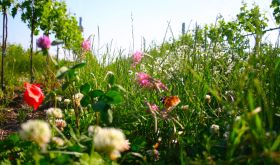
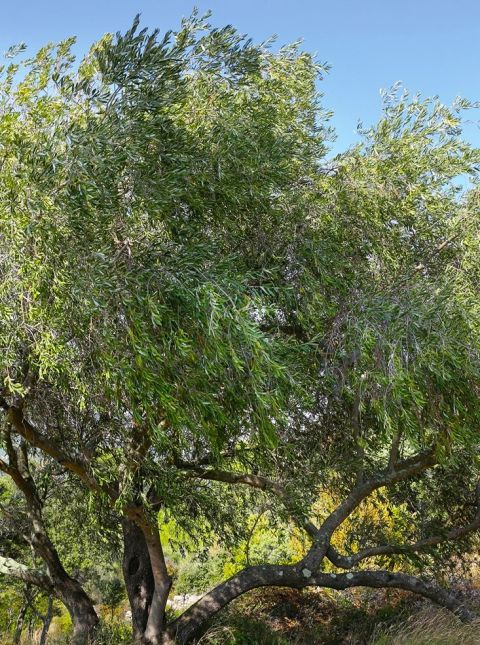
Believing in the importance of biodiversity, she planted more than 200 trees, established and preserved hedgerows, installed bird boxes and bat houses, encouraged wildflowers and herbs, blackberries and olives. Over the years she replanted small parcels of her vineyard, using plant material taken from old vines using mass selection, in order to have vineyards of well-adapted native varieties and wide genetic diversity. Guiraudon was farming for future generations.
Jancis has often included the Clos de l’Anhel wines in her recommendations of flag-bearers for the region of Corbières and for the Languedoc as a whole, writing in 2018 that ‘Sophie Guiraudon is doing a first-class job on the generally south-facing slopes of Montagne d’Alaric in the northern Corbières’.
However, in the aftermath of the devastation, Guiraudon says she will probably not rebuild the domaine. She will probably give up winegrowing. To start again is simply too enormous. Too fraught. She’s done.
By some small mercy, however, the fire did not reach the winery, so there are still stocks of the latest vintages of Clos de l’Anhel wines. Two of the wines are imported into the UK and three into the US. There is still a chance to celebrate Sophie Guiraudon, her work, her vineyards, her vision, and all the people like her who quietly get on with doing the right thing, making beautiful things, when the world is going mad.
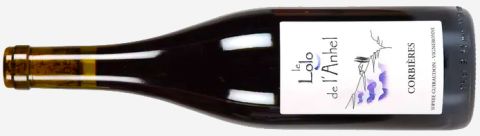
Le Lolo de l’Anhel is the wine she describes as ‘a wine for friends’. It’s 70% Carignan from vines between 40 and 84 years old, 15% Syrah from 32-year-old vines, 10% Grenache Noir from 35-year-old vines and 5% Mourvèdre from 19-year-old vines. As with all her wines, all the grapes are hand-picked. All four varieties are co-fermented for about 20 days. It’s bottled unfined, very lightly filtered and with very little added sulphites, 13.5%. A joyously ‘purple’ wine, it tastes like someone dipped an ink quill in a purple pool of juice and scrawled stories of herbs across a purple page. It has a certain fey-fragrant, rebel-ruggedness, like a pixie in big old farm boots stomping up a mountain to throw her arms wide and shout fearless defiance at the storm. It’s a wine that hides its tenderness, almost, behind a bravado of wild herbs, black fruit and stony minerality. The tannins give an impression of muscle until you really look at them and realise they’re soft and curling lovingly around the fruit. Dusty-track texture and minerality on the finish. The 2023 vintage is imported into the UK by Special Cases and is available from the London restaurants Josette and Paulette on their wine lists, but also for £25 if you buy it retail (both restaurants offer that option). It is imported into the US by K&L Wines who sell it for $10.99 (reduced from $15). It costs €13 if you buy it from the Clos de l’Anhel website. NB that the vintages on the shop part of the website do not reflect the actual vintages for sale – solo winemakers are short on time when it comes to admin! Contact Sophie to make sure exactly which vintage you are buying, but you will most likely receive the latest release and as her wines are good every year, this is not something to be concerned about.
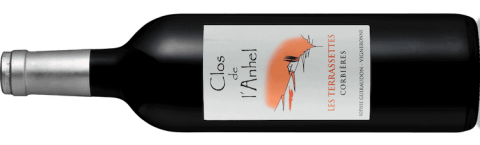
Les Terrassettes is a blend of 50% Carignan from vines more than 80 years old, 25% Syrah, 20% Grenache Noir and 5% Mourvèdre. Spontaneous fermentation takes 20–30 days and then it’s blended and aged in tank only. Minimal sulphites are added and it’s 13.5% alcohol. It smells of black berries (more than just blackberries) and the fruit on the palate seems to gleam with jewelled darkness. Garrigue runs through the wine like the long, cool breath and sigh of a night wind carrying the fragrance of the trees and shrubs from sea to mountain. The tannins have the slip and scrabble and dusty scuff of stones and scree. And then the dark fruit closes in on the finish like moonless midnight. The 2023 is €18 from the Clos de l’Anhel website, $19.99 from K&L Wines, but (very sadly) it is not available in the UK. Although Sophie is happy to arrange a direct shipment to anywhere outside of France – you just need to contact her directly.
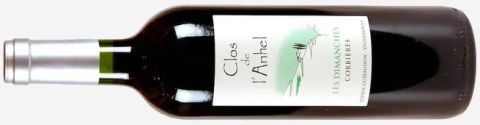
Les Dimanches, so-called because it’s ‘a Sunday wine’, is mostly (80%) Carignan from a very special vineyard which was planted in 1907. When they bought the domaine, this vineyard was terribly neglected and in very bad shape. They gently restored it and, until the fire, it was giving Sophie beautiful fruit, if at absurdly low yields of 8 hl/ha! The destemmed berries undergo spontaneous fermentation for 25–30 days with just one manual punchdown a day and then the wine is aged in stainless steel, no oak. It’s wickedly intense! Baritone rich. Tamari and damsons, dark-red roses. It’s heady and perfumed and seductive with weight and kohl but also sweetness, spilling over the brim of the burl of tannins. Despite the concentration, however, it’s only 13% alcohol. It might not have to be Sunday dinner specifically, but I would recommend this goes with a hearty meal. It also has good potential for laying down and could easily cellar for 10 years or so. The 2022 can be found at Josette and Paulette for £37 retail, £69 if you buy a bottle with your meal, and it will also be available by the glass from next week. K&L Wines are selling it for an incredibly good value $24.99. The wine can be bought directly from Clos de l’Anhel for €24.
Find Le Lolo de l’Anhel
Find Les Terrassettes
Find Les Dimanches
While not all Corbières producers were affected by the fires, if you’re interested in the wines that we love from this beautiful appellation, take a look here.
The main photo and the photo of Sophie Guiraudon at her pink-and-blue winery door were taken by Louise Hurren, the other photos were sent to me by Sophie. All photos published with permission.