
4 August 2016 Microbes are everywhere, and there’s a growing interest in their decisive role in the vineyard and the winery, which is why we are republishing this article free as part of our Throwback Thursday series. Britain may have voted for Brexit but we intend to follow with high hopes the progress of the 15 EU-funded PhDs introduced here.
2 Feb 2016 There are things we know we don’t know. Even fundamental things such as why vines grown in certain places make wines that smell, taste and feel the way they do. We have partial explanations, as-yet-unproven theories and plenty of mythology.
While we were revising the Oxford Companion to Wine, the idea that microbiology could answer some of our questions, providing missing links between vineyard and glass, cropped up more than once, particularly when it came to entries such as terroir, minerality and soil microbiota but also in relation to topics such as soil and wine quality, yeast, fermentation, pests and diseases, mycorrhiza, and so on. The importance of microbiology and our understanding of terroir was the impetus behind the new microbial terroir entry.
Imagine my delight when I heard about MicroWine (shorthand for Microbial metagenomics and the modern wine industry), an EU-funded Marie Skłodowska-Curie training network and part of the EU’s much bigger Horizon 2020 research and innovation programme, aiming to exploit the power of next-generation DNA sequencing approaches for the benefit of the wine industry.
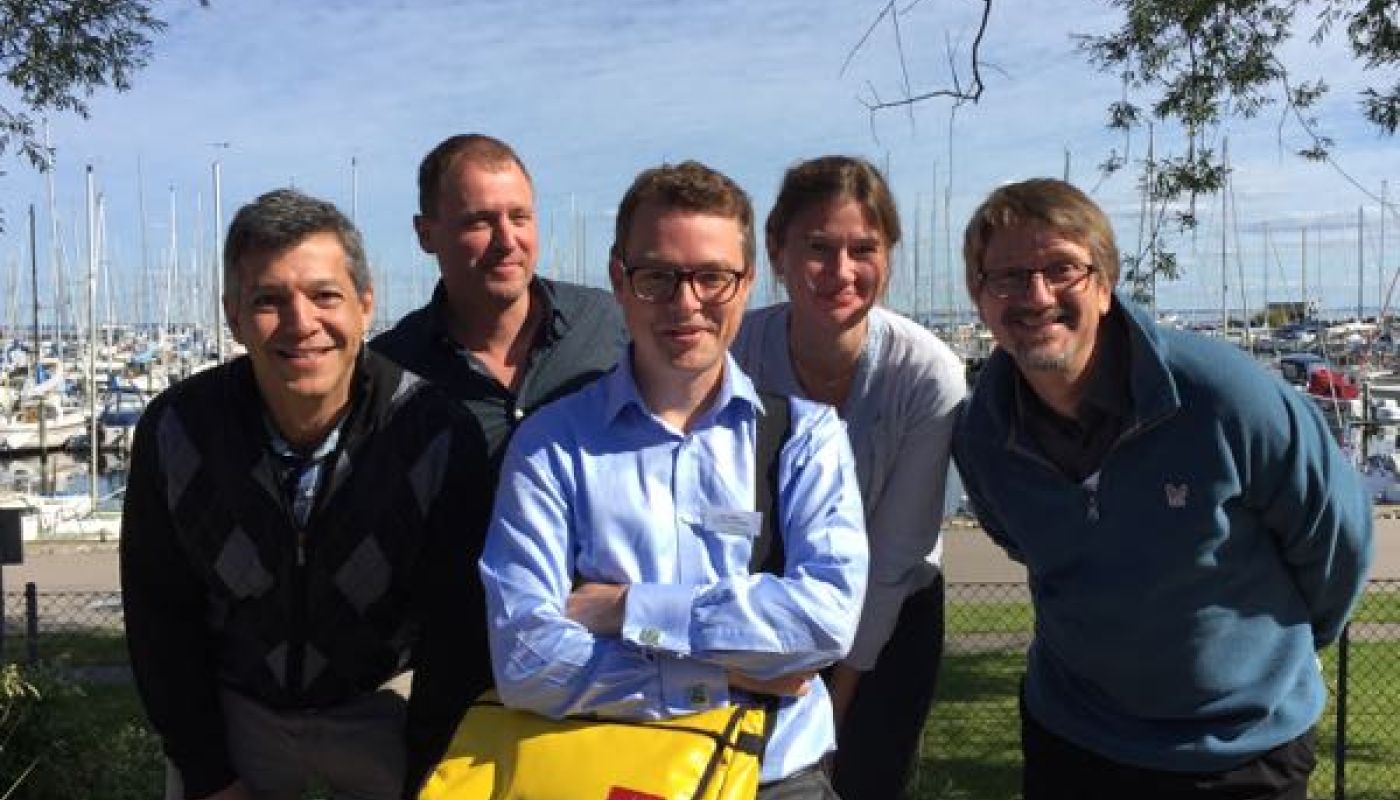
According to Professor Tom Gilbert of the Natural History Museum of Denmark, one of the masterminds behind the successful funding application for the 15 interlinked PhDs that form this network, the key to obtaining the proposed network's funding was being able to show those scrutinising the application the relevance of the research, its long-term financial benefits for the EU wine industry (especially in the face of global competition) as well as the value of the training for all the PhD students involved around the world, ‘making useful people’, to quote Gilbert. His own previous research area involved the tricky business of getting DNA out of old bones and he currently supervises a student who is applying a similar techniques to old wine, a technique they hope will make it possible to fingerprint wine in a way that makes fraud impossible. The photograph, taken close to the conference venue in Rungsted Kyst, between Copenhagen and Helsingør, shows Tom Gilbert in the centre, flanked by, left to right, Mariano Pistorio (La Plata University, Argentina), project co-ordinator Lars Hestbjerg Hansen (Aarhus University, Denmark), Lea Ellegaard-Jensen (Aarhus University) and Patrice This (INRA, Montpellier).
As neatly explained on the home page of the MicroWine website: ‘A diverse, complex, and poorly characterised community of microorganisms lies at the heart of the wine – an industry worth over €220 billion globally. These microorganisms play key roles at all stages of the viniculture and vinification processes, from helping the plants access nutrients from the soil, driving the plants’ health through protection against pathogens, to the fermentation process that transforms the must into wine with its complex array of aromas and flavours. Given this importance, an improved understanding of the microbial community and its interplay will have significant effects on the wine industry.’
Key to all areas of research, which span soil geochemistry, improving our understanding of both old and emerging pathogens such as phylloxera and esca, aroma composition and malolactic fermentation (for a complete list of the 15 PhDs and their aims, see this Projects page), is their exploitation of so-called ‘next-generation DNA sequencing’ techniques. Briefly, these are relatively recently developed improvements in researchers' abilities to decode the genetic make-up of living organisms, generating datasets that are many orders of magnitude bigger than those of just 5-10 years ago. Such techniques are revolutionising research across natural and medical sciences, but of particular relevance to the MicroWine network is the opportunity they offer for deciphering the complex mix of microbes (bacteria and yeast) that might play key roles in vine and grape health, in fermentation as well as in the final flavours of the wines themselves.
The project leaders also ‘anticipate contributing to the strength and scientific progress of the wine industry through training of a cohort of leading, interdisciplinary and tightly interconnected scientists at the forefront of modern microbiological, genomic, computational and related techniques’. According to the Horizon 2020 website, the EU contribution towards the project is almost €4 million but Tom Gilbert told me that the total budget, if you include the industry support, is €6-7 million. That amounts to serious pressure to come up with useful results and make lots of useful people.
The principal industry partner (a required feature of this type of EU training network) is Chr Hansen, ‘a global bioscience company that develops natural solutions for the food, nutritional, pharmaceutical and agricultural industries’ with their headquarters in Denmark, according to their website. I did wonder if this type of industry partner might compromise the research in any way but lengthy discussions on this topic went a good way to reassure me that this was not the case. Chr Hansen is a significant supplier to the wine industry of lactic acid bacteria (LAB), which are by no means irrelevant in this project, but Chr Hansen are already ahead of the game when it comes to the fine-tuning of LAB. MicroWine is far more concerned with research on yeast and fermentation, with which Chr Hansen is much less involved. The main restriction that results from Chr Hansen’s involvement is that students are requested not to initiate collaborations with Hansen's potential competitors without prior discussion. The mutual benefits to the research and Chr Hansen are clear but the industry funding is also critical to the viability of the project.
In September I went to the project’s KickOff conference in Copenhagen to meet, and learn from, the students, supervisors and industry partners that make up this network. Aside from all that throbbing brainpower, those crackling synapses and the fascinating research that has brought them this far, one of the most impressive aspects of the event and the network is the constant emphasis on communication between the different parts of the network, and the sharing of skills, knowledge and computing power.
This sharing is even more impressive given the locations of the universities that are home to the 15 different PhDs, from the co-ordinating hub located in and around Copenhagen to the UK (Warwick), France (Bordeaux, INRA and INRIA), Argentina (La Plata), Germany, the Netherlands, Spain (Zaragoza) and Portugal (Lisbon and Porto). There’s also input from academics in locations spanning Curtin University in Western Australia to UC Davis and Santa Cruz in California.
The title of this article was also the theme of a talk I was invited to give to students and supervisors, illustrated by four wines, two that showed the deliciousness of terroir in a glass (see the end of the article for the actual wines) and two that demonstrated the effect of geosmin (a by-product of soil bacteria) on the taste of a red wine.
The day of ‘Contexts and perspectives’ – following on from the first day’s management meeting, which I was glad to have been spared, although some of the topics looked fascinating, eg ethical challenges and how to collaborate – had begun with a brilliant overview of existing research at UC Davis by Professor David Mills and his former PhD student Nicolas Bokulich (see this 2014 report on the MW Symposium in Florence and the references at the end of the microbial terroir entry) and also included a presentation by Professor Vicente Ferreira of the University of Zaragoza outlining his team’s work on ‘wine flavour, wine odorants and the role of yeast in wine flavour modulation’, not to mention a homily by Pingus’s Peter Sisseck to his vineyards in Ribera del Duero. I needed every ounce of concentration to keep up and some of the science was way over my head but it was exciting nevertheless to see how much has already been done in making connections and to sense and share the voracious appetite for more.
As the time came for me to present my wine-wetted talk, I thought I was going to be the first speaker to mention the word ‘pleasure’ but in fact Professor Ferreira beat me to it. The wines, kindly donated by the producers in the interest of both science and pleasure, went down well – as did a tasting of Mikkeller craft beers and Josh Evans’ terroir-driven vinegar samples from experiments at the Nordic Food Lab – and were a fine reminder of what wine is all about, perhaps especially for some of the PhD students who were coming to this project with only a tangential interest in wine (so far). Further contexts and perspectives were provided by Professor Mike Bunce of Curtin University (‘metabarcoding fermentative yeast populations on Margaret River Cabernet grapes’) and INRIA’s Dr Marie-France Sagot (‘computational approaches to species interactions'), among others.
I am hoping to be able to post updates on the progress of this research during the next three years, and to see not only the revelation of some missing links but also the making of some useful people who are passionate about what’s in the glass.
We tasted:
Gaia, Wild Ferment Assyrtiko 2014 Santorini
100% Assyrtiko from volcanic soils. Fermented with ambient yeast.
Wine & Soul, Pintas 2012 Douro
A field blend of 30 different varieties grown on schist. Fermented with inoculated yeast.













