Stilton, the venerable blue-veined cheese, standing alongside a decanter of port, nuts and a roaring fire has become synonymous with Christmas.
It seems fitting therefore that the initial discussions that have finally materialised in Stichelton, a new cheese made to the same recipe but using unpasteurised milk, a type of Stilton last available in 1990, should have taken place in a pub just before Christmas 2004.
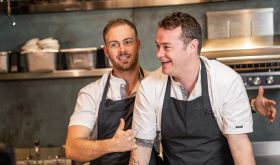
At the bar of The Wheatsheaf by London’s Borough Market were Randolph Hodgson, whose Neal’s Yard Dairy has been the conduit for the renaissance of so many British farmhouse cheeses, and Joe Schneider, an American. Despite only eating Kraft slices and Velveeta block cheese as a child, Schneider used his degree as an agricultural engineer to become a cheesemaker initially in Holland and then in the UK.
Both drinkers had a dream. Schneider’s was to use his training and love of cheese to do something on his own. Hodgson’s was to recreate the creamy, gentle flavours he associated with unpasteurised Stilton, flavours that were still firmly lodged in his memory bank of tastes. That Stichelton (which takes its name from the 13th-century rolls of Lincoln Cathedral and means a stile by a hamlet) has emerged in such a short period of time is a tribute to many factors and individuals but principally, as Schneider put it, to Hodgson’s role as the cheese industry’s equivalent of ‘Johnny Appleseed’. “Randolph goes round planting ideas,” he explained, “and pretty soon there are cheeses everywhere.”
But while finding a site for this new dairy and producing as good a cheese as Stichelton already is at the end of its first year’s production may have proved a challenge, the difference between it and Stilton, two very similar looking cheeses distinguished only by the letters CHE, has preoccupied many since that meeting in the pub.
Stilton is the most strictly prescribed cheese in the UK. It is protected initially by a trademark certification from the 1930s which stipulates how it can be made and that it can only be made in three counties: Derbyshire, Leicestershire and Nottinghamshire. The second, a PDO or Protected Designation of Origin, dates from the mid-1990s and is the equivalent of an EU appellation contrôlée. This backs up the previous certification but makes one significant new stipulation: Stilton, it states, may be made only from pasteurised milk.
This is the result of a series of food poisoning incidents which took place at various dinner parties in the area just before Christmas 1989. Stilton appeared to be the common denominator although extensive investigations on the dairies, cattle and cheese were all clean. However, as in so many such incidents, a crisis induced panic and Colston Bassett, the sole remaining producers of unpasteurised Stilton at that time, bowed to pressure and abandoned the practice with which they had worked for centuries for the more predictable pasteurised milk. By March 1990 Hodgson was selling his last unpasteurised Stilton.
From the beginning Hodgson appreciated that the seven different companies which make up the Stilton Cheesemakers’ Association would object to his using the same name for his cheese but he had hoped that he could convince them before production began. “I can appreciate their concern for their collective business if raw milk cheeses were found to cause food poisoning. But the whole debate has moved on from where it was 17 years ago and I think many now appreciate that there can be more risk involved in large – as opposed to small – scale cheese production and that listeria is more likely to occur in soft, pasteurised cheeses than hard, unpasteurised ones.”
This project, initially codenamed Notlits or Stilton backwards, got an early break when Hodgson was, somewhat circuitously, introduced to the current descendants of the family of the Duke of Portland, who have owned the 17,000 acre Welbeck Estate near Worksop in Nottinghamshire since 1606.
Although the estate already includes a café, farm shop, garden centre and gallery, its current owners were looking for additional uses for their extensive buildings and see food production as a logical extension to their extensive farmland. Schneider was smitten by the challenge of converting a 250 year-old L-shaped barn into a modern dairy, while Hodgson was excited by the milk from a herd of 150 Friesian-Holstein cows whose milk had been certified organic several years before.
This meeting of minds resulted in a most unusual company. While Neal’s Yard Dairy and the Welbeck Estate contributed equal shares of the capital, they took in return only 49 per cent of the company shared equally between them. Schenider is the cheesemaker and the major shareholder although he was not too proud to go off with a small milk urn to get us some milk from the dairy for a cup of tea shortly after we had arrived to see him earlier this month.
By October 2006 the barn had been lovingly converted into a modern, hygienic dairy that tries to retain as many Stilton cheesemaking traditions as possible. As though to warn him not to stray too far, hanging on the stairs is a photo of Ernie Wagstaff, the last cheesemaker to make unpasteurised Colston Bassett Stilton, the specialist retailers’ favourite.
Wagstaff and Stilton traditionalists need not worry. The dairy, which produces 6,000 cheeses a year, is effectively a two-man operation, Schneider and dairy man Mick Lingard, who now that he appreciates the flavours that are being looked for takes twice as long to milk the cattle as he did originally. The milk is transferred the hundred metres from the milking parlour via an underground stainless steel pipe to the dairy, which is no more than two large, open stainless steel vats, which, thanks to Schneider’s muscles, begin the transformation of raw milk into Stichelton.
Schneider could not have been more effusive in his thanks for the cheesemakers at Colston Bassett. “They not only sold us these two vats second hand at a great price but also came over and helped with the layout, made cheese with us on our first day and then came back regularly to help us tweak the recipe,” he explained.
The process is simple. 2,500 litres of milk come into the first tank and stay there for 24 hours, after which about 1,200 litres of more solid but still soft curds and whey are transferred manually by ladles into the second tank alongside. Then it is milled, salted and placed into blue hoops, which give it its distinctive shape. From there it moves into three different drying rooms, where, most importantly, six weeks later it is pierced to allow the blue veining to form inside. After a further six weeks maturing in Neal’s Yard’s cellars under a set of railway arches in somewhat less bucolic Bermondsey, Stichelton is ready.
Stichelton, with a current production of 60 tons a year and capacity for only another 20%, will never make its investors rich according to Hodgson. But its presence on cheese counters, at a 25% premium to Stilton, is already having an impact not just in the UK but also in the US, Italy Germany, Spain and, most unexpectedly given the plethora of its own blue cheeses, in France.
Most importantly it is easing supply. Worldwide demand for artisanal Stilton is increasing by 20% per annum and neither Colston Bassett, which produces over 400 tons annually, nor the considerably bigger Cropwell Bishop (which invariably wins the awards), are in a position to increase production quickly.
But as Hodgson begins to enjoy in Stichelton the flavours he has not tasted for almost 18 years since unpasteurised Stilton was last widely available, he is, like a winemaker reviewing his vineyards, reflecting on just what the future may hold. Is Stichelton the product of this particularly verdant part of England or is it the result of careful husbandry, excellent milk, a traditional cheesmaking recipe and great attention to detail? If it is the latter, could it be reproduced elsewhere somewhere where all the essential ingredients may be even better? Most fascinatingly, only a few centuries may tell.