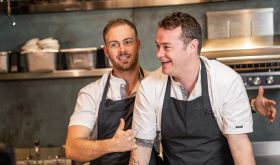
Purple pagers may like to know that very active purple pager Roger Jones has retained his star for The Harrow at Little Bedwyn – JR
I wouldn’t expect any of my fellow restaurant writers would give an impartial view on the Michelin guide. To a greater or lesser extent we are all jealous of the headlines it attracts on publication and the influence it has on chefs, their restaurants and their business during the year thereafter.
Having said that, I don’t know one of my colleagues – although as a group we rarely meet – who would swap what they are doing for a job as a Michelin inspector. The monotony of those endless meals; the reports rather than the joy of writing; the loneliness of the single diner; and the fact that so much – too much, I would argue – of its approach is looking for faults rather than maximising pleasure are individually and collectively enough to be off-putting in the extreme.
The recent, simultaneous publication of the 2008 Michelin Guide to Great Britain and Ireland as well as the 2008 Michelin Guide to London do, however, provide the opportunity to evaluate whether the conscious transformation of this little red book from a touring handbook into an international guide book is in the best interests of what must be its most important constituent, its readers.
The first point that has to be made is that Michelin has undoubtedly become a victim of the success of the industry it has nurtured and monitored for so long. There is no doubt that it has played a major part in the proliferation of restaurants but there are now so many that I believe it is economically not possible for it to be as detailed as its authority would claim. By using readers’ reports as well as their own opinions Harden’s Guides on this side of the Atlantic, and Zagat on the other benefit from what I believe is a more comprehensive methodology.
At the same time, while sticking so rigidly to its classification system, Michelin has failed to appreciate how the market has evolved and become increasingly more knowledgeable. There is far more now to a great meal than just the excellence of the cooking and that is where I most fundamentally disagree with this guide’s findings. Although it is good to see this year’s Guide highlighting the rise of restaurant-goers’ concern for the provenance of ingredients and the decline, at last, of fusion cooking, and continuing, via its awards of Bib Gourmands, its search for those restaurants offering particularly good value.
It is of course in both the chefs’ and Michelin’s best interests to maintain a united front to the world that it is only the food that matters. Yet understandable as this may be, it is an association that has become too close for comfort. At a conference last November the star turn was to be a panel featuring France’s two leading chefs Joel Robuchon and Alain Ducasse, something that had even been printed the programme. But when the request came from Michelin to help them publicise their guide to Tokyo, first one then the other backed out.
This guide has, to its great credit, been able to ignore the opening of Alain Ducasse’s restaurant at The Dorchester. One of the unforeseen consequences of the publication of this annual guide in late January is the flurry of openings during November of the previous year which, the chefs hope, will allow them enough time to impress the inspectors. The most conspicuous late 2007 openings included Hibiscus, to which the Michelin has I believe correctly given one star with the note that it is capable of regaining the second it had in Ludlow, and Ducasse, quite rightly unstarred.
Both my meals at this new de luxe restaurant at the Dorchester, a lunch and a dinner, have been extremely disappointing with only the quality of the patisserie section to distinguish it and some very high prices to make one want to forget it. I am not alone in this view but it is difficult to see how this underperformance will be rectified in the short term. Only a few days after my disappointing lunch in early January I received an invitation to attend the opening of Ducasse’s next restaurant in the Eiffel Tower, to be followed shortly by his opening in the St Regis Hotel in New York.
These meals were, fortunately, interspersed with one very good and extremely good-value example of French cooking in the heart of London which mysteriously does not seem to register on Michelin’s radar.
Clos Maggiore in Covent Garden is a rather old-fashioned looking restaurant from its front desk with a range of old bottles of Cognac and Armagnac to the fore. Inside, however, has an extremely warm and rather homely feel to it which is matched by some punctilious service. But what was most impressive was the precision of the cooking from chef Marcellin Marc during a meal that included squid in black ink, well sourced, flavourful lamb and an unctuous dessert of a praline trapezienne. This set lunch was £19.50 for three courses and the restaurant’s wine list is one of the most comprehensive and keenly priced in the capital.
But now that everyone has become a ‘food expert’ it is only to be expected that there will always be differences of opinion in this highly subjective field as to the specific ranking of certain restaurants. But as Michelin seeks to rank the world’s restaurants two larger concerns trouble me.
The first is that the standard of cooking across France has unquestionably fallen over the past decade and this has been while Michelin has been the most respected guardian of its native country’s culinary reputation. Is this because it has not been tough enough or because its methodology is just too costly? Or has this happened because it has looked overseas for growth to countries whose cuisine, most notably Spain, Italy and Japan, I and many others believe Michelin has never really understood? (By contrast, chefs and restaurant goers in the UK are fortunate to have an experienced and sympathetic editor in Derek Bulmer).
My second and deeper concern is whether, as Michelin turns its attention to far more cities than ever before, this approach is really in restaurant-goers best interests. With the spread of globalisation restaurants are becoming one of the few remaining distinctive measures of any individual city. Is the best way of evaluating restaurants an international set of criteria even if these are supplemented by some local expertise? My personal preference will always be for the national over the international.
But these concerns will not, I hope, negate in any way the talents of so many chefs collated in this guide and others, the true nature of whose profession was encapsulated for me last week by Italian chef Fulvio Pierangelini whose Tuscan restaurant, Gambero Rosso, is highly regarded by everyone. “When I cook,” he explained “the muscle I use the most is not my tongue but my heart.”
The Michelin Guide to Great Britain and Ireland 2008, £15.99
The Michelin Guide to London, £9.99
Clos Maggiore, www.closmaggiore.com
Restaurant guides to specific countries:
Italy: Slow Food and L’Espresso
Germany: Der Feinschmecker
Spain: Gourmetour