This is the final part of Tanya Garnham's report of vintage 2012 at Descendientes de J Palacios in Bierzo. For the earlier sections, see Part 1 – introducing DJP, Part 2 – waiting and sampling, Part 3 – harvest begins. and Part 4 – processing the fruit.
Although more equipment is used to make Pétalos, fermentation is entirely natural – 'whatever takes over, takes over'. All ferments need to be monitored, so my job was to go to Maderas to take the twice daily density and temperature readings and the daily cap-temperature reading. This is the most common wine-industry approach to measuring the fermentation rate.
 Taking the density readings was a bit nerve racking at first because I had to get a fairly small wine sample out of the tank's fairly large bottom valve. Open it too little and you can be there for ages getting the sample; open it too much and you end up taking a second, but not so clean, shower.
 Taking the cap temperatures was also a bit unnerving, mostly because I am a bit scared of heights and I had to climb up and down ladders with a pen, clipboard and an awkward three-foot-long 'thermometer' in one hand. I am proud to say that I did it, however, and, by the end, was even moving from tank top to tank top (but just because it was easier and faster than climbing down the ladder, moving the ladder to the next tank and climbing back up it again).
I also got to help with the twice-daily remontaje (ie remontage or pumping over) of the Pétalos wines. This is done to extract what is needed from the grape skins and to keep the cap wet. It mainly involves brute strength, agility and the skills of a contortionist as everything in the winery seemed to be either very long (eg unwieldy hose pipes and pump wires) and/or very heavy (eg pumps), and/or very big (eg ladders).
With pumping over, the fermenting wine is emptied into a big plastic tub and simultaneously transferred to the top of the tank via a pump and hose. It's a job
 for two – one at the top of the tank to make sure the entire cap gets submerged, and the other at the bottom to make sure that the liquid gushing out of the tank at 200 litres per minute is going where it is supposed to go. A few of the tanks (like the one shown) were semi-automated, which made wetting the cap quite easy. We otherwise had to do this with a hose (necessitating the contortionism) while trying to avoid taking in lungfuls of carbon dioxide.
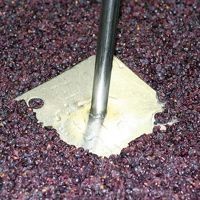
 Corullón, Moncerbal, Las Lamas and La Faraona undergo a twice-daily bazuqueado (ie pigeage or punching down, pictured top) instead of pumping over. Pumps are strictly persona non grata for these wines so a very long upside-down T-shaped stick is used to push the cap underneath the must. The idea is the same; it's just gentler.
Punching down sounds easy but, unless you know how to do it, particularly at the start of fermentation when the berries are still fairly whole, it really isn't. Miguel 'Bolero' was kind enough to admit that he couldn't punch down either at first and told me that the trick was to literally punch a hole in the cap and then make it bigger. I had been trying to press down the entire surface area of the cap evenly which just didn't work.
Once again, it was all about strength, agility, contortionism, as well as extremely solid core muscles, especially for the open-topped vats, as you simultaneously have to balance on a wooden plank placed over the middle of the vat. I never dared ask Ricardo whether he had lost an intern although it did cross my mind quite a lot.
Fermentation generally took about two weeks, after which the wines were left alone. Density and cap-temperature readings and pumping over/punching down were reduced to once a day at this point and then ceased altogether when Sandra confirmed through lab and other tests for sugars and carbon dioxide, among others, that the wines had stopped fermenting. Because grapes were coming in right up until 17 October, the ferments were staggered so there was still a lot to do. And, because there are about a zillion tanks of every possible shape, size and material at DJP, things didn't really slow down until the very end of October.
Pressing
Pressing started on 9 October at Maderas. I had to get my information
 second hand from Bolero as a huge order had come in from Germany and I was asked to help with that. Boli said the press was pneumatic and that it took two press cycles to get through the pasta (grape skins) left in one of the 18,000-litre tanks. He said that some of the tanks had revolving scrapers which pushed the grape skins through a hose to the press. I got the impression that he quite liked those ones as the older tanks, he said, had to be shoveled out by hand into a large tub, the tub moved to the press by forklift, and the tub shoveled out again into the press.
 Back at DJP, things kicked off on 17 October. I don't think pressing was supposed to start that day (although it didn't affect anything), but an unexpected 6000 kg of grapes arrived from a grower and, well, they had to be put somewhere! Spaniards are really chilled-out people – no one said a word about the miscommunication; they just got on and made room for the grapes.
From what I saw and experienced, pressing was a lot more labour intensive at DJP than at Maderas (barring the tanks that needed to be shoveled out by hand, of course). Free-run wine was first transferred to an empty tank via a cribo (a wire basket to catch the skins) and container. The remaining skins were then shoveled out of the tank or vat into a basket press. Once pressed dry (about 150 bar), the press juice was transferred to a barrel (for use as necessary later on) and the block of dry skins had to be broken apart, either to be taken somewhere to decompose or somewhere else to be distilled.
 I think I have made it sound quite easy but, in fact, it was all very physical and time consuming. The basket press alone (left) weighed a ton and had to be taken apart and put back together countless times per day as it took about four to five press cycles per 8,000 litre tank.
 And that was basically it before I left – harvest, crush and/or destem the grapes, monitor the fermentation, and press the wine.
Of course there were lots of other things going on: Sandra's numerous lab tests for sugars, alcohol, malolactic fermentation, etc, Ricardo's tastings (or at least I think so as I only saw him do this once), all the admin surrounding the vintage, getting the barrels prepared for the 2012 wines, not to mention the interminable cleaning – I could write a book about cleaning …
I left before all the pressing had been completed but it was pretty quiet by that time. The wines will now be going through malolactic fermentation and some time next year will be 'barrelled', blended and bottled.
I hope you have have been able to follow the winemaking process, and, even if you choose not to make your own wine next year, I hope you will try the 2012 DJP wines when they become available!



ゲスト寄稿者













