
Twenty years might represent an aeon online, but it’s the mere blink of an eye for viticulture. It can take decades to fully establish a vineyard, and longer still to understand its potential. With only one vintage a year, changes in winemaking style tend to happen gradually.
The most significant influence worldwide is surely the warming climate. Data abounds to illustrate how alcohol levels have been steadily rising this century, and that harvest dates have been getting earlier around the world. Yet while long-term viability is a serious concern, especially in warmer climates, quality continues to improve, with most classic regions experiencing top-quality potential with ever-increasing frequency, it seems.
Try as we might, many factors in wine are not easily quantifiable – but there are some hard statistics that we can crunch to evaluate trends in the production and consumption of wine, thanks to two major sources: the OIV (International Organisation of Vine and Wine) and the statistical compendia assembled by Professor Kym Anderson and colleagues at the University of Adelaide. [The OIV yesterday released provisional data for 2019 and preliminary figures for 2020 here – JR.]
The most recent numbers available are from 2018, but this is enough to show us the trends, and we can investigate four main areas: vineyard area, wine production, varietal distribution and wine consumption.
Global vineyard area
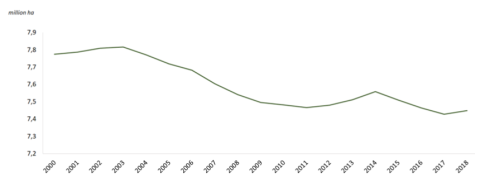
Since 2000, the world's total area of vines has decreased by 6%, from 7.8 million to 7.4 million hectares. This is more or less a steady decline, but the implication isn’t necessarily negative for wine drinkers. For example, it should be noted that production has actually increased in the same period (see below).
Furthermore, this overall figure includes grapes grown for non-vinous purposes, as becomes especially apparent when looking at the changes within individual countries. At first glance, China’s share of global vineyard has expanded hugely, in line with the narrative that it has become a new wine powerhouse – yet only 10% of this fruit is actually fermented into wine.
Table 1: Percentage of global vineyard area by country
|
Country |
2000 |
2018 |
% used for wine |
|
Spain |
15.6% |
13% |
96% |
|
China |
3.8% |
12% |
10% |
|
France |
11.5% |
11% |
99.6% |
|
Italy |
11.5% |
9% |
86.5% |
|
Turkey |
7% |
6% |
3% |
In terms of V. vinifera, Spain, Italy and France remain the largest growers by a significant margin.
Global wine production
Despite fewer grapevines, average annual wine production has increased by 4% since the turn of the century, from 280 million to 292 million hectolitres. We can therefore calculate that yields must have increased by 11% on average. Some of this can be explained by the removal of old, unproductive vineyards, while improved farming efficiency – also known as industrialisation – is presumably also a factor.
Looking at the breakdown by country, Italy’s share of production remains consistent at around 18.5%, with the meteoric rise of Prosecco offsetting declines elsewhere in the country. In 2006 only a million bottles of Prosecco were made, but by 2020 that number was expected to reach 100 million. Extraordinary!
Table 2: Percentage of global wine production by country
|
Country |
2000 |
2018 |
|
Italy |
18.43% |
18.77% |
|
France |
20.50% |
16.64% |
|
Spain |
14.89% |
15.21% |
|
USA |
7.68% |
8.18% |
|
Argentina |
3.75% |
4.97% |
France has suffered the biggest decline, while Argentina’s share of global production has increased by almost 33% – although it remains significantly smaller than that of the rest of the top five.
Varietal distribution
We know who’s growing the most vines and making the most wine, but which varieties are most popular? In the late 20th century, there was a significant trend towards the ‘international’ varieties, perhaps at the expense of indigenous grapes. However, since 2000 there has been little change in the most popular varieties. The big three – Chardonnay, Cabernet Sauvignon and Merlot – continue to grow, although it will surprise some that Tempranillo has expanded so rapidly. Presumably it has replaced the Airén and Garnacha that significantly shrunk in the same period. See more in The world's favourite grapes.

Global wine consumption
Consumption of wine continues to grow overall, although one notable statistic is that there is still far more made each year than is drunk. We drank 9% more wine in 2018 than we did 18 years earlier – 246 million compared with 226 million hectolitres – which is 16% and 19% respectively less than was actually produced in each of those years.
Both the US and China have increased their share of the world's total wine consumption, while Italy and France have witnessed a big decline (though they are still the second- and third-biggest consumers after the US). France has seen a particularly dramatic contraction – in less than two decades, France's total consumption of wine fell by more than a third, from 34.5 million to 22.4 million hectolitres a year.
Table 3: Percentage of global wine consumption by country
|
Country |
2000 |
2018 |
|
USA |
9.4% |
13.4% |
|
Italy |
13.6% |
10.9% |
|
France |
15.3% |
9.1% |
|
Germany |
8.9% |
8.1% |
|
China |
4.7% |
7.1% |
Twenty years ago, nobody could have foreseen such dramatic changes. As for the next two decades, who knows?













