I am a female located all too near (but not quite at) the age of 50. Despite what my USA email address might indicate, I currently live in Dundee, Scotland. I have a PhD in biology and worked in academic research and then biotech for over 20 years before becoming a freelance proofreader and copy editor – primarily of scientific/mathematical manuscripts, although I also have worked on manuscripts on history and the classics. Although the two articles below are of a scientific bent, I am happy to write on a variety of topics.
Can drinking red wine make you smarter?
Medical studies showing that consuming moderate amounts of red wine may have health benefits, particularly with respect to the prevention of heart disease and diabetes, have been around since the 1970s. More recently, moderate drinking, particularly of wine, has been shown to be associated with a lower risk of developing dementia and Alzheimer's disease and may even keep it from progressing. However, exactly how red wine might do this is as yet unclear. Northumbria University in Newcastle, England recently announced that a research team there is looking for volunteers for a study examining how a particular compound found in red wine and grapes, called resveratrol, may help improve mental function and memory. But what exactly is resveratrol, and how does it work?
Resveratrol is a naturally occurring polyphenol and is structurally related to other compounds such as capsaicin (the compound that makes chili peppers hot), methyl salicylate (which gives the characteristic minty taste to wintergreen), and salicylic acid (used in many skin care products). It was originally isolated from hellebore in Japan before the start of the Second World War. However, it only came to prominence in 2003, when David Sinclair, Professor of Genetics at Harvard Medical School, published a study showing that the compound extended the lifespan of yeast cells. More importantly, he showed that the mechanism through which resveratrol acts in yeast is also present in humans, thus raising the possibility that resveratrol could be used for life extension and anti-ageing in humans.
Since then, resveratrol has been shown to reduce inflammation and protect against arteriosclerosis and heart disease. Other studies have shown that it may protect against cancer and diabetes. In addition, it acts as an antioxidant and increases arterial blood flow. The latter property may be related to its ability to increase blood flow to the brain, as shown by a study carried out at Northumbria University in 2010. Theoretically, increasing the blood flow to the brain should improve brain function. However, this and other studies since then have been unable to demonstrate that the increase in blood flow results in any improvement in cognitive function.
A possible explanation for this puzzling result might be that, up until now, these studies were conducted on young individuals who might be expected to be functioning at their mental peak (more or less) and for whom further increase in blood flow to the brain would have a negligible effect. In contrast, in older individuals, blood flow to the brain reduces as part of the natural ageing process. Consequently, the new studies at Northumbria University will examine whether resveratrol can be seen to have an effect on cognition in older subjects.
Does this mean that, after a certain age, we should all be drinking red wine to promote brain health? Well, to achieve the levels of resveratrol that will be used in the studies, you would have to drink 390 large glasses of wine in one sitting! Therefore, a better approach might be to take a resveratrol supplement. In fact, some anti-ageing experts recommend taking resveratrol daily, as resveratrol has also been shown to significantly increase the activity of an enzyme called telomerase, which protects against the effects of ageing by maintaining the integrity of the cell’s DNA. Recommendations for daily doses vary from 20 to 100 mg of resveratrol, which is still a lot of wine to drink – approximately 15 to 80 glasses a day!
However, red wine has been shown to contain other polyphenols with potential health benefits, such as quercetin and catechin, as well as anthocyanins, which give the wine its red-purple colour and may act as antioxidants. These compounds may act synergistically, so that it may not be necessary to consume such large amounts of red wine to get its health benefits. Nonetheless, it will be very interesting to see how this newest study turns out. If you are interested in participating in the study, see the announcement on the university’s website. Volunteers will receive £30 for their time.
Indian corn and jumping genes – the many clones of Pinot Noir
In September, China announced that it had, as part of its current manned space programme, sent Cabernet Sauvignon, Merlot and Pinot Noir vines into space, to be grown on the space lab Tiangong-2. Why on earth, you might ask, would you want to grow wine grapes in space? (Aside from the obvious coolness of the idea and the opportunity to come up with some truly epic appellations: 'Waiter? Another bottle of your finest Death Star Red, please!') Actually, the Chinese don’t really want to make wine from these grapes (at least, not yet). They want space radiation to induce mutations that may lead to increased resistance to disease, low temperatures and drought.
While the idea of launching vines into orbit in order to get new varieties may seem a bit over the top, it turns out that Pinot Noir is particularly sensitive to another type of mutagenesis: one involving transposons, or so-called jumping genes. Transposons are genes that can literally move from place to place in the genome. They were originally described in 1950 by Barbara McClintock, a scientist at the Cold Spring Harbor Laboratory in New York. She discovered them while studying the genetics underlying the beautiful and unique colour patterns in maize.
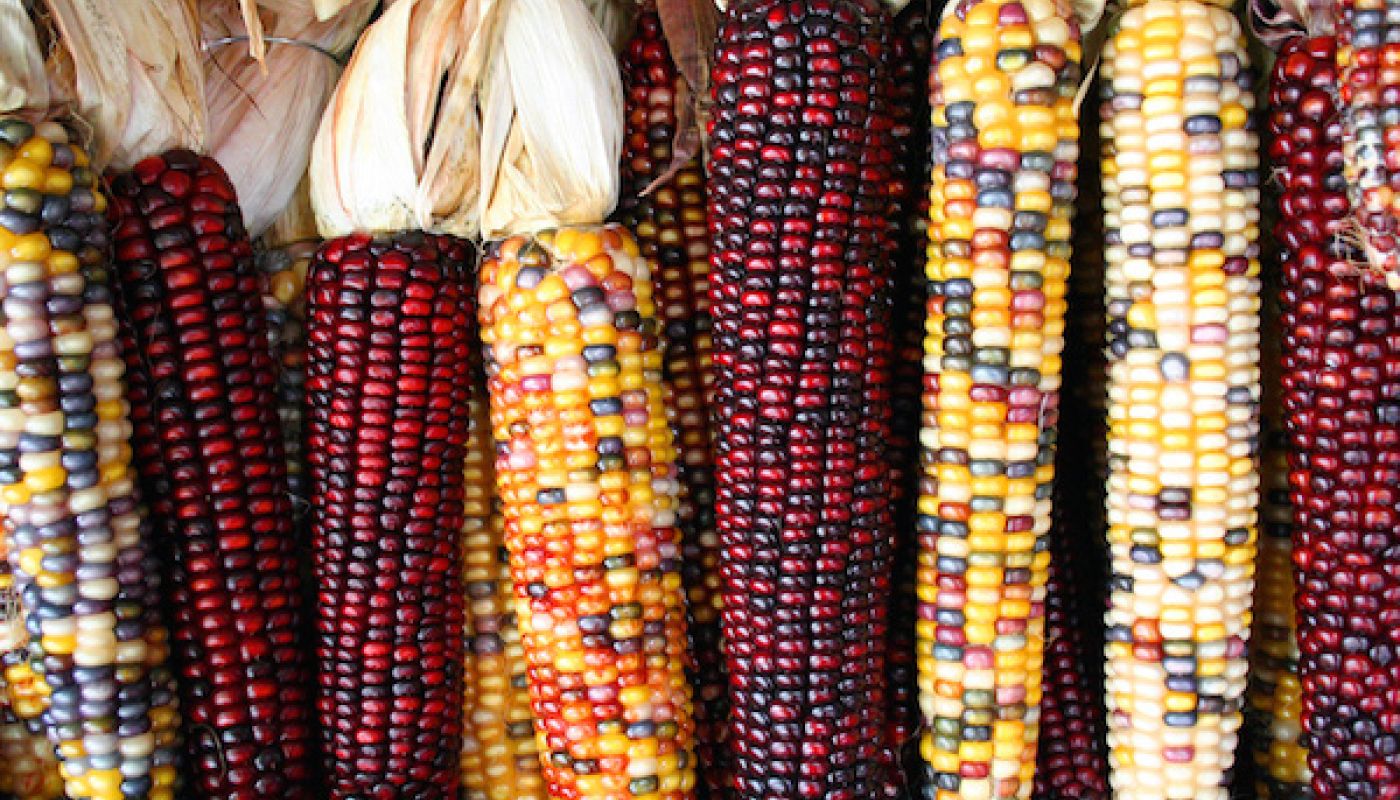
Most maize grown for consumption is uniformly yellow. However, in a type of maize known in North America as ‘Indian corn’, each kernel may be a different colour. In addition, if you look closely, you will notice that some kernels may have beautiful swirling patterns.
McClintock noticed that, between generations of maize, these patterns seemed to appear and disappear at random, indicating that the patterns were not being inherited in a traditional, Mendelian way. She realised that they were being caused by a type of controller gene ‘jumping’ next to and turning off the colour gene in the cells in the kernel of corn. If, in a subsequent generation, the controller gene ‘jumped’ away from the colour gene, the pattern would disappear.
Interestingly, when McClintock first presented her findings, the scientific community reacted with ‘puzzlement, even hostility’; so much so that, in 1953, she stopped publishing her research on this subject. It was not until the late 1960s and early 1970s, when scientists began finding transposons in bacteria and yeast, that her research was confirmed. In 1983, she was awarded the Nobel Prize for Physiology or Medicine; when she was awarded the prize by the Nobel committee, they compared her to Gregor Mendel in terms of her contribution to the field of genetics.
In addition to affecting genes that they jump next to, transposons can cause mutations in genes in the following ways: (1) by jumping into and disrupting a gene; (2) by jumping out of a gene, but taking pieces of the gene with it as it goes; and (3) interfering with DNA replication. In the years since McClintock’s discovery, transposons have been found in most organisms, including humans. The fact that there are hundreds of different Pinot Noir clones first alerted researchers that transposons might be involved. When they compared sequences of four different clones, they were able to show that the differences between the clones were linked to specific transposons. Their research also indicates that transposons may be present in other varieties of wine grapes (such as Cabernet Sauvignon) as well.
What does this mean for wine lovers? It is actually good news – the easier it is to generate mutations, the faster a species can evolve and adapt. The more clones there are, the more likely it is that one will be resistant to a new disease, a new pest, or changing environmental conditions. In light of ongoing changing climate and the concomitant spread of pests and disease around the world, the many clones of Pinot Noir mean that the wine grape will be able to survive – whatever the future throws at it.
Picture of corn cobs by Sam Fentress, reproduced here under the Creative Commons licence.
















