It is not often, as an Anglican priest, that I advocate rampant sexual promiscuity, but that is what the pioneering efforts at Domaine de la Colombette in the Languedoc are leading me to do.
This is not, of course, quite as scandalous as it sounds: I am talking grapes and their hybrids rather than humanity, but as we shall see, even this requires serious reconsideration of conservative norms in the area of wine. As with certain Catholic attitudes to sex, so with grapes: the ultimate question is ‘How far can you go?’
First, a bit of context. The Pugibet family of la Colombette, like so many in the Langudeoc are free spirits. For decades, first Francois and then Vincent and Sophie have pioneered rule-breaking innovations in their domaine, which lies five miles north of Beziers. For example, fifteen years ago, they introduced a 9% wine, branded Plume, whose creation depended on a bespoke reverse osmosis technique such that French and EU authorities queried whether this was actually wine at all. (For the record, the Pugibets won that battle and Plume has been selling by the lakeful since it entered the market.)
Commitment to scientific intervention does not always correlate with environmental sensibility; the natural wine ideologues who are often the sentinels of care for the environment, would not be playing around with reverse osmosis like this. Yet take it a different way: the genuinely free thinker can consider possibilities that do not sit in conventional silos, and this is where Colombette’s new approach to organic wine comes in.
For even though ten years ago their vines were being farmed as organically as possible, the Pugibets still found themselves turning to copper and sulphur compounds to combat mildew and oidium in their chardonnay, cabernet franc and all the other usual suspects in their vineyard. They could see that the land was thus being steadily adulterated by chemicals, albeit at a low level, even with an approach was already certifiably organic. So they have taken it one stage further on: disease-resistant grape varieties.
They are not entirely alone in this. There are dozens of so-called PIWI wineries across Europe, mainly in Germany, but they are the only ones in France.
The principle is basically Darwinian. If you take a vineyard and plant random grapes – amurensis, Marechal Foch… – alongside the old thoroughbreds, chardonnay and pinot noir etc., they can be made to cross-fertilise each other. Pollen from the male ‘parent’ is inserted into flowers castrated of their stamens and left only with pistils – the female ‘parent’. After a September harvest, the seeds are extracted and planted in the spring. There then follows ten years of observing seedling growth, seeing which survives what disease, and then which grapes look like they can survive without the need for chemical help. There are literally thousands of hybrids made from these contrived sexual liaisons, but only the fittest will survive.
For the thing about all the grapes you have ever heard of is that they have become chemical-dependent. At a certain point, every chardonnay grape vine needs a bit of sulphate to help it thrive through that wet spell in June or whatever. It is the way that centuries of the intersection of human viticulture and grape growth has developed. The result of the PIWI trials is that you can create a world, or at least a vineyard, where this is not necessary after all.
For seven years now, the Pugibets have produced wine from a section of their vineyards with literally no chemical intervention at all. No pesticide, no fungicide, no copper, no sulphites, zip. And hybrid grapes are thrown up; some like Cabernet Noir have been given a name; others are still referred to by a numerical code form. They will one day form new chapters in Julia and Jancis’ magnum opus on Wine Grapes.
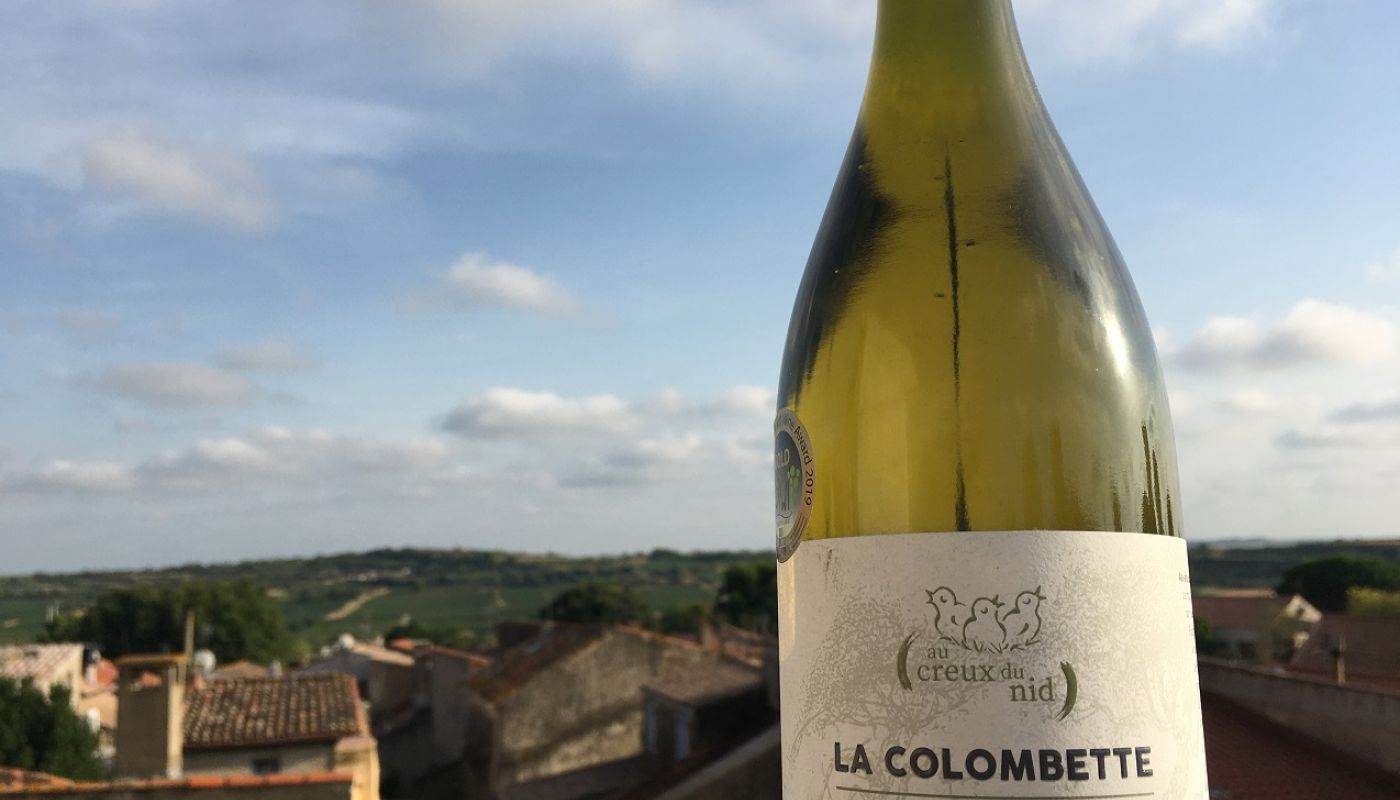
And so it comes to what is in my glass as I write, Au Creux du Nid, Cabernet Noir, 2018, from La Colombette, the PIWI international gold medal award winner for 2019, one of 7,000 bottles from this year’s vintage. (There is also a white, Cabernet Blanc, of which over 10,000 bottles are made each year, pictured above in its Languedoc setting.)
But what is it like to drink? It has a lovely nose full of fruit, but it peaks there; it tastes fine, with a rounded mouthfeel, and there is an unfortunate abrupt finish. If you pin me down, right now, I would rather be drinking the Pugibets’ grenache-syrah blend, the merely organic one which must have needed a bit of sulphate to help it on its way.
A zero pesticide world has to be the right goal, but as it means hybridising all traditional grapes, is that a cost that we wine drinkers want to pay? The fittest, most disease-resistant grapes, are not the fairest and most delectable, at least not for now. How far can you go?
To take another perspective, though: just ten years in to the project, can you really expect the PIWI grapes to be capable of matching the grace of the grapes with centuries of viticulture and decades of clone analysis behind them? If we see the bigger picture – as the Psalmist puts it, for a thousand years in thy sight are as yesterday when it is past… – then we may be more sympathetic to this development.
Most vignerons leave this process of development to the scientists. It is undoubtedly more laborious to work from the vineyard up, creating wines from grape hybrids you yourself have helped to create, but surely the people who make the key decisions need to be winemakers (and indeed wine drinkers). It is too important to be left to outsiders.
The people who will build a great new world are the ones who are prepared to put a lifetime into a project whose end will barely be achieved in their days, but who are laying the foundations upon which a coherent natural wine world can be shaped in the centuries to come. They are people like the Pugibets, and that is why I nominate them as my wine sustainability heroes.
















