We are approaching crunch time for the 2005 harvest in many parts of France.
Progress in the Languedoc, which as I have reported had seemed so promising with its modest crop levels of unusually healthy grapes, has been seriously afflicted by heavy rain over the last couple of days. Below is an account from Charles and Ruth Simpson of Domaine Sainte Rose near Servian in the Hérault department, the one of which Montpellier (rumoured to have received 300mm of rainin the downpour) is the capital, just east of the Aude whose capital is Carcassonne. The swollen grapes are likely to be particularly prone to rot over the days to come, although a drying north wind may help.
As usual the highly organised (and many would say slightly paranoid) Brits are ready for the harvest by the second week of August! Everyone else is still on holiday! The weather is hot and sunny and the by then slightly anxious Brits are worrying about the lack of water that is a common factor throughout the Hérault. Following the 15 aug holiday the rest of the Languedoc begins to stir from its summer slumber and realises that their white grapes are maturing far faster than they realised and that they are clearly not ready or able to take them into the winery.
The larger negociants and most local co-operatives are not ready to receive grapes until the end of August. Smug Brits pick their 13.5 per cent ripe Chardonnay on 20aug and have it safe in the winery!
Weather then takes a turn for the worse. Storms forecast throughout the Languedoc. It seems that we are about to receive too much water at just the wrong time. Highly stressed Brits spend the entire weekend (03-05 sep) ahead of the bad weather harvesting Merlot and Roussanne. Receive some rain at 6am last Monday morning (05sep) just after the final trailer of Roussanne is processed – Champagne to celebrate! Once again smug Brits watch all the neighbours and the co-operative working all morning and into the baking hot and humid afternoon to harvest something, anything, before the storms come.
Tense Brits wait all day for storm (still 05 sep!), frantically clearing drains. It finally breaks at 8pm with one of the loudest claps of thunder ever heard! Not as bad as we expected with only 10mm of rain, however our oenologist Delphine in the Aude receives 60mm. If we don’t get any more rain we can probably get into the vineyards to pick the grapes that we are due to sell to the co-operative (excess Grenache and unwanted Cinsault). Inflexible co-operative only receives certain grape varieties on certain days, regardless of weather – in fact they appear to be completely unaware of the weather altogether!
(Tuesday 06sep) See on the ‘Meteo’ that Hérault is now on red alert. ‘Une vigilance absolue’ is imposed for ‘phénomenes météorologiques dangereux’. At midday we get a call from daughter’s maternelle [elementary school]. The Municipale Police have shut the schools. The talk on the street is of floods like those in 1997/9. Brits now resigned that they can do nothing to stop the impending doom. Have been advised once before (by a certain Mr James Herrick!) that the only thing to do in this situation is to drink! Between 6pm and 11pm, the storms rage. Domaine Sainte Rose rain guage overflows, but neighbours’ volumes range from 120 to 150 mm, relatively little compared to some other areas. The Hérault has been hit hard, however chez Delphine in the Aude it is a calmer night and she receives only 10mm.
(Wednesday 07sep) River Thongue at the back of the garden has transformed overnight from a turgid green pool into a raging torrent. There is a little standing water in the already- harvested Merlot, but not the death and destruction anticipated by our overly active imagination! Clearly the vineyards are waterlogged and there will be no harvesting for many days. The rain continues off and on throughout the day and by the next morning we have received another 10mm. In the Aude it is still raining.
(Thursday 08 sep) Schools reopen and people return to the streets. The forecast is for continued unsettled weather for another 24 hours. By the weekend the wind will turn to the north and the sun will come out – ideal for drying things up. Our precious Syrah, our old vine Grenache and our Cabernet Sauvignon will be closely watched for any sign of disease, however having completed our careful spray programme throughout the growing season, we know we have done all we can to prevent that eventuality. A lot of water will have been absorbed, thus maturity slowed – but in the interim there is plenty to be done in the winery until such time as we can bring the rest of the harvest home. Blood pressure returns to relatively normal levels!
This heavy rain seems to have been a strictly southern French phenomenon. In Burgundy they are still reporting unusually healthy grapes and expect to start picking in the middle of the month with both reds and whites looking promising (but then they would say that, wouldn’t they?).
Bordeaux was not touched by these heavy rains either and Christian Moueix of Ch Pétrus et al, never one to oversell a vintage in my experience, has already started picking and pronounced that he has never seen the vines in better condition. Denis Durantou of Eglise Clinet reports that he began picking his Merlot on Wednesday 07 sep but that most Pomerol growers expect to start harvesting next week. The grapes are small and in very good health with low malic acidity and very high potential alcohols of between 13 and 15 per cent which may cause problems during fermentation (no, I don't know why they don't pick sooner). Charles Sichel sends the following report from the left bank: The 2005 harvest is underway. We've even started picking the most precocious plots of Merlot at Angludet – 14 per cent alcohol and 3 g/l acidity. For comparison purposes it is as early as the 1989; in 2000 we started picking on 15 sep and in 2003 on 10 sep!!! This is where our state-of-the-art harvesting machine allows so much flexibility... and avoids the dreaded "surmaturité" which would result in increased structure and loss of purity and fragrance. Our Bel Air winery is bringing in the Semillon and Sauvignon. Both are very fragrant, fresh and very healthy. The weather looks as if it is holding off for the time being. Rain forecast for Saturday which might be good for me whilst I'm running the Médoc Marathon.
(I suspect that as a polarisation develops between those who use and eschew agrochemicals – see my FT article last Saturday with some details of one producer in Roussillon – we will be seeing a longer and longer gap between when the first and last grapes are harvested in a given region).
The start of harvest has been set for 22 sep in Alsace and you can follow progress live from today, thanks to Etienne Hugel’s enthusiasm for IT, at
http://www.hugel.com/en/videovendange/index_webcam.php (shame he doesn’t carry the test match scores on it too).
And here’s another 2005 vintage report, from California, from Kendall Jackson which, not surprisingly, gives us a certain amount of puffery but a lot of useful information too.
An awe-inspiring act of nature heralded the end of a long, wet winter in Sonoma County wine country this year. Millions of strikingly colourful Painted Lady butterflies made their way north up the California Coast in record numbers, migrating from their winter homes in Mexico and the deserts of Southern California.
Another unexpected surprise from Mother Nature was the burst of vibrant wildflowers in places throughout California that haven't seen this type of plentiful display in years. Locals, particularly in the Knights Valley of Sonoma County, can't remember when they were treated to such vivid carpets of lupine and crimson clover.
In addition to the wildflowers growing between the vine rows, each spring vineyard managers plant organic cover crops to encourage the balance of beneficial insects. This is particularly the case among Kendall-Jackson's more than 12,000 acres planted in five major California Coastal appellations Napa, Sonoma, Monterey, Santa Barbara
and Mendocino. These cover crops, such as crimson poppies, fava beans, purple vetch and other legumes, provide excellent natural sources of nitrogen and organic matter in the vineyard, eliminating the use of insecticides.
With several North Coast wine regions, including the Russian River Valley and Alexander Valley, receiving as much as 50 inches of rain this past winter, water tables and irrigation ponds were at all-time high levels. The wet winter was followed by a typically cool and wet spring. (Point of reference: 50 inches of rainfall is considered "above average" along the coastal mountains and ridges of Northern California. The majority of rainfall in California usually falls between the months of October and May.)
Bud break and grape set for Chardonnay and most other varieties went pretty much without a hitch, although Merlot and Pinot Noir in some areas of Sonoma and Mendocino counties were affected by the spring storms.
In several regions of California where Kendall-Jackson farms, the Merlot crop was down in tonnage. Much of the Merlot crop was in bloom during the heavy spring rain showers, particularly in Mendocino and Sonoma counties. The force of the rain, mixed with pockets of hail, simply knocked the blooms off the vine. Where Merlot had already moved through bloom, the tiny grape berries suffered "shatter." Shatter occurs when the cool grapes absorb too much moisture and then are
subjected to warmer temperatures.
The much-heralded arrival of Pinot Noir as America's new "it"
wine may be put on hold due to reduced crop levels in specific areas of Santa Barbara, Sonoma, Mendocino, and Monterey counties. This is the third consecutive harvest where Pinot Noir has been down in tonnage while consumer demand continues to rise. In Sonoma County, Pinot Noir crop levels were actually up in a number of Russian River locations, while numerous vineyards in Western Sonoma County and Mendocino's
Anderson Valley experienced major crop losses.
Despite the vineyard-to-vineyard tonnage variations, the Pinot Noir stars continue to align for Kendall-Jackson since founder Jess Jackson had the foresight to create some of the finest, high-quality coastal Pinot Noir vineyards in Sonoma, Santa Barbara, Monterey, and Mendocino counties. Even before the Sideways hoopla, Kendall-Jackson Vintner's Reserve was and remains America's best-selling Pinot Noir over $10.
With the arrival of mostly sunny and warm days in July and August, summer managed to hit full throttle throughout California's wine regions. The heat was moderated by alternating days of cool Pacific Ocean coastal fog, followed by intense days of sunlight. Temperatures typically rise as a result of the infamous fog-blocking Pacific High Pressure system, and, in this case, managed to break into the high 90s and low 100s on several days in July and August. By late August and early September, daytime temperatures had settled into an average of 88 degrees in most coastal vineyards.
What distinguishes California's true coastal wine regions from other regions in the state is the fact that nearly every evening, the temperature will drop some 40 to 50 degrees from the daytime highs. This harsh act of nature helps to ripen the grapes and soften tannin levels. This process is also beneficial in producing optimum sugar and excellent acidity levels in grapes, helping to achieve a superb juice-to-pulp ratio. Add to this equation the fact that many of Kendall-Jackson's vineyards are located on mountains, ridges, hillsides and benches, and you have the setup for intense berries with exceptional ripeness and fruit flavours.
As Kendall-Jackson's harvest began to swing into action on 18 aug, it was clear that 2005 was going to feature similar weather and climate traits to 1997's harvest. That harvest, eight years ago, produced one of the great vintages in California's wine history, one that exhibited healthy overall crop levels, excellent ripeness and quality.
"We have a great crop of grapes this year and we've tasted some really luscious Cabernet Sauvignon and Chardonnay," said Kendall-Jackson Winemaster Randy Ullom. "I suggest you check back with us in November to verify our initial excitement regarding grape quality, but at this point, I will go out on a limb and say that 2005 may be as great as 1997.”
Kendall-Jackson farms grapes in five major California coastal wine regions. The climate and harvest conditions on the Central Coast are vastly different from the climate conditions on the North Coast. To avoid generalizations about the harvest, we've broken down comments from our vineyard managers, region-by-region:
Napa Valley: "We slogged through the late winter and spring rains to discover that we are about 5 to 10 days off our normal harvest schedule. It was a mild spring with only one day of frost alarms in our Kendall-Jackson Oakville vineyards. Our Napa Merlot suffered only minimal "shatter" during the rains. The Cabernet Sauvignon showed vigorous growth due to the high moisture levels in the soil this year and we will see slightly higher tonnage figures throughout the valley because of this. We expect to be harvesting grapes through the end of
October." Mariano Navarro, Vineyard Manager
Sonoma County: "Pinot Noir crop levels from the Russian River Valley and Shiloh ranches are right on target * up slightly from last year. Chardonnay and Pinot Noir brix levels are running neck and neck this year. We expect to be picking grapes in mid-September." Hector Bedolla, Vineyard Manager
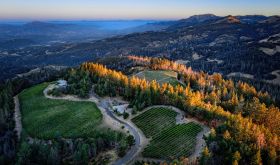
Alexander Valley: "In the terraced vineyards of Alexander Mountain Estate, about 1,800 feet above the Alexander Valley floor, climate conditions vary block to block. Overall, the grape berries are very small, with concentrated fruit flavours. The crop tonnage at Kendall-Jackson's Hawkeye Mountain Estate is average in size. Because of the rugged soils and cool climate, we won't begin to harvest the Merlot and Cabernet Sauvignon until the end of September. Much of the Cabernet Sauvignon will not be harvested until early October." Tony Viramontes, Vineyard Manager
Mendocino County: "Farming on the top of mountains and ridges is always a risky proposition and this year was no exception. The timing of our Merlot bloom on Kendall-Jackson's Grizz Ridge Estate high above the Anderson Valley coincided with the spring storms that rolled off the Ocean. We may have lost as much as 25 per cent of the Merlot crop on this particular 250-acre vineyard. The Chardonnay and Pinot Noir crop in our Philo vineyards is a different story. It's slightly above average, though some Pinot Noir in our western-most vineyards was hit by the rain. We expect to be picking by the end of September." Dennis Winchester, Vineyard Manager
Monterey County: "We experienced an early bud break (February 17) and managed to get through bloom without being affected by the spring rains. For the most part, the Kendall-Jackson harvest is about 7 to 10 days late due to the relentless cool, foggy summer mornings. We'll begin
picking the Pinot Noir by late-September and Chardonnay in early October." Bill Hammond, Director of Vineyard Operations
Santa Barbara County: "Our Chardonnay crop on the Santa Maria Bench and in Los Alamos is excellent this year, perhaps up by as much as 10% over past years. Pinot Noir is also a good size crop this year for us. We'll be picking Pinot Noir first with Chardonnay to follow by mid-September. Syrah is just now passing through verasion and should be ready to harvest in the first couple weeks in October." Pat Huguenard, Vineyard Director