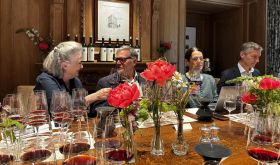
We all have emails that mysteriously go missing. Many of them are unimportant. But I will forever regret one that was sent but never arrived in my Inbox from Aubert de Villaine of the world’s most famous burgundy producer, Domaine de la Romanée-Conti (pictured, in a photograph on the wall of DRC's offices), inviting me for a snack lunch before my visit to the domaine last November to taste the 2008 vintage.
Tasting in Burgundy is much less exhausting than in most regions because vignerons there stick to such a strict schedule. In my experience, appointments are countenanced exclusively within two periods: 8.30 to 12 and 2 to 5.30. Unlike most other wine regions, there is no tasting in the evening or at weekends, and there is an enforced extended break in the middle of the day during which I tend to huddle for warmth in a modest village restaurant. But apparently lost forever in cyberspace was an opportunity to huddle over a glass of DRC burgundy with one of the most articulate vignerons in the world. Zut alors!
Nevertheless I did have the chance to hear what de Villaine, and another 27 of the more celebrated wine producers of the Côte d’Or, had to say about the mercurial 2008 vintage currently being offered by wine merchants around the world, particularly in the UK, conveniently at a time when bankers’ bonuses are in the air.
It was even more difficult than usual to cover the ground in Burgundy last November because, unusually, a significant proportion of the 2008s were still, long after the next, much-trumpeted, harvest was safely in barrel, undergoing the second fermentation that transforms harsh malic acid into softer lactic acid. This process was particularly necessary for the 2008s, in which the proportion of malic, usually less than half the tartaric acid component, was its equal. But because there was so much searing malic acid, and because the persistent summer and early autumn rain had tended to wash off the grapes the yeast and lactic acid bacteria that get the fermentations going, the malolactic fermentations were slow to start and proceeded unusually slowly. So, I had to forego, for example, Domaine Leflaive’s Le Montrachet and Puligny-Montrachet Les Combettes because they were still slowly bubbling away. (On the rare occasions I was given a taste of a wine still going through le malo, it was so milky, fizzy, harsh and inexpressive that I found it impossible to assess.)
The previous, 2007, vintage had already been very stressful for Burgundy’s growers, who had to wait until the third week of August before being rescued from the prospect of a vintage that would be rained off, but 2008 turned out to be even worse.
The crucial early-summer flowering was strung out over three weeks in 2008 in very mixed weather so that many grapes were lost to coulure, or poor fruit set. By mid July, vignerons were already battle-weary in their attempts to fend off mildew. A particularly savage hailstorm laid waste to many significant vineyards around Meursault and Volnay on 26 July. Everyone reported much lower final yields than in 2007 or 2009 – only 16 hl/ha (less than 1 ton/acre) at DRC.
By the end of August, many growers were wondering whether it would be worth even picking the grapes. Then came the first two weeks of September, described as ‘catastrophic’ by Eric Rousseau of Domaine Armand Rousseau, when it continued to rain. Rot and mildew rampaged through the vineyards. All seemed to be lost, but then a miracle happened.
As Aubert de Villaine described it, ‘I was biking with a friend in Bresse on the weekend of 12/13 September. The Saturday was still very wet, but on the Sunday morning the sun suddenly came out and shone for a month, providing us with proof that if you’re careful to take off all the not-good grapes, you can make very good, even great, wine.’
According to François Millet at Domaine Comte Georges de Vogüé, ‘we all went to church that Sunday and lit candles for the miracle – the north wind that dried out the grapes’. Romain Taupenot of Domaine Taupenot-Merme reported that the winds of the second half of September were prolonged right through to harvest, generally the end of September and very beginning of October, and reached speeds of 60 km/hr, calling them, ‘the best treatment we could have had’ since they dried out the vines and the grapes and halted the progress of vine disease.
But temperatures were relatively low – down to 10 °C (50 °F) during the harvest days – so a strong characteristic of this vintage is that the grapes did not go through normal physiological ripening. Instead, the sugars were concentrated by the drying wind. It remains to be seen what effect this will have in the long term, but at the best domaines anyway the results were certainly hugely better than expected.
Millet was bullish. ‘Skin ripeness was only medium in 2008, but so what? Medium is enough. The grapes matured slowly in late September because of the low temperatures, but that helped to preserve the freshness.’
These 2008s are nothing if not ‘fresh’. Acid levels are notably high (which is why the spectre of 1996 hangs over this vintage), but provided the vines were not overloaded with grapes that were too numerous to ripen, the best wines seem to have developed enough flesh to compensate.
‘Twas not always so, however. For their first few months in barrel, the 2008s looked irredeemably tart and even the best failed to round out until well into last summer or even later. Jean-Marie Fourrier of Domaine Fourrier confessed in late November, ‘it has been only in the last 10 days that I have started to like these wines. It took me ages to understand the weather conditions. They were like the 1970s so I had never experienced them before. This was the first year, for instance, when it was so cool that only half of the berries saw the sun, and so berries could be so different even on the same vine. We had to reject 20-30% of the berries on the sorting table.’
Sorting was the single most important activity in 2008 (in stark contrast to 2009). At Leflaive they needed five to six people on either side of the sorting table, and Stéphane Thibodaux of Domaine Comte Lafon reported just how difficult it was to keep people motivated, picking out damaged or diseased grapes for 10 hours at a time. According to him, the ideal person for this demanding, finicky task is ‘a specialist in sorting, not a picker brought in from the vineyard, and ideally Japanese, or at least Asian, or a woman, or a man of at least 40’. He summed up this ‘very complicated’ year thus: ‘it was a lot of work for a very small crop, with unexpected results, so we’re very immodest about them’.
Aubert de Villaine admitted that ‘20-30 years ago we wouldn’t have been able to ripen the grapes at all, but now we’re helped by global warming and our greater care in the vineyard. There is maturity but only half of a normal crop, for us about 16 hl/ha. We left lots of grapes on the ground and there was lots of coulure.’
But only really conscientious vignerons who watched their vines every step of the way have managed to produce wines that have enough flesh to counterbalance 2008’s sometimes painful acid levels.
And the prices? In very general terms they look pretty similar to last year's in pounds. The euro:sterlng exchange rate is similar and some growers have actually reduced ex-cellar prices in euros. There are also many UK merchants making offers of the same or similar wines which helps. We'll publish a list of them early next we
Next Saturday – sorting the 2008 wheat from the chaf.
We expect to publish well over 1,000 tasting notes on Purple pages early next week.