
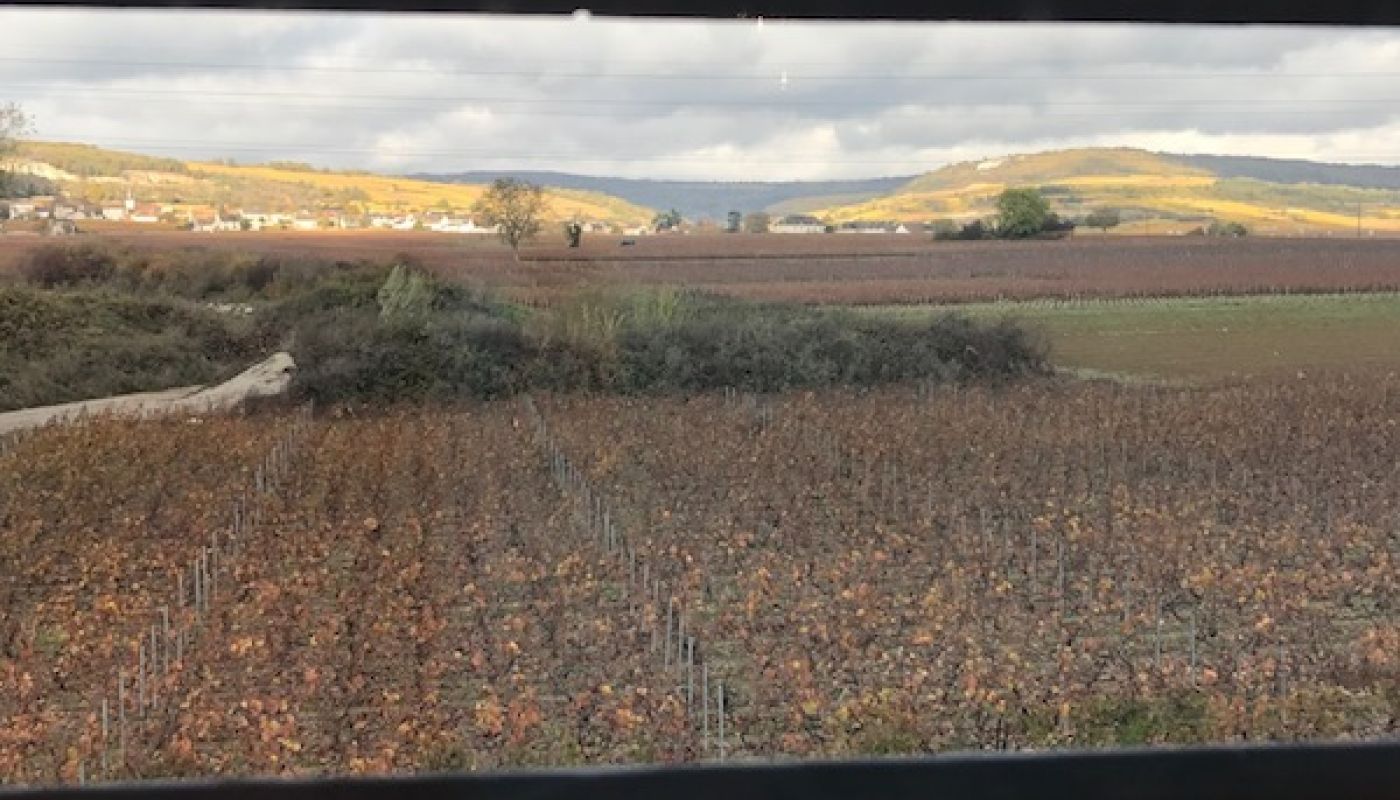
Things are now going very well for Pierre-Yves Colin-Morey but he still looks haunted by problems. His gamble of leaving the family domaine Marc Colin in 2005, having set up his own small négociant business with his wife Caroline Morey in 2001, has paid off. It took time for him to build up a reputation, particularly in France, but his wines are now recognised as some of the most precise and rewarding white burgundies, regardless of appellation. I have followed his progress from tasting at his kitchen table, to shared, somewhat chaotic, premises in Chassagne-Montrachet to a custom-built site south-east of the village that looks at first glance like a hip hotel (view from his snazzy tasting room above right). ‘Every year when I present my wines to my clients, I’m scared', he told me as he poured the last of his 2015s into a wafer-thin Zalto glass. ‘But this building has given us lots of serenity and wisdom.’
His 2015s, the first vintage made in his swish, deep, exceptionally cool cellar, are superb and, like most white burgundy producers in 2015, his harvest was particularly early. After a torrid July and changeable August, the notably healthy grapes were ripe enough to pick by 27 August but daytime temperatures were higher than he likes to pick in so he waited until the first week of September when they were no more than 23 ºC. Unlike those in the last heatwave vintage, 2003, alcohol levels were relatively modest – between 12 and 13.2% chez Colin-Morey, for instance – and acidities high enough. The coolness of his cellar means the wines evolve more slowly and were left in contact with the lees of fermentation for longer than usual. ‘I found the 2015s gained lots in freshness every month', he told me, adding, ‘one of my main concerns was not to bottle too early'. Colin-Morey now produces 31 different wines, mainly whites, from his own 7.5 hectares (18.5 acres) of vines and two more that he farms under long-term agreements.
Through importers such as A&B Vintners in the UK, Atherton and Skurnik in the US and Altaya in Hong Kong, his wines are highly sought-after but the increasingly fraught conjunction of burgundy and money clearly worries him. ‘There are people who want to buy domaines or part of them', he observed, echoing the current Côte d’Or conviction that their precious vineyards are under threat from foreign marauders, ‘and there are people who want the wines at any price. This gives me vertigo. It may sound pretentious but I put a lot of work into who my clients are. I want them to drink the wine, not trade it.’
And there is another major concern, one that I heard repeated up and down the Côtes de Nuits and Beaune. It is generally agreed that, although the first few harvests may be particularly successful while crop levels are relatively low, as vines age, the quality of the wine they produce increases. This may be partly because yields decline so what there is is more concentrated, but older vines’ well-established root systems are also much better at withstanding the increasing problem of drought (young vines suffered water stress in Burgundy in 2015 – especially in St-Aubin).
Every vigneron likes to boast of how old their vines are – even if many of them cite the age of the oldest plants in a vineyard rather than the average vine age. Many a label all over the world carries the (unregulated) claim of Old Vines, Vieilles Vignes, Viñas Viejas, Vinhas Velhas or Alte Reben. But with really old vines, yields can fall to seriously uneconomic levels, and the vines themselves are sometimes so fragile that they are easily susceptible to fatal damage in the vineyard. Yet, replanting is a long and expensive process. Ideally the vineyard is left fallow for a few years and then, once replanted, it will be at least 10 or 12 years before the vines are mature enough to produce even half-decent wine.
Colin-Morey is 44 years old. His oldest child is 18 and already showing an interest in wine. ‘I’m worried about replanting old parcels of vines. You need a total of at least 27 years for them to start producing interesting wine. So far I’ve been replacing sick vines plant by plant but I can’t keep on doing that. It’s important to pass on vineyards in good shape to your children. If not, it’s not a gift. I’m constantly torn between wine quality and vineyard upkeep.’
Just up the road in Meursault, Jean-Marc Roulot acknowledges how lucky he is that his father Guy did a major replanting in the 1960s, presenting Jean-Marc with already-mature vines on his return to the domaine in 1989. Also in Meursault, Arnaud Ente is tortured by what to do about his most distinctive wine, the one he calls La Sève du Clos (‘the sap of the walled vineyard’), a special selection of century-old vines inherited from his father-in-law. He blends the produce of the younger vines into his village Meursault but people will pay well over £200 for a bottle of the Sève du Clos, which is produced in ever-decreasing quantities. In 2015 he made just 300 litres from his fifth of a hectare, or half an acre. ‘Every year I’m disappointed by the yield', admits Ente. ‘I just don’t know how long I can carry on, but the wine really is special.’
Ex-pilot Frédéric Mugnier of Chambolle-Musigny is one of Burgundy’s pragmatists. ‘You don’t want to pull out vines that are performing well, but if you don’t, you’re just saving up a problem', he maintains. The jewel in his inherited crown is his hectare of vines in the grand cru vineyard Le Musigny. Some of his vines were planted in the 1940s, the others between1958 and 1963. This year he pulled out the last portion, about a fifth, of the oldest vines. He admitted it was a difficult decision but explained, ‘I took an American friend in the vineyard and we had to inspect six vines before we found a single grape. There’s no point in farming leaves.’ Mugnier is not a fan of vine-by-vine replanting. ‘Replanting a whole plot allows you to restructure the soil and solve any compaction problems. And the roots take much better. You end up with better balanced vines.’
Given the dramatic financial impact of replanting – zero income from that land for many years – I wondered exactly who makes the decision when, as so often, wine estates are owned by many different relatives. Mugnier gave a wry smile. ‘The big problem of family domaines are the relationships, and the imbalance of expectations between the active family member and the others.’
See our collection of more than 1,500 tasting notes on 2015 burgundies. Click on the 'old vines' tag to see many more articles on this subject.
SOME GREAT 2015 WHITE BURGUNDIES
The 2014 whites may have been more classical but the following producers made particularly successful 2015 whites, which seem to combine attractive ripeness with energy. (Some 2015 whites seem a bit flabby or dilute.)
Jean-Claude Bachelet
Ballot-Millot
Samuel Billaud
Billaud-Simon
Bret Brothers
Jacques Carillon
Alain Chavy
Bruno Colin
Marc Colin
Pierre-Yves Colin-Morey
Droin
Arnaud Ente
Eric Forest
Antoine Jobard
Comtes Lafon
Hubert Lamy
Bernard Moreau
Fernand & Laurent Pillot
Pinson
Guy Roulot
Arnaud Tessier













