

It seems only moments ago that wine producers the world over routinely, and enviously, cited champagne as the model of a commercially successful wine.
But things have changed. Champagne sales have been slowing. Vast numbers of wine drinkers are just as happy with Prosecco. In my own country, English sparkling wine is now regarded as just as socially acceptable as champagne.
And perhaps the greatest changes have been in the vineyards and cellars of the Champagne region. You could argue that currently Champagne is undergoing a greater revolution than any other wine region. The most obvious change is in the climate. Virtually all wine regions are experiencing more and more hot summers, but this matters particularly in Champagne where high acids have been treasured in the base wines to be made fizzy. Average acid levels have been falling, and I think you can taste in many champagnes that the grapes were riper than in the past.
This is not necessarily a bad thing. The old formula of milking the vines to produce large volumes of underripe grapes and then beefing up both the base wine and the finished wine with added sugar seems to be in retreat, and nowadays champagne is much more likely to have been made from grapes that absorbed real character from their time on the vine.
The sea change in viticulture is the change most obvious to a visitor who has not been to the region for a few years. In the old days there wasn’t a living thing between the rows of tired vines – just heaps of thinly spread refuse from Paris. It was always jarring to see scraps of bright blue plastic in the vineyards. Today we are seeing the fruits of a region-wide policy to encourage much more sustainable ways of growing vines (‘more earthworms!’), with cover crops, benign weeds, and ever-increasing numbers of growers adopting organic and even biodynamic practices – not always an easy path in such a relatively damp climate.
Another major change that has taken place remarkably quickly is the organisation and even veneration of growers as opposed to the big houses. The region has always been divided politico-economically between the 16,000 farmers who grow the grapes and those who make the wine. At one time those were two very distinct activities but the line has become blurred, especially as the houses increasingly acquire vineyards. Thousands of Champagne’s vine growers sell all the grapes they grow to a house and/or one of the co-ops that are so important in Champagne (Krug buys from several of them). But in recent years much of the media noise about champagne has been focused on the best examples of growers who make their own champagne.
There is no shortage of very ordinary grower champagne, but the best winemaking growers (récoltant-manipulants) have sensibly banded together to form groups who show their latest wares in the region every April, attracting trade and press from around the world. Because such growers tend to give maximum information on their back labels, the difference between each year’s cuvées is very clear, so it is screamingly obvious that they are showing something new every year – something for journalists to write about and importers to rave about. Compare and contrast with the non-vintage blends that comprise over 80% of a typical champagne house’s output. What is there to report?
When they first burst on the international wine scene, the best grower champagnes seemed great bargains, but prices have been catching up with their reputations and this, alas, is no longer the case. Nevertheless, they seem hugely popular. On my recent trip to the coasts of the US and to Sydney and Melbourne in Australia, I hardly saw a grande marque on shelves and wine lists. They seemed definitively to have made way for a host of grower champagnes.
One current, very noticeable trend is for the younger generation to inherit the family vineyards and decide to make wine for the first time. This is inevitably capital-intensive – not just because of all the equipment and cellar space needed but because champagne has to be aged much longer before release than most still wines. Because of this, many of them continue to sell some grapes to finance their winemaking.
When they launch their new label they won’t have the stocks of older reserve wines that add complexity to the blends of more venerable producers. But what they can offer, which many of the big houses do not, is terroir-specific wines. Although houses such as Philipponnat, Billecart-Salmon and Krug offer single-vineyard champagnes as part of their range, growers are much more likely to offer wines that are fashioned by one small area in Champagne – because that’s where their vines are. (The big houses buy in grapes from all over the region.) Many a grower-champagne back label will tell you exactly where the grapes were grown, as well as when.
Another trend also flies in the face of the traditional champagne mantra that blending is all. We’re seeing more and more varietal champagnes, those made from a single grape variety. Of course we have long had many all-Chardonnay Blanc de Blancs to choose from, but now champagnes made from Pinot Meunier are far from uncommon, or ones labelled Pinot Noir, or even champagnes made from the region’s more obscure grapes such as Arbane and Petit Meslier. Novelties rather than great wines, perhaps, but signs of real evolution and experimentation in a region that used to be so complacently static.
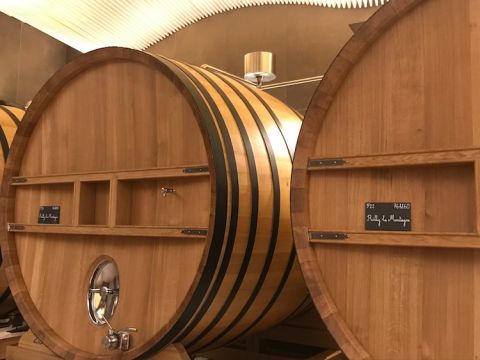
Just as many still-wine producers are moving away from oak, the Champenois are head-over-heels in love with it, producers using increasing proportions oak for ageing the base wines, typically large and well-used. (I took the picture top right and below in Billecart-Salmon's cellars in Mareuil-sur-Aÿ. And, yes, I have seen fashionable concrete eggs in Champagne too.
There used to be a doctrinal difference between houses that suppressed the malolactic conversion of harsh acids into softer ones and the rest. But now, with acidity at a premium, I would guess that malo is less routinely sought even by those in the second camp.
Over recent years I have noticed champagne becoming less fizzy, with many producers preferring a gentle, persistent mousse to an aggressive one. To achieve this, some houses and growers are adding rather less sugar with the yeast that invokes the second fermentation in bottle. It also seems to me that the average length of time wines are aged on the lees of that fermentation has been increasing. This would be a natural result of slowing sales, of course, but I hear more and more producers, particularly houses that can afford it, boasting of deliberately extending their ageing period.
The most obvious change perhaps has been the reduction in dosage, the mix of wine and sugar with which bottles are topped up immediately after the frozen sediment has been expelled from the upended bottles. (The introduction of computerised, mechanical riddling of the sediment on to the cork has made hand riddling almost extinct in the Champagne region, although neighbours Billecart-Salmon and Philipponnat continue the tradition – perhaps they employ the same strong-wristed people?)
A dosage as high as 12 g/l used to be routine, especially in an era when grapes struggled to reach what was then the legal minimum potential alcohol of 7% (it’s 9% today). Today even big, commercial houses may employ a dosage of only about 7 g/l, thanks to those riper grapes. And then there is an unavoidable fashion, particularly among certain growers, for champagnes with an even lower, or no, dosage. Zero Dosage is regarded by some as a badge of honour, but I must say that I find some of the resulting wines just too austere for comfort, even if age can compensate for a low dosage.
But one benign effect of increasingly ripe grapes is the increase of interest in producing still Coteaux Champenois. During a concentrated tour of the region last June I was shown several very respectable still Chardonnays and Pinot Noirs. I also noted the rehabilitation of rosé champagne – no longer regarded as a commercially useful afterthought.
And then there is the very welcome increase in the number of champagne producers prepared to share information about what’s in the bottle – whether via small print on the back label, a number or a QR code – with their customers.
All of this adds up to the fact that, overall, champagne is better quality than it has ever been. Hoorah!













