
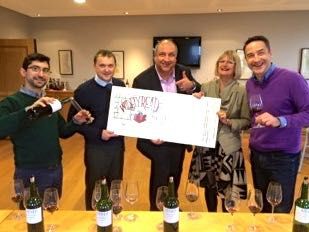
Although I have never wanted to make wine myself (too much of a control freak to be in thrall to nature, too impractical to manage it), I always fancied my blending skills. But a recent session with Bordeaux’s most admired consultant oenologist was enough to demonstrate to me I have a long way to go in this respect.
The genesis of this humbling experience lies in Japan. Just before Christmas last year Berry Bros & Rudd’s Tokyo-based sales director Simon Staples was sitting in the reception of an office in Ginza waiting to see his most important Japanese client. Through him, this chap had ordered a barrel of both 2012 and 2014 red bordeaux made to his instructions to celebrate the birth years of his daughters, already planning to have the wines served in magnums at their weddings. What got Staples thinking was his special request to have the wine labels incorporate drawings by his elder daughter.
Berrys in general and Staples in particular have long been generous and enthusiastic supporters of Room to Read, the charity that so effectively spreads literacy in the developing world (and whose 109 staff in Nepal have all, miraculously, survived the recent earthquake, unlike the schools and libraries that have been constructed and have so far benefited two million children there). Staples started to think how exciting it would be to have a special wine sold in aid of the charity and decorated with labels designed by some of the millions of children whose lives have been improved by Room to Read. He returned to Britain for Christmas via Hong Kong to propose the idea, approved on the spot, to Room to Read’s founder John Wood over a beer at the Mandarin’s Captain’s Bar.
Staples then contacted Stephen Bolger, who runs Viniv, the custom-crush facility with its own top-quality winemaking facilities that is co-owned by Bolger and the Cazes family of Château Lynch Bages in Pauillac. Berry Bros are UK and Hong Kong agents for Viniv, which offers well-heeled hobby vignerons the chance to make their own wine, advised by the oenologist Eric Boissenot and the technical staff at Lynch Bages. Viniv had supplied the wine for Staples’ matrimonially minded Ginza client and it seemed logical to blend a Room to Read wine from the grape sources that have been sought out by the Franco-American Bolger.
With the next Room to Read fund-raising wine galas in Tokyo and Singapore scheduled for April, there was no time to hold a children’s art competition for the initial bottling of a 2013. The launch label had therefore already been designed (at half price by Samantha Dion Baker of Brooklyn) and the name – Widely Read – decided upon by the time Staples and I met the last evening of March in the tasting room at Viniv with a hard day’s tasting of 2014 primeurs behind us.

Eric Boissenot is as shy and diminutive as Simon Staples is the opposite. So when we began to taste the eight possible ingredients lined up by Stephen Bolger, it was Staples who dominated the conversation. (A further complication was that Boissenot speaks so little English and Staples only the most rudimentary and bombastic French.)
Coming late to the whole exercise, I expected to have to try to make a silk purse out of the many sow’s ears remaining from the less-than-splendid 2013 vintage. I was agreeably surprised therefore to find that our samples, rather than being a rag bag of offcuts from the lowliest appellation, AOC Bordeaux, that is generally applied to the sea of red wine made in the pretty but undistinguished Entre-Deux-Mers region, came from appellations as grand as Pauillac, St-Émilion, Haut-Médoc and Graves.
We were each issued with one of Viniv’s blending templates, a grid that suggested we might have to try up to 14 different permutations of the eight samples, three Merlots, two Cabernet Francs and three Cabernet Sauvignons. We started off by picking our favourite Merlots. The one from Côte de Castillon was a bit too weedy, a bit too obviously a 2013. But the one from Canon-Fronsac, the appellation west of Pomerol that tends to be criminally overlooked nowadays, was delicious – really plump and attractive but with structure too. Stephen Bolger told us it came from a plot ‘on the top of the natural amphitheatre at the highest point of the appellation (limestone, baby!)’.We decided we might use as much of this as was available.
We then tried the two Cabernet Francs, a grape that can be aggressively herbaceous in less-than-fully-ripe vintages. We much preferred the one that came from St-Émilion vines above Château Faugères and not far from prototype garage wine Château Valandraud. And the standout Cabernet Sauvignon, not surprisingly perhaps, was the one from just down the road in Pauillac, next to Château Pichon Baron (now sold under the name it has always been known by rather than as Château Pichon Longueville as Jean-Michel Cazes tried to rename it; his son and successor Jean-Charles was watching our blending antics with bemusement).
As far as neophyte blenders Simon Staples and I were concerned, it was just a question of getting the proportions of these three ingredients right, and since, because of remaining stocks, the maxima allowed of the excellent Merlot and Cabernet Sauvignon were respectively 54 and 34% of the final blend, then surely just making it up with 12% of our preferred Cabernet Franc would do the trick?
The Viniv staff got to work with their measuring cylinders and presented us with that blend, but Eric was looking increasingly doubtful. He wanted us to try a little dash of the third Merlot we’d tried, one from St-Émilion that we felt was a bit too tannic. Well, he does advise on the blending of most of the classed growths, including several firsts, so we shut up and tried a blend that incorporated 4% of this St-Émilion Merlot. To our amazement, and slight chagrin, he was absolutely right. This was a new, improved version of ‘our’ wine. Job done. Surely that would do? We had a rather good dinner in prospect after all. (Jean-Charles was to treat us to dinner at Cordeillan Bages with Ch Lynch Bages 1990, 1982 and 1959 – members will find tasting notes on them in our 111,000-strong database.)
But no. Monsieur Boissenot was not yet satisfied. He thought that 14% Cabernet Franc was just a little too much, and we accordingly experimented with different but decreasing proportions of it. In the end we were convinced – who wouldn’t be? – so the final blend of Widely Read 2013 is 54% Merlot from Canon Fronsac, 4% Merlot and 10% Cabernet Franc from St-Émilion, and 32% Cabernet Sauvignon from Pauillac. The blend may qualify only as AOC Bordeaux because it incorporates wines from both left and right banks of the Gironde but it has an outstanding pedigree, and was blended according to the highest standards. Ahem.
Last month a total of 144 six-bottle cases were pre-ordered at the Tokyo and Singapore Room to Read wine galas respectively, leaving 336 six-bottle cases to be sold at future wine galas and by Berry Bros online. This toothsome blend will be delivered early next year when it should just be starting to come into its own. I recommend it.
Widely Read 2013 is £330 in bond per six-bottle case from Berry Bros (bbr.com), who have pledged £160 of that to Room to Read. This may not be the keenest price for a 2013 AOC Bordeaux, but each case sold will educate five children for a year.
Our picture shows (left to right) Thierry Cowez and Stephen Bolger flanking Eric Boissenot, Simon Staples and me with a blown-up version of the label.













