Amber Revolution
How the world learned to love orange wine
Simon J Woolf
Published by Morning Claret Productions (Netherlands) and Interlink Books (USA)
ISBN 9781623719661
$35, £30, €35, ¥3,980
On 21 September 2017, Simon Woolf launched a Kickstarter campaign to fund a book. He’d spent six years obsessing about orange wine, and had finally caved in, given up his well-paid job, and was writing a book to answer all the questions he had to which no one else seemed to have an answer.
At the time of tasting his first orange wine, Simon was living in London, had a full-time job in IT, and had just started a wine blog on the side (for which he partly blames Jancis). Fast forward to today, he lives in Amsterdam, his blog The Morning Claret has all grown up and acquired a team, and he contributes to Decanter and Meininger Wine Business International, among others. And he also managed to persuade 388 backers to part with a total of €25,148 (smashing the target of €17,500) so that he could publish the book I am reviewing today.
The wine that lit the orange flame for the author was a barrel sample in Sandi Skerk’s cellar in Carso. That wine led to Joško Gravner and Stanko Radikon in Collio, north-east Italy, then over the border into Slovenia and on eastwards to Georgia.
But I’m going to start with the title. Throughout the book, Woolf calls it ‘orange wine’, presumably because this was the term coined by David A Harvey of Raeburn Fine Wines after much cogitation while working as a cellar rat for Cornelissen (read the story on page 161). The name stuck. In the preface Woolf explains that ‘orange wine as a term is troublesome enough that immediate clarification is necessary. This book focuses only on wines made with white grapes treated as if they were red, fermented together with their skins (and sometimes stems too) for a period of multiple days, weeks or months. The term "orange wine" crops up in various corners of the globe in relation to other fermented beverages, but they are wilfully and summarily ignored here. Lovers of fruit wines truly made from oranges or enthusiasts of the doubtless exceptional output from the Orange appellation in New South Wales, Australia, may want to exercise their right to a refund before they angrily scuff the covers.’*
I had to email him to ask: Why call it Amber on the cover if you’re calling it orange between the pages? He replied:
‘There are three main reasons:
- Out of respect for Josko Gravner, and most Georgian qvevri winemakers, who all prefer the term "amber" to the term "orange". Gravner actively hates the term "orange wine", in fact.
- I chose the title of this book around the time that POTUS was being elected. There were enough jokes about orange wine being his favourite drink. I couldn't bear the thought of the title of my book having *any* link with the man. Furthermore "orange revolution" invites all kinds of additional political implications (there was a so-called orange revolution in Ukraine, after all. And let's not get started on Northern Ireland).
- I just think Amber Revolution has a nicer ring to it!’
That clear, we can proceed. I have no beef with the Revolution bit of the title.
But the revolution Woolf writes of starts with war; bloody, savage, with the chilling reality of cultural genocide enacted on small Eastern European communities caught in the crossfire during the first half of the twentieth century. These were chapters of history only partly known to me.
Anyone who has become interested in Georgian wines knows the heavy toll that Soviet Russia exacted from Georgia over 70 years, and if you read Caroline Gilby’s excellent book on The Wines of Bulgaria, Romania and Moldova (which I will be reviewing shortly), you get an even more pixelated view of the trauma that oppressive regimes impose on land, culture, economy, tradition and the human psyche.
It’s the smell of hundreds of thousands of tons of pesticides, herbicides and fungicides dumped on vineyards (‘the only way the Soviets knew how to farm’); the thousands of precious handmade qvevris smashed or filled with petrol for giant tractors; the 60 indigenous varieties commonly used reduced to six; the polyphonic songs and oral storytelling traditions forgotten; it’s a wine, you start to realise, born of so much loss. (See Georgia’s dilemma, written by Julia after her first visit to Georgia.)
What I didn’t know about was quite how brutally lives were torn apart on what is now the Slovenian-Italian border. It wasn’t just that whole villages were destroyed and 1.75 million soldiers died along a stretch of river. It was the years that followed, when homes and families were cut through by a randomly drawn-up barbed-wire border. One man had to face border guards to go to his own outside toilet; many had to cross hostile checkpoints on a daily basis to tend their vineyards. Slovenes who found themselves living in Italy were forced by law to change their names, their language, bury their customs.
I’d expected a history lesson (chapter one of every wine book). I wasn’t prepared to be brought to the brink of tears. In these regions where orange wine survived by a thread – Georgia, Slovenia, Friuli – the revolution, the revival, was in Woolf’s word ‘a fight to reclaim identity’, one that had almost been erased by the horrors of war and dictatorship.
Across these three regions and a period of about a hundred years, Woolf has carefully, relentlessly tracked down every tiny morsel of information he could find about this curious wine and where and why it started. And this is how he meets the soldiers of the revolution. Led by Joško Gravner, a small band of Friuli winemakers, mostly with Slovenian roots, first started to make outstanding fine wines in a region notorious for its inferior wines. The world started to take notice. Michelin restaurants started to list them.
Then, almost overnight, Gravner, then Radikon, stopped making ‘wine’. Horrified sommeliers opened bottles that were cloudy, amber and smelled utterly unlike anything they’d known. Almost overnight these princes of Friuli lost customers, lost respect, lost income, lost face.
Yet they persisted. With courage and nerves of steel they continued to make these wines they knew were good, along principles they believed in, turning their backs on consumerism, showiness, chemicals and technology. Slowly their unbending commitment started to win hearts, palates and wallets. One by one, other winemakers in their own regions and in other countries started to experiment. A movement began.
There’s a chapter called ‘Haters gonna hate’. It’s an important one in a book like this. It deals openly with the polemical nature of orange wine, especially among wine critics, and how the wine-drinking consumer has reacted to it. That the Japanese and Scandinavians were the first countries to really embrace it may come as a surprise to some. It also looks at the myths, misconceptions, challenges and problems that swirl around the beverage.
Following that is an equally important chapter: ‘Ceci n’est pas un blanc’. This tackles the minefield of defining the category, labelling it and regulating it. Would it surprise anyone to know that France and Italy, with hundreds of orange-wine producers between them, have no regulations? Could you guess the only regions that have officially recognised it and defined it? Would you have said South Africa and Ontario?
He finishes on two very bright notes. One: reassuringly simple, sensible and interesting food-matching advice. But please may we have Figo Onna’s (of Choux in the Netherlands) recipe for semi-sweet desserts made with beetroot and carrot!
Two: his wry tales of making his own two orange wines. This is still a work in progress, but a salutary experience and one that probably every wine writer should put themselves through, if only for the humbling factor.
On the last 75 pages is a list of over 180 producers making orange wine. Woolf calls it ‘an unashamedly personal selection of acknowledged masters and upcoming new talent’, but he clearly lays out the criteria with which he picked them. Most of them come with a photograph, all come with contact details and a clear steer on what the producer is about and what the wines are like. It’s an excellent directory. As he freely admits, it’s far from complete, but he wasn’t going to list producers whose wines he hadn’t tasted or who didn’t have a decent track record of making orange wine. Still, there are enough orange wines in there to keep anyone going for a couple of years.
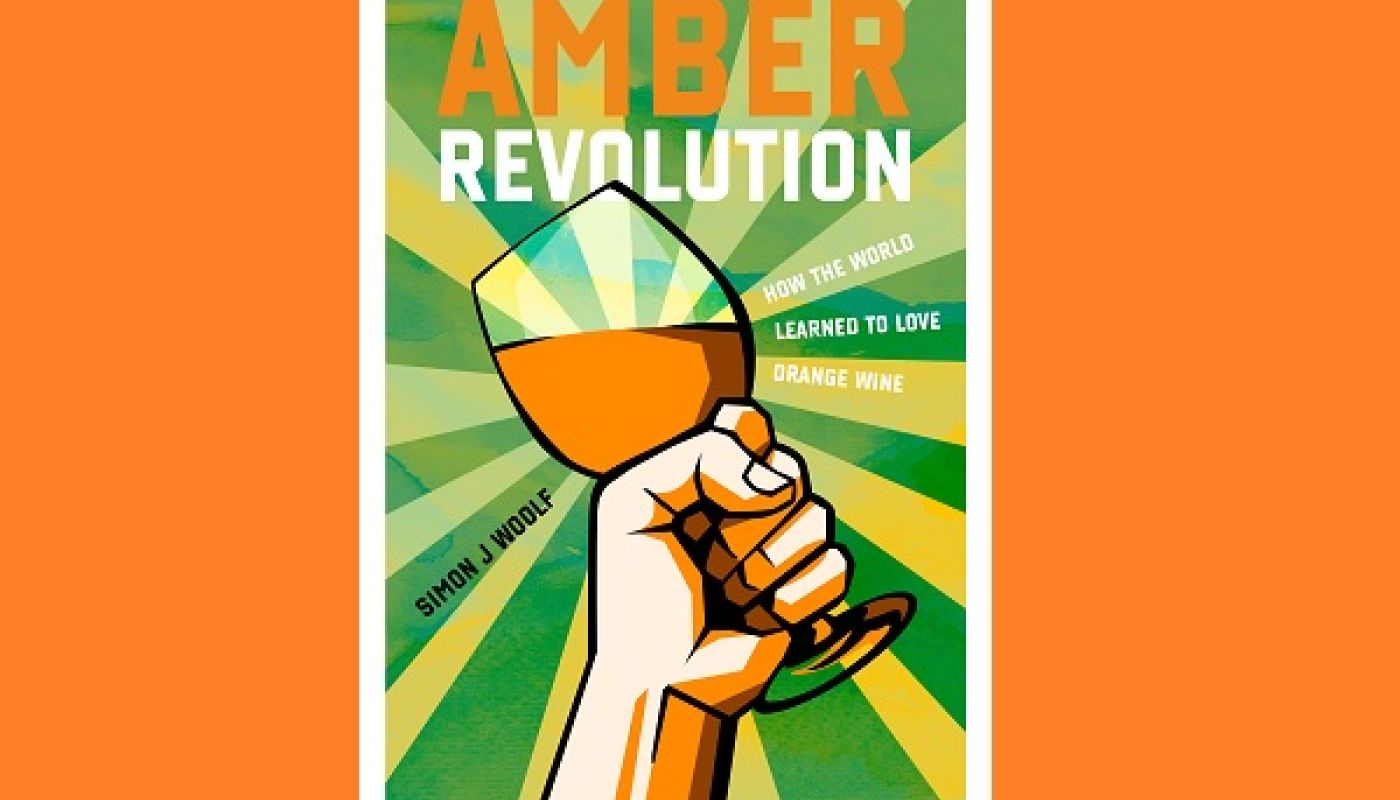
It’s at this point that I just want to pause and raise a hat to Ryan Opaz, Myrthe Stel, Eyal Holtzman and Andrew Lindesay. The editing, Andrew Lindesay, is superb. The design and layout, Eyal and Myrthe, is outstanding. I love the cover. Strong, defiant, modern, retro, ancient, textured, shiny, matt, shocking, victorious – it says everything.
Ryan Opaz: for photography. A Minnesota boy long adrift in Iberia, he describes himself as ‘Travel Consultant, Wine Geek, and Event Organizer in Porto, Portugal’. He is the founder of Catavino, organiser of Born Digital, and the author of Liquid Agnostic, but not officially a photographer. He could be. If he wasn’t so good at everything else, he should have been a photographer. Beautiful, emotional work. You have the eye of a poet.
Woolf writes with quiet modesty, gravity and deep compassion. Yet he is comfortable with poking fun at himself and is unpretentiously witty. He is, in his own words, obsessed with orange wine, but he doesn’t write with the navel-gazing self-indulgence of the obsessed. We often talk about wines tasting as clear and pure as a mountain stream. That description came to mind several times during this book: this is how Simon Woolf writes. You want to dip your mind in his words. There is no excess, yet he writes with great strength. His content is robust, his style has lift.
This is an extraordinary story, compellingly told, and I would plead with anyone who drinks wine to read it. Even if you (think you) don’t like orange wine, please read it.
*For the sake of simplicity, I’ve stuck to ‘orange wine’ myself throughout this review.